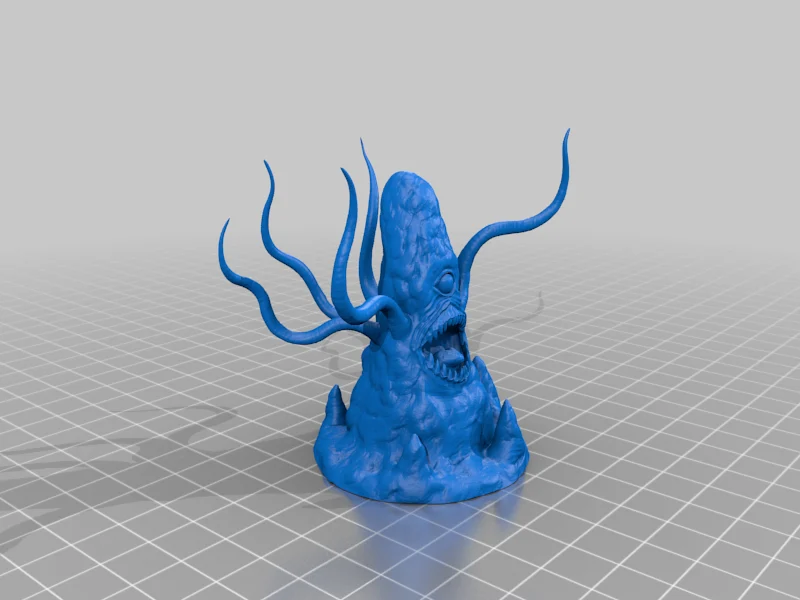
Blue tapered rocklike miniature with one eye, an open toothed mouth and long curling tentacles, standing on a rocky base over a grey grid.
mz4250’s Roper model, shown as a tabletop miniature. Fan-made tabletop illustration, not official franchise artwork.
Overview
A roper makes the cave itself appear to be the threat. The 2014 creature can resemble an ordinary rock formation while remaining still; ceiling climbing allows that concealment to become an overhead ambush as readily as a danger on the floor. Its long tendrils reach prey well beyond its bite, restrain them and weaken their attempts to resist through strength. Reel then draws the trapped creatures toward its mouth. Its slow ground movement suits this waiting predator better than a description of relentless sprinting pursuit. The legacy profile explicitly lets opponents destroy a tendril or break it through a strength-based effort, without counting that injury against the central body. A replacement can appear afterward, so freeing a companion and defeating the monster are distinct goals.
The revised profile preserves long-reaching capture but changes both the attack sequence and the victim's condition. It uses two Tentacle attacks and two bites, rather than the legacy four tendril attacks followed by one bite. A captured creature is Poisoned until the grapple ends; the revised text does not repeat the legacy Restrained and strength-disadvantage package. Tentacle reach and the distance covered by Reel also increase. Destroying a tentacle still frees its captive without damaging the roper itself, and the replacement timing is explicit. Spider Climb remains, but the revised block omits the separately listed False Appearance trait. Consequently, the legacy rule's automatic indistinguishability should not be carried into every revised encounter simply because the silhouette remains familiar.
First appearances & development
This account compares selected fifth-edition legacy and revised treatments, with the 2000 third-edition manual retained as earlier bibliography. The revised monster book was published in 2025 within the later core-rules family. Changes in attacks and conditions refer to those named sources, not a new species or a timeless ability shared by every edition.
Canon & continuity
Official legacy and revised profiles supply the trapping, severing and movement comparison. Their different categories also matter: the legacy creature is a monstrosity, while the revised one is an aberration. This is a rules classification change, not independent evidence of a biological transformation. Reader comments and older manual lore are not promoted to revised abilities.
Selected bibliography
Documented works and useful reading. This is not a list of every appearance.
- 01
Monster Manual (2014)
Legacy fifth-edition treatment; relevant mechanics checked against the official dated profile.
- 02
Monster Manual (2000)
Third-edition creature treatment; included for historical comparison, not as the source of fifth-edition mechanics.
- 03
Monster Manual (revised fifth edition)
Revised creature procedures, kept separate from the legacy manual.
Family & connections
A source-supported family tree or inspiration record has not yet been compiled for this profile. Related reading below indicates a connection in subject matter, not a proven lineage or creative influence.
References
Sources supporting this profile. Linked pages have their own scope and editorial standards.
- OfficialRoper (Dungeons & Dragons) — official franchise guideResearch access: 2026-10-05
- OfficialRoper — revised profileResearch access: 2026-10-05
Image credits
Creator-made Roper miniature renderBlue tapered rocklike miniature with one eye, an open toothed mouth and long curling tentacles, standing on a rocky base over a grey grid.
mz4250’s Roper model, shown as a tabletop miniature. Fan-made tabletop illustration, not official franchise artwork.