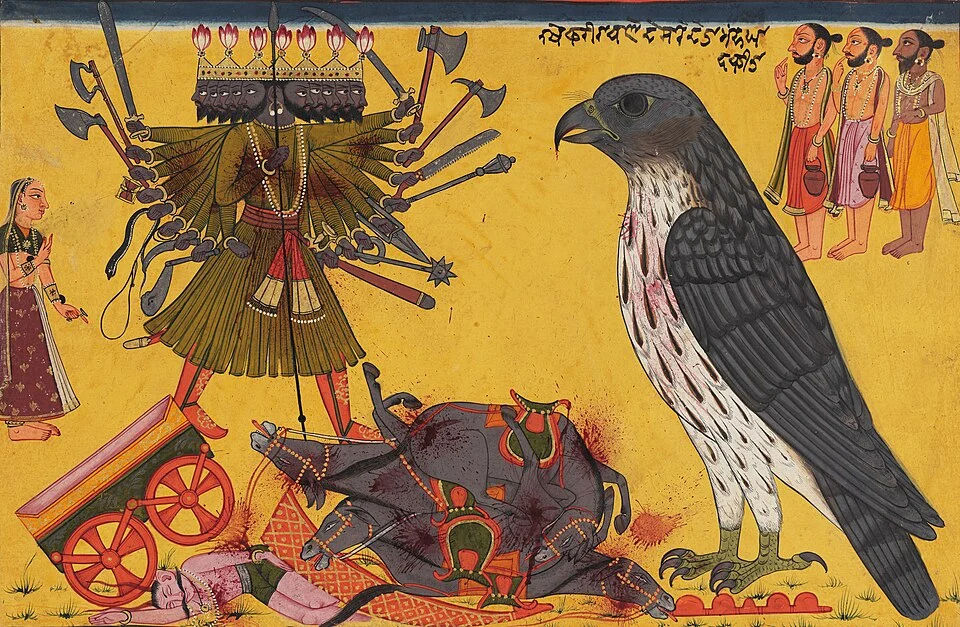
Many-headed Ravana confronted by Jatayu, early18th century
Actual many-headed armed Ravana beside his damaged chariot; historical episode rather than unverified modern Gita Press artwork.
Overview
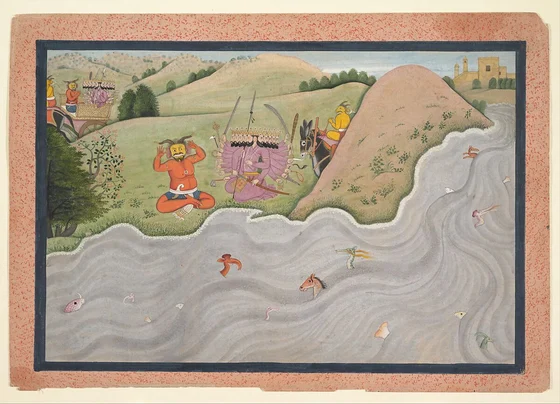
Griffith’s Rāmāyaṇa depicts Rāvaṇa enthroned among counsellors, massive as a mountain, with twenty arms and ten necks. His body retains scars from clashes with gods and Airāvata’s tusks. Royal clothing, garlands and gold adorn a dark, jewel-like figure. The description presents military power and kingship alongside the poem’s accusation that he disrupts sacrifices and takes other men’s wives.
His long austerities earn protection from gods, demons and numerous supernatural races, but not from humans. He takes Kubera’s flying car Puṣpaka and later plots Sītā’s abduction with Mārīca. During the war he recognises the neglected human danger in Rāma. In the final battle, Rāma uses the divine arrow supplied by Agastya to pierce his chest and heart. His death is the defeat of a named epic ruler, rather than a definition of every rākṣasa.
Book III XLVI shows a different appearance used for the abduction. Rāvaṇa comes as a mendicant with red clothing, tufted hair, sandals, a staff and water vessel. He speaks gently and recites texts to sustain the false religious identity. Sītā’s hospitality is directed toward the apparent holy visitor: she offers a seat, washing water and food while waiting for the princes. The narrator expressly contrasts the trusted outward signs with the concealed intention. This disguise is part of the plot rather than Rāvaṇa’s permanent physical form.
Origins & earliest records
South Asian Rāmāyaṇa narrative tradition
Records & interpretation
Primary-text translation directly read by identified book/canto.
Selected bibliography
Documented works and useful reading. This is not a list of every appearance.
- 01
The Rámáyan of Válmíki
Title page gives translation span 1870–1874. Book III XXXII, pp. 267–268; VI LX and CX. Selected historical verse witness. Also III XLVI, pp. 282–284, mendicant disguise.
Family & connections
A source-supported family tree or inspiration record has not yet been compiled for this profile. Related reading below indicates a connection in subject matter, not a proven lineage or creative influence.
Primary records and illustrations
The Rámáyan of Válmíki
Book III. III XXXII, pp. 267–268; VI LX and CX
Actual translated primary passages directly read. Checked HTML canto anchor. No new image bytes inspected.
Book III XLVI shows a different appearance used for the abduction. Rāvaṇa comes as a mendicant with red clothing, tufted hair, sandals, a staff and water vessel. He speaks gently and recites texts to sustain the false religious identity. Sītā’s hospitality is directed toward the apparent holy visitor: she offers a seat, washing water and food while waiting for the princes. The narrator expressly contrasts the trusted outward signs with the concealed intention. This disguise is part of the plot rather than Rāvaṇa’s permanent physical form.
References
Sources supporting this profile. Linked pages have their own scope and editorial standards.
- Historical primary-text translationGriffith Rāmāyaṇa — Book III XXXII, pp. 267–268; VI LX and CXResearch access: 2026-10-05
Image credits
Historical illustrationMany-headed Ravana confronted by Jatayu, early18th century
Actual many-headed armed Ravana beside his damaged chariot; historical episode rather than unverified modern Gita Press artwork.