Microscopic thin section of Ramathallus lobatus holotype NRM X5638, with enlarged structural details
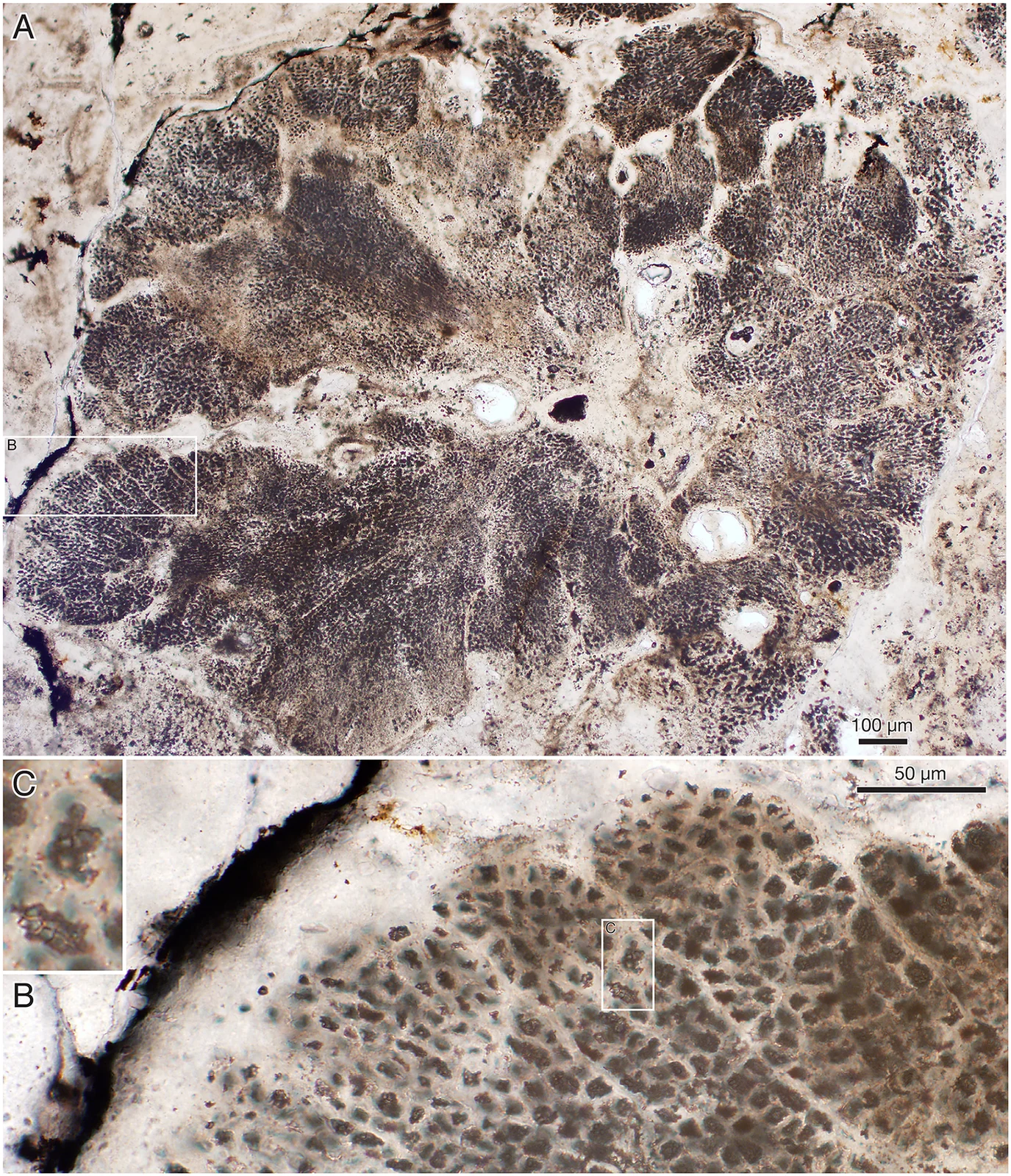
This thin section of holotype NRM X5638 shows the lobed fossil and enlarged details of its preserved cellular structure. The overview and lower enlargement have different scales, marked by 100- and 50-micrometre bars. It records fossil material in section, rather than the organism’s living appearance or colour. The published figure is reproduced unchanged.
Overview
Ramathallus lobatus formed rounded and finger-like protrusions radiating from a shared central region. Individual bodies range from about half a millimetre to more than 3 mm across; aggregates can exceed a centimetre. The fossils remain embedded in the microbial deposits where they grew, supporting an attached seafloor habit. Bengtson and colleagues distinguish them from the surrounding cyanobacterial mats by their larger, organized lobed bodies and internal cellular architecture.
Cells approximately 5–15 micrometres across form rows curving through the projecting lobes. The paper calls these arrangements cell fountains. They resemble tissue produced by the coordinated growth of joined filaments, known as pseudoparenchyma. Smaller cells commonly occupy these organized rows, whereas larger cells can occur toward swollen distal regions and in smaller globular protrusions. These differences suggest regulated growth and possible specialized growing cells, but do not reveal a complete developmental sequence.
Some localized groups contain four cells arranged in a clover-like pattern. The authors compare these with possible reproductive tetrads, or tetraspores. Their biological significance remains unresolved: they are not recovered germinating spores, and their occurrence alone does not demonstrate a modern red-algal life cycle. Likewise, small bodies inside larger cells are mineral-coated structures whose identity should not be assumed to be a particular organelle.
Preservation introduces a second layer of interpretation. Original thin cell walls acquired coatings of apatite crystals; apparent wall thickness can therefore exceed the biological thickness. Some interiors retain carbonaceous material, some remain hollow and others have been filled by mineral growth. An apparently noncellular covering, up to 40 micrometres thick, surrounds many lobes and penetrates between them. The authors consider it a replacement of an original biological feature, while recognizing later overgrowth and ambiguous internal cavities.
The strongest comparisons are with other lobed fossil algae and florideophycean red algae, which can share similar filament-built tissue and growth patterns. Those architectures also occur in unrelated organisms, including some fungi and other algae. The authors tentatively propose a stem-florideophycean position, but report no clear pit connections or definitive reproductive structures. Their claim that Ramathallus may represent an ancient crown-group red alga therefore depends on the anatomical interpretation as well as the approximately 1.6-billion-year age assigned to its deposit. Similarity to another fossil is evidence for comparison, rather than a documented parent–descendant relationship.
Origins & earliest records
Sallstedt named the genus and species in 2017 from Tirohan Dolomite material at Jankikund, Chitrakoot. The species epithet describes its lobed body. Its age is inherited from the study’s stratigraphic and radiometric evaluation of the deposit.
Evidence & interpretation
Holotype NRM X 5638 is deposited in the Swedish Museum of Natural History; Figure 13 shows its thin-section anatomy, with further observations in Figures 15,16 and 18. Figure 19 presents putative tetrads in NRM X 5641. Sections Morphology, Taphonomy and Interpretation distinguish observations from proposed biological identities.
Selected bibliography
Documented works and useful reading. This is not a list of every appearance.
- 01
Three-dimensional preservation of cellular and subcellular structures suggests 1.6 billion-year-old crown-group red algae
PLOS Biology15(3),e2000735; complete relevant morphological, preservational, interpretive, dating and systematic sections, plus Materials and methods. Original summary adapted from CC BY4.0 article; https://creativecommons.org/licenses/by/4.0/.
Family, evolution & connections
Taxonomic classification
A hierarchy of classified groups, not a chain of direct ancestors.
- GenusRamathallus
- SpeciesRamathallus lobatus
References
Sources supporting this profile. Linked pages have their own scope and editorial standards.
- ResearchBengtson et al.2017, primary Vindhyan microfossil studyResearch access: 2026-10-05
Image credits
Scientific fossil microscopy photographMicroscopic thin section of Ramathallus lobatus holotype NRM X5638, with enlarged structural details
This thin section of holotype NRM X5638 shows the lobed fossil and enlarged details of its preserved cellular structure. The overview and lower enlargement have different scales, marked by 100- and 50-micrometre bars. It records fossil material in section, rather than the organism’s living appearance or colour. The published figure is reproduced unchanged.