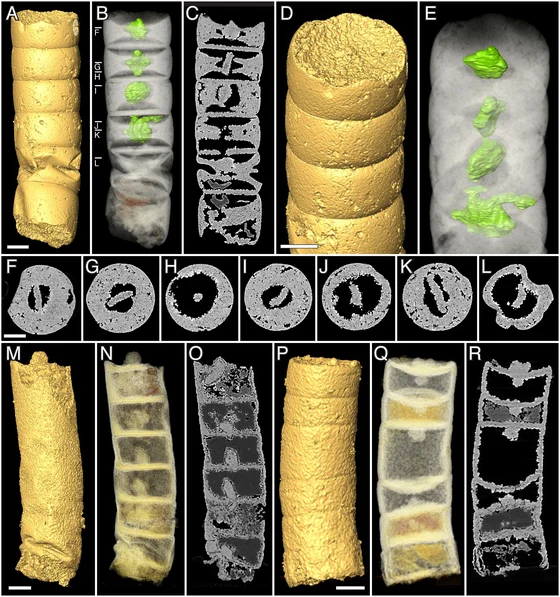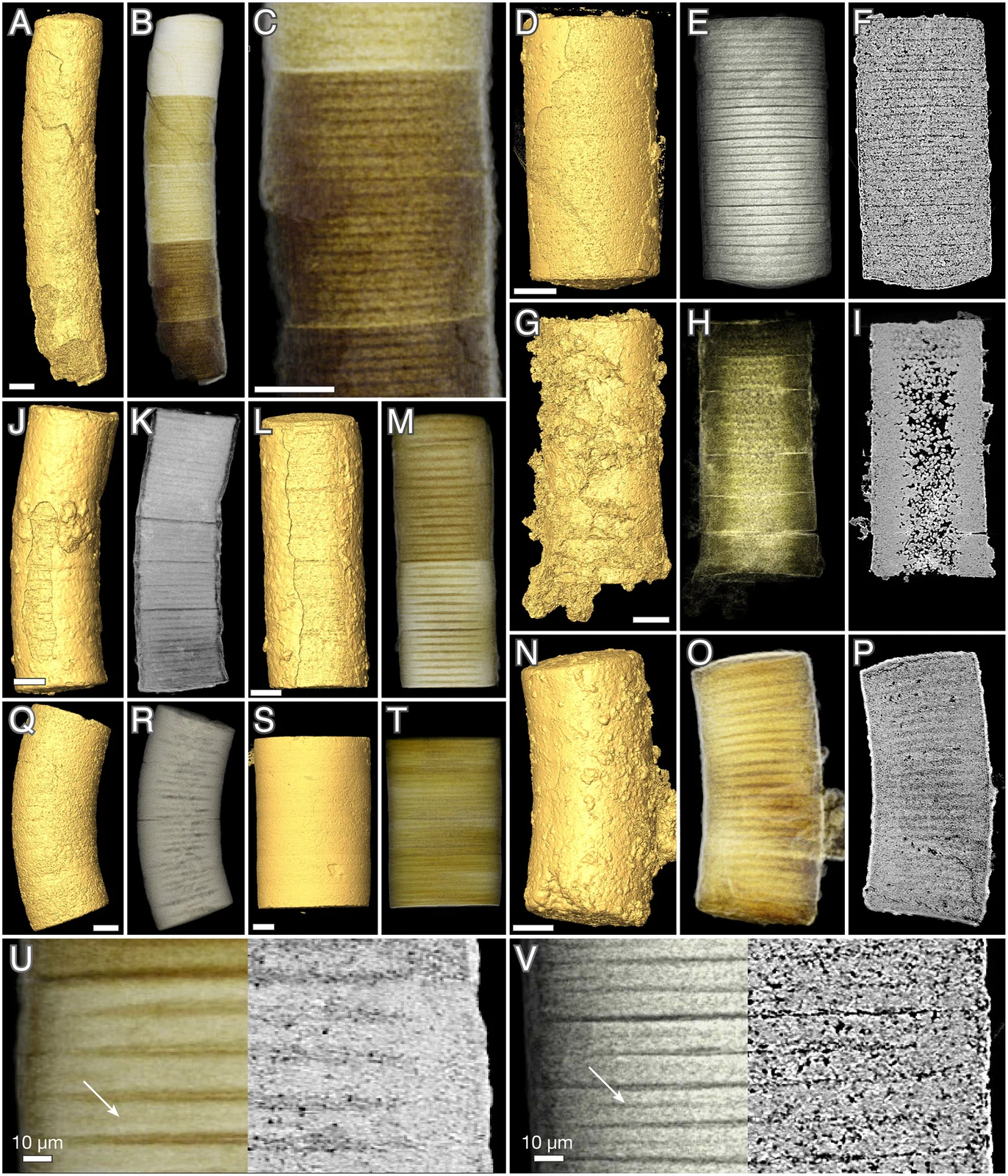
Synchrotron tomographic renderings and sections of Denaricion mendax fossils, including holotype NRM X5644
Panels A–C show holotype NRM X5644 alongside renderings and sections of other specimens. Arrows in the enlarged lower panels mark structures interpreted as possible incipient septation. These scan visualizations show preserved fossil structure, rather than a reconstruction of living colour or a settled biological affinity. Scale bars vary between panels; the published figure is reproduced unchanged.
Overview
Denaricion mendax preserves comparatively broad tubes,130–275 micrometres across, with an interior resembling a stack of coins. The longest reported fragment measures 755 micrometres; all examined specimens are broken at both ends. Their cross sections are circular to slightly oval. Unlike neighboring Rafatazmia, whose compartments often collapsed or acquired hollow mineral coatings, Denaricion retained a comparatively solid internal structure. This contrast led Bengtson and colleagues to distinguish the fossils as different organisms rather than variations in one filament.
Tomographic views reveal compartments containing commonly eight or sixteen coin-like units, sometimes with a weaker division after four. The authors interpret this repeating 4/8/16 pattern as coordinated cell partitioning. Some boundaries are also planes of weakness where fragments broke. Individual cellular units can be difficult to see in a virtual slice yet become apparent in a semitransparent volume rendering; their identification therefore rests on several complementary views.
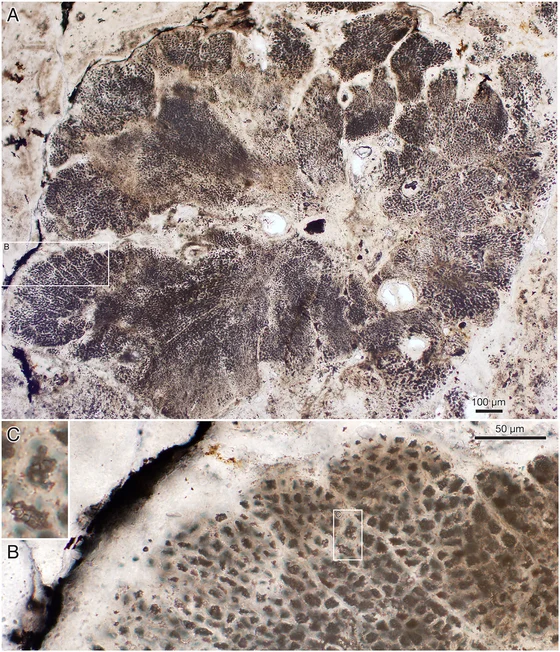
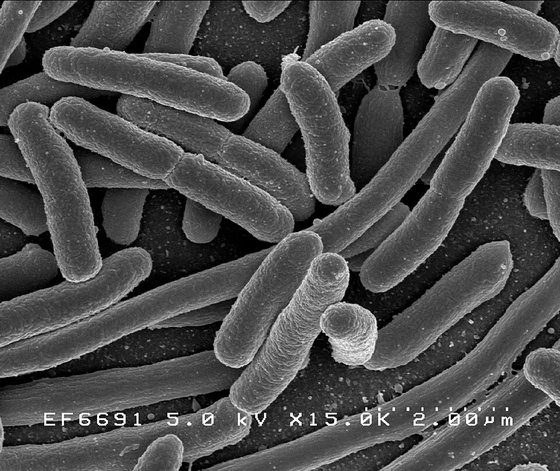
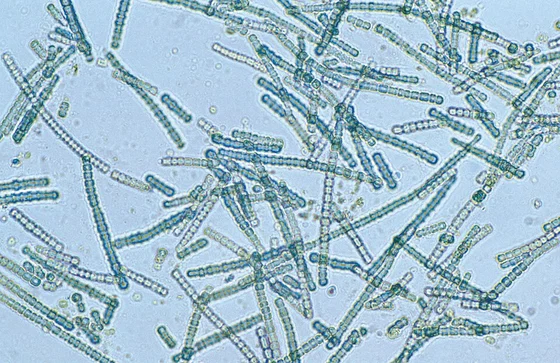
The biological comparison remains open. Thin cells within large filaments resemble some cyanobacteria, but these fossils exceed the dimensions of the known filamentous examples used in the study. Giant sulfur bacteria offer another analogy, yet their large apparent size often depends on fluid-filled vacuoles that collapse readily after death. Denaricion’s stiff, solidly preserved interiors do not fit that explanation well. The researchers also report no convincing preserved sulfur granules. None of these comparisons establishes a sulfur-oxidizing metabolism.
The formal diagnosis consequently permits an algal or prokaryotic organism without choosing a modern group. The authors explicitly leave open extinct bacterial branches with cellular volumes unlike familiar examples. Its name, combining a coin reference with a pillar and the epithet meaning deceptive, reflects this uncertainty. The approximate 1.6-billion-year age concerns the Tirohan deposit; it does not make this organism a demonstrated ancestor of cyanobacteria, sulfur bacteria or red algae.
Origins & earliest records
Bengtson named Denaricion mendax in 2017 from the Tirohan Dolomite at Jankikund. Its diagnostic cellular arrangement is distinct from Rafatazmia in the same fossil-bearing deposits.
Evidence & interpretation
Holotype NRM X 5644, Swedish Museum of Natural History, is shown in Figure 10 A–C. Figure 11 enlarges the inferred 4/8/16 cell pattern. The primary description and Interpretation of the tubular fossils explicitly leave wider affinities unresolved; neither genomic identity nor metabolism is preserved.
Selected bibliography
Documented works and useful reading. This is not a list of every appearance.
- 01
Three-dimensional preservation of cellular and subcellular structures suggests 1.6 billion-year-old crown-group red algae
PLOS Biology15(3),e2000735; complete relevant morphological, preservational, interpretive, dating and systematic sections, plus Materials and methods. Original summary adapted from CC BY4.0 article; https://creativecommons.org/licenses/by/4.0/.
Family, evolution & connections
Taxonomic classification
A hierarchy of classified groups, not a chain of direct ancestors.
- GenusDenaricion
- SpeciesDenaricion mendax
References
Sources supporting this profile. Linked pages have their own scope and editorial standards.
- ResearchBengtson et al.2017, primary Vindhyan microfossil studyResearch access: 2026-10-05
Image credits
Scientific fossil tomography renderingSynchrotron tomographic renderings and sections of Denaricion mendax fossils, including holotype NRM X5644
Panels A–C show holotype NRM X5644 alongside renderings and sections of other specimens. Arrows in the enlarged lower panels mark structures interpreted as possible incipient septation. These scan visualizations show preserved fossil structure, rather than a reconstruction of living colour or a settled biological affinity. Scale bars vary between panels; the published figure is reproduced unchanged.