Ponaturi in The Legend of Tawhaki, historical printed chapter opening; documentary source-page facsimile
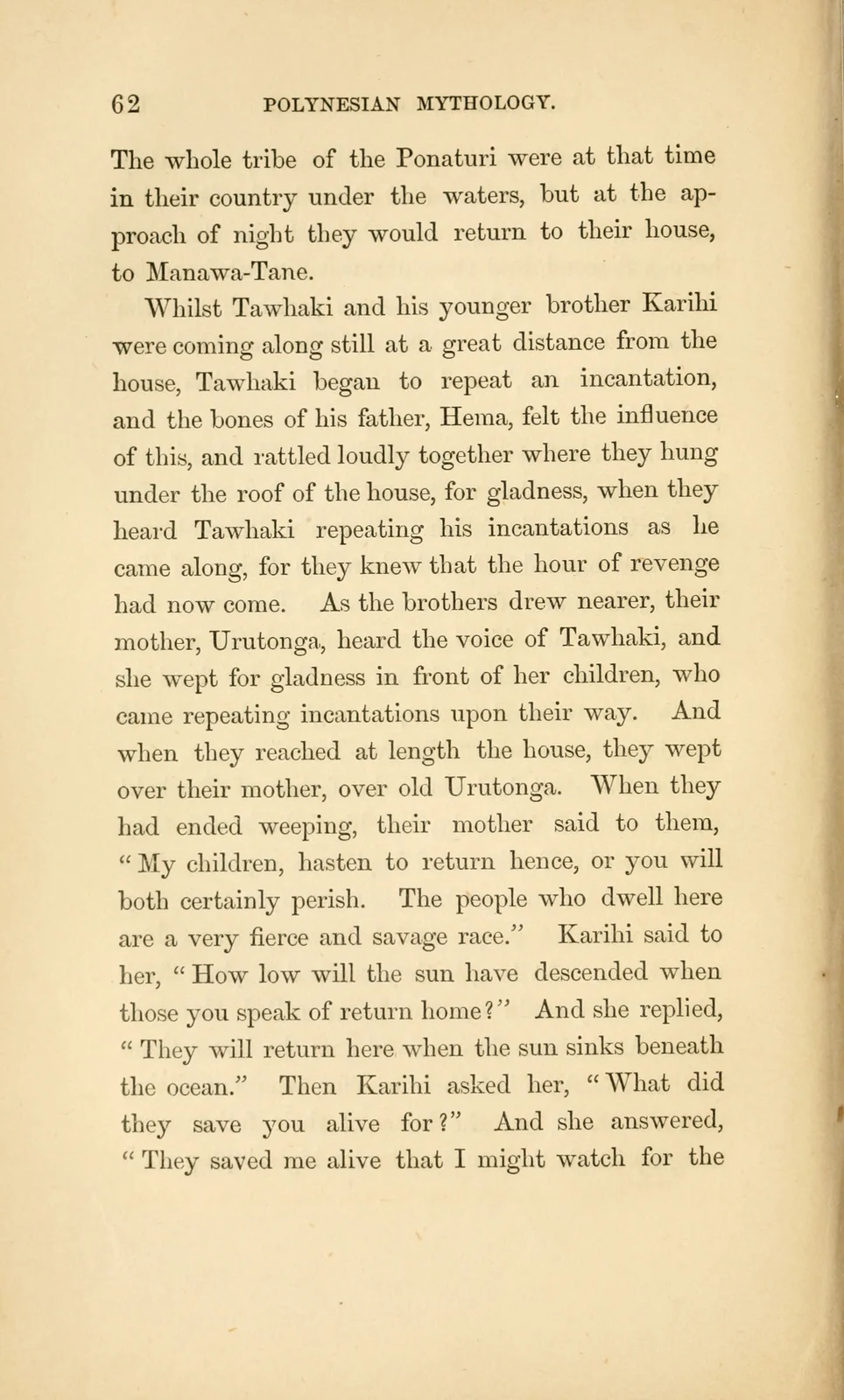
Primary text witness to Ponaturi in The Legend of Tawhaki in the 1855 edition. Documentary text facsimile, not creature artwork; historical terminology and collector interpretations belong to the original publication.
Overview
In Grey’s English rendering, the ponaturi have killed Hema, Tāwhaki’s father, and hold his mother captive. They live beneath the water by day and crowd into a large house on land to sleep at night. Tāwhaki and his brother Karihi reach the house and discover how their mother can help them recover their father’s remains.
The revenge depends on timing and deception. The house remains dark until the sun has risen, after which its openings admit the light that destroys the occupants. This selected episode makes their daily movement between water and land essential to the plot. Other Māori accounts should be read separately rather than forcing every ponaturi appearance into this version.
Grey’s separate Rata narrative, printed pages 83–85, makes Ponaturi the distant people who possess Wahieroa’s bones. Rata reaches their settlement with 140 warriors but goes ashore alone. Hidden beside their sacred place, he hears priests beating the bones together while reciting Titikura. He memorises the incantation, attacks the priests and takes the remains back to his canoe. A thousand Ponaturi pursue him to his fortress, where their assault kills sixty of his warriors. Rata repeats the learned incantation, restoring those dead companions to life; the renewed battle then destroys the pursuing force. This episode describes priests, a settlement, warfare and revivification. It does not mention the sunlight defeat of the Tāwhaki account, and the means of victory is not silently transferred between the two stories.
Origins & earliest records
Grey’s 1855 publication contains the selected Tāwhaki episode in English. Its editorial mediation and Māori sources must be considered when comparing it with later retellings. A surviving record dates its documentation, not the beginning of an oral tradition; earlier transmission cannot be timed precisely from this witness alone.
Records & interpretation
The selected Tāwhaki account records the underwater dwelling and sunlight defeat; the separately located Rata account records priests, stolen bones, pursuit and an incantation restoring Rata’s warriors. Their distinct mechanisms and contexts are retained.
Selected bibliography
Documented works and useful reading. This is not a list of every appearance.
- 01
Polynesian Mythology and Ancient Traditional History of the New Zealand Race
Selected primary witness; not an exhaustive bibliography.
- 02
Polynesian Mythology: The Legend of Rata, pp. 83–85
Separate Rata/Ponaturi conflict; Titikura restoration outcome distinguished from Tāwhaki daylight account.
Family & connections
A source-supported family tree or inspiration record has not yet been compiled for this profile. Related reading below indicates a connection in subject matter, not a proven lineage or creative influence.
Encyclopedia background
An additional attributed reference, separate from the editorial profile above.
Read the open encyclopedia overview
In Māori mythology, the Ponaturi are a group of hostile creatures (goblins) who live in a land beneath the sea by day, returning to shore each evening to sleep. They dread daylight, which is fatal to them. They appear in a number of stories, including:
a story of Tāwhaki. The Ponaturi kill Tāwhaki's father Hemā, and carry his body away. They also capture Urutonga, Tāwhaki's mother, whom they put to work as the doorkeeper of their house Manawa-Tāne. In revenge, Tāwhaki and Urutonga block up all the holes of the house to make the Ponaturi think that it is still night. They then suddenly let in the rays of the sun, and all the dreadful creatures are destroyed (Tregear 1891:206, 350).
a story of the hero Rātā. The Ponaturi carry off his father's bones and use them to beat time when as they practice their magical arts. Rātā hides himself, learns their incantations, and recites a more powerful spell called Titikura. He then attacks them, kills their priests, and recaptures his father's bones. The Ponaturi regroup and chase Rātā, but with the aid of his warriors and his powerful incantations he defeats and kills a thousand of them (Tregear 1891:350).
Text from Wikipedia contributors, “Ponaturi”. CC BY-SA 4.0. Extracted introduction; formatting changed. Retrieved 5 October 2026. The source article may have changed since retrieval.
References
Sources supporting this profile. Linked pages have their own scope and editorial standards.
- Primary textPolynesian Mythology: The Legend of Tawhaki (public-domain transcription)Research access: 2026-10-05
- Primary historical narrative transcriptionGrey: The Legend of RataResearch access: 2026-10-05
Image credits
Historical text facsimilePonaturi in The Legend of Tawhaki, historical printed chapter opening; documentary source-page facsimile
Primary text witness to Ponaturi in The Legend of Tawhaki in the 1855 edition. Documentary text facsimile, not creature artwork; historical terminology and collector interpretations belong to the original publication.