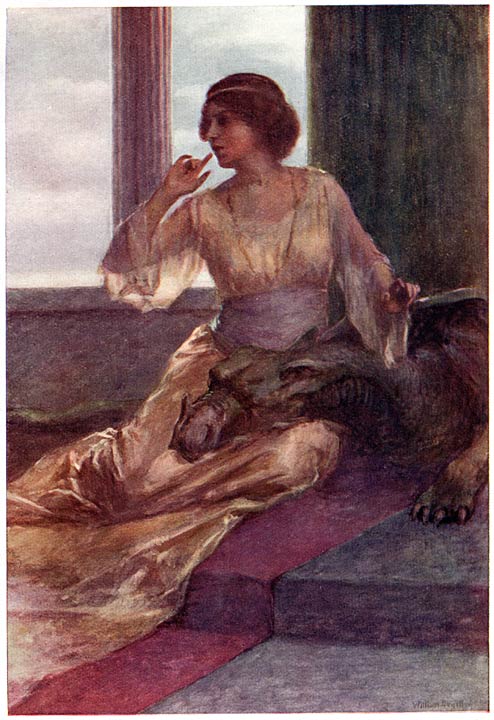
Sleeping pavilion dragon with its head on the captive princess’s knee, William Sewell’s illustration
The sleeping dragon rests its head on the captive princess’s knee in The Pavilion Between Earth and Sky. Its appearance belongs to Sewell’s later pictorial interpretation.
Overview
A dragon snatches a princess and flies into the clouds. Her brothers discover a pavilion suspended between earth and sky; the youngest reaches it and finds the dragon asleep with its head on her knee. Two mace blows merely prompt the creature to point with a claw and complain of a bite. The princess indicates a vulnerable place, and the next blow kills him.
Inside are three richly equipped horses and three women with golden work and pearl-sorting birds. Throwing the dragon’s corpse down terrifies the brothers below; the rescuer then lowers the captives. Their betrayal strands him in the pavilion, but its horses later carry him back to expose them. A source footnote credits Prince Michel Obrenovitch III’s written contribution to Karadžić, learned in childhood from his nurse.
Origins & earliest records
Woislav M. Petrovitch, Hero Tales and Legends of the Serbians, Chapter XIV.II, pp. 220–224. The inspected English volume lists first publication August 1914 and reprints through December 1921. Local source chains and alternative narratives remain attributed.
Records & interpretation
Relevant complete primary section and connected encounter read, with printed locators retained. Descriptive titles used for unnamed subjects. Comparison with classical mythology and claims about whole populations remain the author’s dated interpretations.
In the literature
“the dragon instantly succumbed”
Chapter XIV II, p.222; fatal third blow · Woislav M. Petrovitch
A flying dragon abducts the princess to a pavilion suspended between sky and earth. The youngest prince reaches it using a leather thong and finds the dragon asleep with its head on her knee. Two mace blows are barely noticed, but his sister indicates a vulnerable spot where the next blow kills it. No particular anatomical name for the fatal spot is supplied.
Selected bibliography
Documented works and useful reading. This is not a list of every appearance.
- 01
Hero Tales and Legends of the Serbians, Chapter XIV.II, pp. 220–224
Specific narrator/contributor attribution belongs to Pavilion footnote, not automatically every story in the book.
- 02
Hero Tales and Legends of the Serbians
Woislav M. Petrovitch, Hero Tales and Legends of the Serbians, London: George G. Harrap; selected December1921 reprint, first August1914 publication explicitly printed. Complete selected Pavilion, Prince Marko and the Veela, and Death of Prince Marko episodes, plus full Veele and Horse Sharatz introductory accounts independently read. Selected original English prose, no modern translation.
Family & connections
A source-supported family tree or inspiration record has not yet been compiled for this profile. Related reading below indicates a connection in subject matter, not a proven lineage or creative influence.
Located primary passages
Specific passages supporting details in this entry, grouped by their published witness.
Hero Tales and Legends of the Serbians
Woislav M. Petrovitch, Hero Tales and Legends of the Serbians, London: George G. Harrap; selected December1921 reprint, first August1914 publication explicitly printed. Complete selected Pavilion, Prince Marko and the Veela, and Death of Prince Marko episodes, plus full Veele and Horse Sharatz introductory accounts independently read. Selected original English prose, no modern translation.
- A flying dragon abducts the princess to a pavilion suspended between sky and earth. The youngest prince reaches it using a leather thong and finds the dragon asleep with its head on her knee. Two mace blows are barely noticed, but his sister indicates a vulnerable spot where the next blow kills it. No particular anatomical name for the fatal spot is supplied.
Chapter XIV II A Pavilion neither in the Sky nor on the Earth, pp.220–222
- The prince throws the dragon’s corpse to earth; the elder brothers fear it, then remove the captives and cut the descent thong. Later the prince exposes their betrayal and his sister and the rescued women confirm his account. The body is not revived, and the three horses are not described as offspring of the dead dragon.
Original Serbian witness not independently inspected; compiler comparisons and variant endings attributed. No sacred formulas excerpted.
References
Sources supporting this profile. Linked pages have their own scope and editorial standards.
- Primary textPetrovitch primary section: Chapter XIV.II, pp. 220–224Research access: 2026-10-05
Image credits
Historical illustrationSleeping pavilion dragon with its head on the captive princess’s knee, William Sewell’s illustration
The sleeping dragon rests its head on the captive princess’s knee in The Pavilion Between Earth and Sky. Its appearance belongs to Sewell’s later pictorial interpretation.