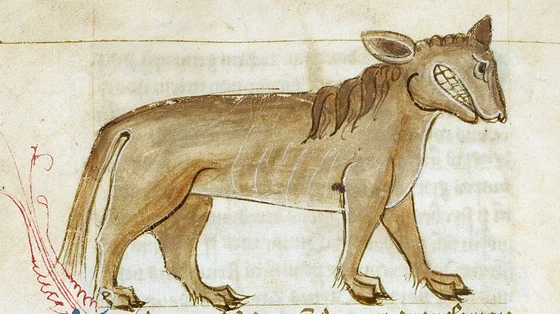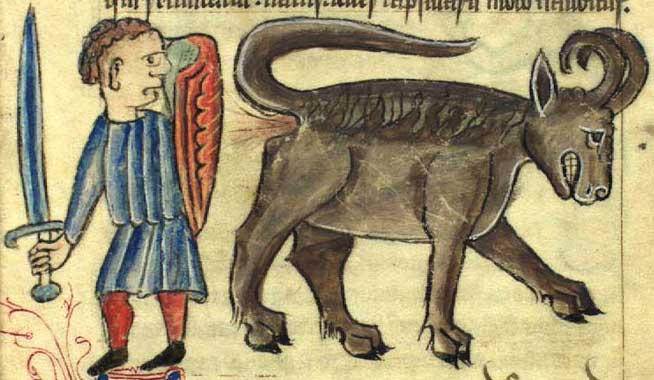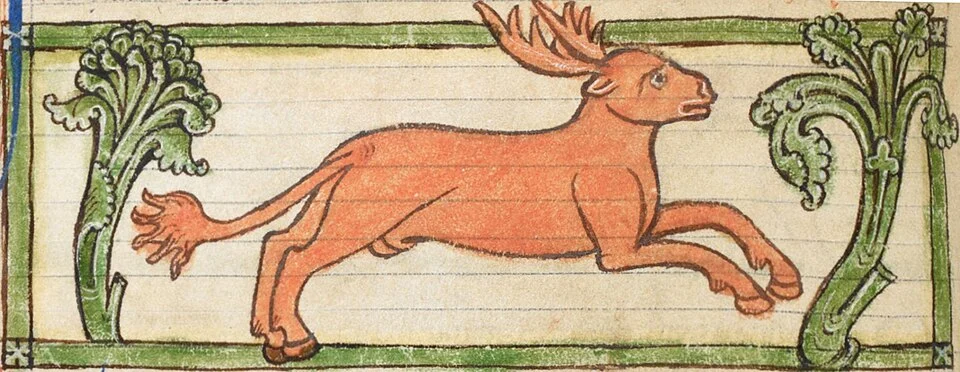
Parandrus in Harley MS3244 medieval bestiary
Historical bestiary depiction of the named parandrus/parander. This plate is from Harley MS3244, a separate witness from the Aberdeen manuscript cited in the article; not a photograph of a real reindeer.
Overview
The surviving text describes a thick-coated creature that responds to fear by changing its appearance. It can take on the likeness of a nearby pale stone or green bush, allowing its surroundings to supply a disguise. The fragment makes concealment the animal’s defining action. It does not establish that the creature physically becomes stone or wood, so resemblance is kept distinct from total transformation.
Much of the beginning of this account is missing in Aberdeen’s manuscript. The present profile therefore avoids importing an unmarked composite anatomy or a complete origin story from later reference lists. The source’s limitation is itself informative: one can document a particular behaviour without possessing the whole medieval description. Parander and tarandos are kept within one enrichment route rather than split into separate creatures merely because their spellings differ.
Origins & earliest records
Folio16r of Aberdeen MS24 preserves a fragment identified by the university edition as the parander account; its opening is missing. The English manuscript dates to around1200. This is a surviving medieval witness to a camouflage claim, not the first use of the creature’s name or a secure reconstruction of earlier oral transmission.
Records & interpretation
The legible fragment supports fear-driven changes in appearance and its examples of stone and bush. The university’s editorial heading identifies the interrupted account. These constitute textual and codicological evidence with a stated gap, not observation of a verified mammalian species capable of assuming the appearance of arbitrary nearby objects.
Selected bibliography
Documented works and useful reading. This is not a list of every appearance.
- 01
Aberdeen Bestiary, University Library MS24, 16r
Selected surviving folios inspected; text and image are treated as distinct evidence.
Family & connections
A source-supported family tree or inspiration record has not yet been compiled for this profile. Related reading below indicates a connection in subject matter, not a proven lineage or creative influence.
References
Sources supporting this profile. Linked pages have their own scope and editorial standards.
- Primary textUniversity of Aberdeen, MS24 folio16rResearch access: 2026-10-05
- ReferenceUniversity of Manchester, Aberdeen Bestiary project and manuscript datingResearch access: 2026-10-05
Image credits
Historical illustrationParandrus in Harley MS3244 medieval bestiary
Historical bestiary depiction of the named parandrus/parander. This plate is from Harley MS3244, a separate witness from the Aberdeen manuscript cited in the article; not a photograph of a real reindeer.