Orc (Warcraft)
Image associated with the exact linked encyclopedia article; consult credited file description for its interpretation.
Overview
Warcraft's orcs originate on Draenor, where their societies included shamanic clans. Kil'jaeden's manipulation and demonic corruption helped turn them into an invading force on Azeroth. The later official race account follows their escape from that influence and settlement in Kalimdor. Orgrimmar, named for Orgrim Doomhammer, becomes a durable capital in Durotar, with defenses reinforced over time. Their struggle is consequently one of building a place in a world they previously attacked, rather than perpetual conquest as an inevitable biological impulse.
Dire wolves serve as companions and mounts, carrying armoured riders and helping take down large prey. The maintained page presents a period after Varok Saurfang's death: Thrall represents the orcs on the Horde council without being described as a newly appointed sole leader, while veterans such as Eitrigg support their people. That political arrangement is a particular historical stage, not a permanent rule for every game era.
The publisher's introduction to Sarah Pine's Heart of War offers an earlier leadership contrast. Garrosh's experiences in Northrend, unease on reaching Orgrimmar and relationship with his mentor Thrall shape a different prospective future for the Horde. Blizzard's Battle for Azeroth Mag'har preview also describes clans refusing Gul'dan's demonic bargain and uniting under Grommash. The alternate-Draenor expansion context must remain separate from the original invasion history; refusal in one timeline does not undo another's catastrophe. Warcraft's particular orcs are thus defined through clan decisions, outside manipulation and competing political projects, not interchangeable with Tolkien's people or folklore.
First appearances & development
Warcraft: Orcs & Humans established the franchise's invasion in 1994; Warcraft III developed later Horde alliances in 2002. The inspected modern race account is a later historical snapshot. The Battle for Azeroth Mag'har preview belongs to an expansion sequence incorporating Warlords of Draenor, and is not used to overwrite the main timeline.
Canon & continuity
The complete public race-page overview and city, mount and leader text support settlement and the named council arrangement. The complete Garrosh story introduction supports its stated themes, not an assertion that the whole story was reread. The complete Mag'har preview supplies refusal and alliance context. The earlier game works identify different stages in Horde history.
Selected bibliography
Documented works and useful reading. This is not a list of every appearance.
- 01
Warcraft: Orcs & Humans
Original strategy game and orc invasion.
- 02
Warcraft III: Reign of Chaos
Tauren alliance and Darkspear troll narrative.
Family & connections
A source-supported family tree or inspiration record has not yet been compiled for this profile. Related reading below indicates a connection in subject matter, not a proven lineage or creative influence.
Encyclopedia background
An additional attributed reference, separate from the editorial profile above.
Read the open encyclopedia overview
In the Warcraft media franchise created by Blizzard Entertainment, the orcs are a fictional humanoid race closely associated with the Horde, a multiracial political and military coalition in the world of Azeroth. Introduced as an extradimensional invading army and the enemies of humanity in the 1994 real-time strategy game Warcraft: Orcs & Humans, orcs are one of the franchise's principal playable peoples in video game media.
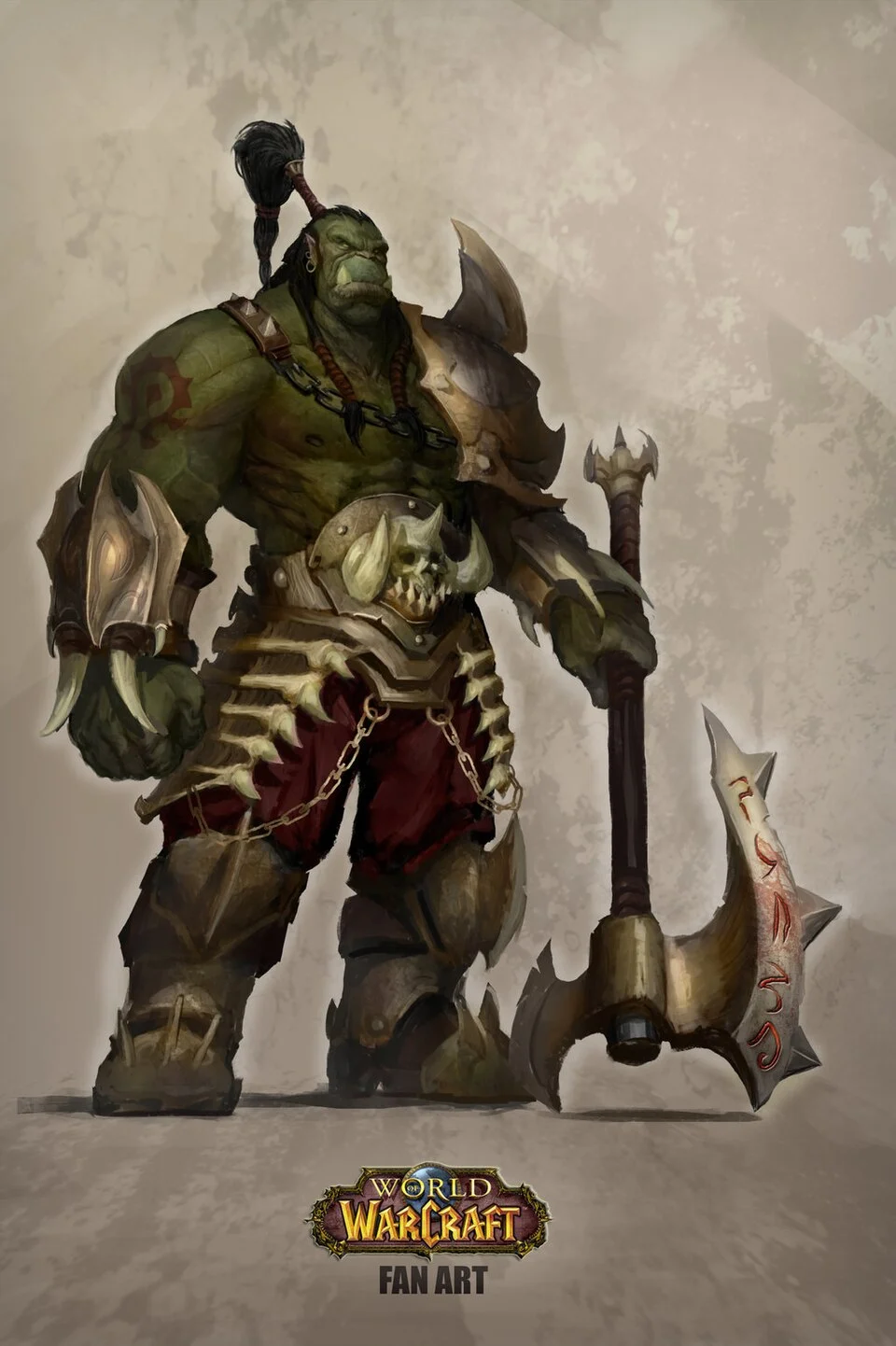
Originally from the world of Draenor, orcs are usually depicted as large, muscular humanoids with tusks, heavy jaws, and green, brown or gray skin. The portrayal of the orcs changed substantially as the franchise expanded. The first two Warcraft games presented the orcs mainly as a destructive force empowered by demonic "fel" magic. The 2001 novel Lord of the Clans, the 2002 video game Warcraft III: Reign of Chaos and other subsequent media revealed their origins as an older, shamanistic culture that had been corrupted by external forces. This revision positioned the orc leader Thrall as a sympathetic protagonist and turned the recovery of orc cultural history into a recurring subject. Later stories continued to revisit the legacy of the original Horde, particularly through characters such as Varok Saurfang, whose guilt over past atrocities and contested understanding of honor became part of the faction's later narrative. The 2016 film adaptation, Warcraft, likewise devotes one of its parallel narratives to Thrall's birth family and their resistance against the demonic corruption of the orcs' culture and spiritual beliefs instigated by the warlock Gul'dan.
The Warcraft franchise's orcs have been discussed by scholars and cultural critics as a prominent revision of the innately evil species popularised by the fantasy works of J. R. R. Tolkien. Their increased moral agency and cultural detail have been interpreted as a move from a conflict between good and evil species toward a conflict of interests among peoples. Critics have nevertheless argued that their designs and stories originate from colonial racial stereotypes, that World of Warcraft treats culture and behavior as properties of biological race, and that the sympathetic orc may substitute the stereotype of the "noble savage" for that of the monster. Other studies emphasize the role of players, game mechanics, and collective behavior in producing the meaning of orc identity beyond the authored narrative.
Text from Wikipedia contributors, “Orcs in Warcraft”. CC BY-SA 4.0. Extracted introduction; formatting changed. Retrieved 5 October 2026. The source article may have changed since retrieval.
References
Sources supporting this profile. Linked pages have their own scope and editorial standards.
- OfficialOrc (Warcraft) — official franchise guideResearch access: 2026-10-05
- OfficialOrc: maintained official race accountResearch access: 2026-10-05
- OfficialGarrosh leader-story introductionResearch access: 2026-10-05
- OfficialMag'har and Dark Iron previewResearch access: 2026-10-05
Image credits
Reference illustrationOrc (Warcraft)
Image associated with the exact linked encyclopedia article; consult credited file description for its interpretation.