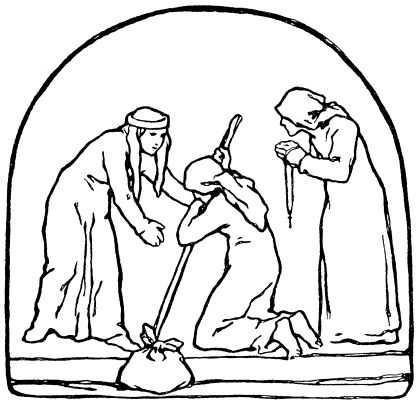
Repentance scene of One-Eye, Two-Eyes and Three-Eyes, Otto Ubbelohde (1909)
Actual original417x400 pixels inspected: three women, two impoverished supplicants (one kneeling) welcomed by the richly dressed third. Exact file identifies One-Eye, Two-Eyes and Three-Eyes; composition corresponds to the concluding repentance encounter in Grimm130. Eye counts are not clearly resolved at this scan size, so caption identifies the narrative scene rather than claiming a detailed anatomical portrait. Other goat/meal and distant orchard candidates remain research only. Original Commons description specifically credits Otto Ubbelohde1909 and Directmedia scan; PDM/PD-old-70 and US pre1931 publication rights verified. No attribution to a modern unrelated artist.
Overview
One-Eye has a single eye in the centre of her forehead, while Three-Eyes has two ordinary eyes and another centrally placed above them. They and their mother reject Two-Eyes precisely because her body resembles ordinary people's. When their hungry sister obtains food from a magical goat, they take turns accompanying her to discover why she no longer eats the scraps offered at home.
A song puts One-Eye to sleep. Against Three-Eyes, Two-Eyes accidentally names only two eyes in the sleeping refrain; the third remains awake and sees the meal appear. Exposure leads to the goat's death, but its remains produce a silver-leaved tree with golden fruit that only Two-Eyes can gather. A knight takes her away. Years later she welcomes the impoverished sisters, whose repentance concludes the tale. Their extraordinary bodies do not determine an irreversible moral destiny.
Origins & earliest records
Grimm's tale130, Einäuglein, Zweiäuglein und Dreiäuglein, is selected through Margaret Hunt's1884 English translation. It gives each sister a descriptive name based on eye count and uses those differences in the sleeping-song episode. This literary witness is not a medical description of actual eye conditions or evidence that people with unusual appearances are inherently hostile.
Records & interpretation
The forehead positions and the overlooked third eye are explicit, making bodily difference central to the spying plot. The later repentance is equally part of the source and should not disappear behind an anatomical catalogue. This is narrative evidence for two individual sisters, not a separate race, a clinical classification or a claim about real disabled people's character.
In the literature
“her third eye was also in the centre of her forehead”
Tale 130, One-eye, Two-eyes, and Three-eyes; Opening description of the sisters · Margaret Hunt
The narrator places the youngest sister’s additional eye explicitly.
Selected bibliography
Documented works and useful reading. This is not a list of every appearance.
- 01
Household Tales, tale 130: One-eye, Two-eyes, and Three-eyes
Specific numbered primary tale inspected. English translation terms and literary transmission remain distinct from oral origin.
- 02
Household Tales — One-eye, Two-eyes, and Three-eyes
Margaret Hunt historical English translation (1884); Project Gutenberg5314. Exact numbered tale and observed HTML anchor used; no inferred printed page or earliest oral date.
Family, evolution & connections
The three daughters in Grimm’s eye-count tale
Only the named numbered tale in Hunt’s 1884 Grimm translation.
Scroll sideways to see all branches. With a keyboard, focus the tree and use the arrow keys.
- Unnamed mother
- One-Eye, eldest
- Two-Eyes, second
- Three-Eyes, youngest
Explicit parentage and birth order in the primary narrative. No father is specified. Eye count labels identify individual sisters, not distinct peoples or medical categories.
Two-Eyes (Grimm)
The opening names One-Eye as the eldest, Two-Eyes as the second daughter, and Three-Eyes as the youngest. Their different appearances occur within one family; the tale does not establish separate peoples or biological races.
The unnamed mother in One-eye, Two-eyes, and Three-eyes
The opening explicitly gives the unnamed woman three daughters. The source’s persecution of Two-Eyes belongs to the story’s conduct, not to a medical inference about real people’s bodies.
Located primary passages
Specific passages supporting details in this entry, grouped by their published witness.
Household Tales, tale 130: One-eye, Two-eyes, and Three-eyes
Margaret Hunt historical English translation (1884); Project Gutenberg5314. Exact numbered tale and observed HTML anchor used; no inferred printed page or earliest oral date.
- One-Eye and Three-Eyes mistreat Two-Eyes for having ordinary eyes. One-Eye sleeps through an attempted spying visit; Three-Eyes keeps her forehead eye awake because the sleep song names only two of her eyes, sees the goat’s food-producing table and informs their mother, who kills it.
Tale 130, One-eye, Two-eyes, and Three-eyes; Sisters’ persecution and unequal success in spying
- A tree grows from the goat’s buried entrails, but its branches evade the sisters and mother. The sisters hide Two-Eyes under a barrel and falsely claim the tree until she reveals golden apples and gives a knight a branch. He takes her away and marries her; later she welcomes her impoverished, repentant sisters.
Tale 130, One-eye, Two-eyes, and Three-eyes; Golden tree, concealment and later reconciliation
Complete named tale read. Original narrative curse causes and modern species identities are not inferred; prose only, no song or ritual-formula excerpts.
References
Sources supporting this profile. Linked pages have their own scope and editorial standards.
- Primary textHunt's Household Tales — 130 One-eye, Two-eyes, and Three-eyesResearch access: 2026-10-05
Image credits
Historical illustrationRepentance scene of One-Eye, Two-Eyes and Three-Eyes, Otto Ubbelohde (1909)
Actual original417x400 pixels inspected: three women, two impoverished supplicants (one kneeling) welcomed by the richly dressed third. Exact file identifies One-Eye, Two-Eyes and Three-Eyes; composition corresponds to the concluding repentance encounter in Grimm130. Eye counts are not clearly resolved at this scan size, so caption identifies the narrative scene rather than claiming a detailed anatomical portrait. Other goat/meal and distant orchard candidates remain research only. Original Commons description specifically credits Otto Ubbelohde1909 and Directmedia scan; PDM/PD-old-70 and US pre1931 publication rights verified. No attribution to a modern unrelated artist.