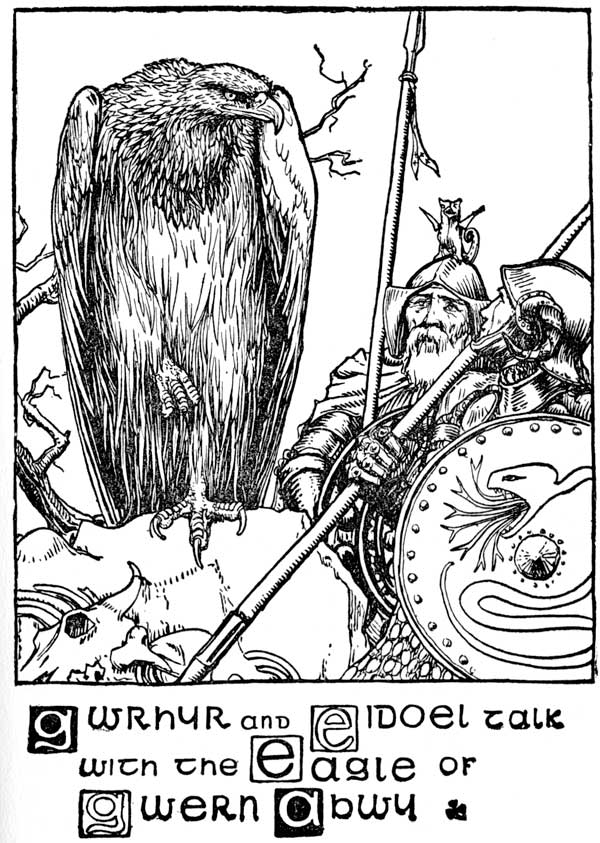
Batten: Eagle of Gwern Abwy speaking with Gwrhyr and Eidoel
Printed caption identifies this particular eagle and its interlocutors. One member of the collective Oldest Animals sequence is depicted. John Dickson Batten (1860–1932) credited by title page. 1892 first publication; selected impression undated.
Overview
Gwrhyr’s ability to understand beasts allows the embassy to question the Ousel of Cilgwri, a blackbird whose evening pecking has reduced an anvil almost to nothing. It directs them to the Stag of Redynvre, which has watched a single oak grow, branch and perish. The Owl of Cwm Cawlwyd remembers successive woods occupying the valley and describes its own wings as withered. Each lacks direct knowledge of Mabon but guides the party to an older witness, making age a network of relationships rather than a list of measured years.
The Eagle of Gwern Abwy remembers a rock from which it once pecked at the stars, now reduced to a small remnant. It directs the party to the Salmon of Llyn Llyw, which once dragged it into deep water. The eagle returned with its kindred to attack, but the salmon negotiated peace and asked it to remove fifty fish spears from its back. The salmon has heard a captive’s lament near Gloucester and carries Kai and Gwrhyr on its two shoulders to investigate. After they report to Arthur, it carries Kai and Bedwyr during the assault that releases Mabon. This paired reconnaissance and rescue distinction preserves the source’s different passengers. The five creatures share one connected consultation sequence; splitting each into a near-identical antiquity profile would obscure how the episode works.
Origins & earliest records
The animals occur together in the medieval Welsh story transmitted through Guest’s 1838–1849 translation. The original oral date is unresolved. Guest uses Ousel and Redynvre where modern discussions commonly use Blackbird and Rhedynfre; these are witness forms, not separate creatures.
Records & interpretation
The immense ages, understood speech and human-bearing salmon are narrative evidence, not zoological longevity records. The translation’s landscape memories establish how antiquity is represented in the story, while no ecological survey or physical animal identification follows from them.
Selected bibliography
Documented works and useful reading. This is not a list of every appearance.
- 01
The Mabinogion
Inspected complete selected episode “Kilhwch and Olwen” and linked quest demands.
Family & connections
A source-supported family tree or inspiration record has not yet been compiled for this profile. Related reading below indicates a connection in subject matter, not a proven lineage or creative influence.
References
Sources supporting this profile. Linked pages have their own scope and editorial standards.
- Primary textGuest, Kilhwch and Olwen: Oldest Animals of Culhwch and OlwenResearch access: 2026-10-05
Image credits
Historical illustrationBatten: Eagle of Gwern Abwy speaking with Gwrhyr and Eidoel
Printed caption identifies this particular eagle and its interlocutors. One member of the collective Oldest Animals sequence is depicted. John Dickson Batten (1860–1932) credited by title page. 1892 first publication; selected impression undated.