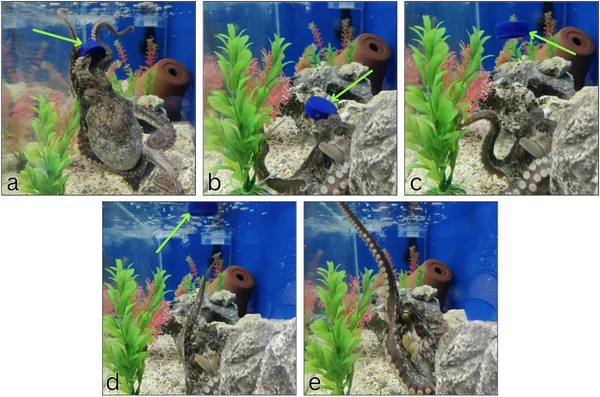
Five photographs of adult Octopus bimaculoides F interacting with a blue test-tube cap in a laboratory aquarium, Jarmoluk and Pelled 2025 figure 1
Five panels show a laboratory-housed adult, designated Octopus F, grasping and releasing a blue test-tube cap. Green arrows locate the cap in four panels. The photographs document one individual in a study aquarium, rather than a wild habitat or behavior demonstrated by every member of the species.
Overview
Octopus bimaculoides is the California two-spot octopus. Its arms carry suckers that combine tactile and chemical sensing, while neurally controlled chromatophores support rapid changes in skin appearance. Its nervous system includes a brain surrounding the oesophagus, optic lobes and nerve cords along the arms. Albertin and colleagues’ 2015 study sequenced a male and examined RNA from twelve tissue preparations. The resulting draft supplied a basis for testing genomic explanations of this specialized body plan.
A 2022 comparative study improves the earlier draft using chromosome-conformation data, which help determine which sequences belong together. It compares the resulting chromosome-scale assembly with two squid genomes. Some chromosomes can be related almost directly across the octopus and squid lineages, while others contain combinations suggesting fusions and extensive rearrangement of gene order. The study reconstructs these historical changes through conserved gene positions, rather than observing ancestral animals or assuming that a modern squid became an octopus.
Protocadherin genes illustrate the distinction between gene-family expansion and duplication of an entire genome. In the sampled octopus, many protocadherins occur in a large cluster on chromosome 14. Corresponding squid chromosomes also carry expanded families, but their individual gene histories include lineage-specific duplications and possible homogenization through gene conversion. These proteins have important neural roles in vertebrates; their abundance and neural expression in cephalopods suggest useful hypotheses, not proof that the same wiring mechanism or behavioral outcome operates in both groups.
The comparison also identifies a cluster of acetylcholine-receptor-like genes on octopus chromosome 15 that are expressed in suckers. The 2022 paper relates them to independently reported chemosensory reception. They should not simply be assigned the usual neurotransmitter function from their family name: related sequences can acquire different roles. Squids have fewer of these atypical subunits in the published comparison, and instead show other expansions associated with their own specialized structures.
Large genomes can arise through repeated sequences and rearrangements without whole-genome duplication. The comparative study finds no evidence that genome doubling explains the coleoid pattern it examines. Likewise, RNA editing, neural gene expression and family size do not constitute a scale of intelligence. This species provides experimentally accessible evidence for an independently evolved cephalopod nervous system and for the genomic history supporting it, while the functions of many expanded or newly identified genes remain open questions.
Origins & earliest records
The 2015 draft genome and tissue study was followed by Albertin and colleagues’ 2022 chromosome-scale improvement using new HiC data and the prior assembly. These are reference genomic studies, not original nomenclatural type designations.
Evidence & interpretation
The 2015 draft establishes tissue-sampled sequence evidence; the 2022 chromosome-scale comparison analyzes conserved gene positions, clustered gene families and relationships with squid genomes. Reconstructed historical rearrangements and proposed neural roles are distinguished from direct functional measurements.
Selected bibliography
Documented works and useful reading. This is not a list of every appearance.
- 01
The octopus genome and the evolution of cephalopod neural and morphological novelties
Nature 524,220–224; selected complete anatomy, genome and assembly sections. Article license CC BY-NC-SA 3.0; brief factual summary only, no licensed-image reuse asserted.
- 02
Genome and transcriptome mechanisms driving cephalopod evolution
Nature Communications 13,2427; chromosome comparisons, gene-family expansions and complete corresponding Methods. Original adaptation of CC BY 4.0 article. https://creativecommons.org/licenses/by/4.0/.
Family, evolution & connections
Selected cephalopod genomes — Zhang 2021
Six terminals pruned from Figure 1c: five cephalopods and the limpet Lottia gigantea. Aplysia and all other animal samples are omitted.
Scroll sideways to see all branches. With a keyboard, focus the tree and use the arrow keys.
- Selected molluscan subtree
- Lottia gigantea
- Sampled cephalopods
- Sampled coleoids
- Euprymna scolopes
- Sampled octopuses
- Octopus minor
- O. bimaculoides / O. vulgaris
- Octopus vulgaris
Maximum-likelihood analysis of 423 concatenated single-copy orthologues from 16 animals, using MUSCLE and RAxML. The study ran 1,000 rapid bootstraps; Figure 1c does not display their values, so none are supplied here. This sampled genomic topology does not make living Nautilus an ancestor of coleoids. Figure bars indicate modeled divergence-time intervals, and adjacent signed numbers count gene-family changes; neither is branching confidence. Dates and population-history curves are not transcribed.
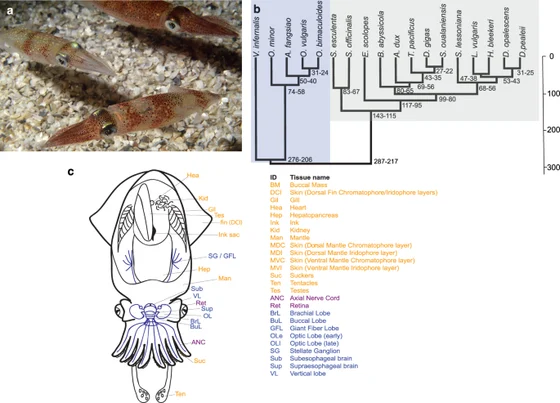
Selected coleoid relationships in Albertin et al.’s 2022 mitochondrial analysis
Six retained coleoid species from Figure 1b. The study analysed 19 species including the Nautilus outgroup, which is not drawn in that panel. Other displayed octopods, squid and cuttlefish are pruned.
Scroll sideways to see all branches. With a keyboard, focus the tree and use the arrow keys.
- Selected coleoids
- Selected octopods
- Octopus minor
- Octopus vulgaris / bimaculoides pair
- Octopus vulgaris
- Selected decapodiforms
- Euprymna scolopes
- Doryteuthis opalescens / pealeii pair
- Doryteuthis opalescens
Concatenated mitochondrial protein-coding sequences, codon-based MUSCLE alignment and IQ-TREE maximum likelihood with ModelFinder partition/model selection and 1,000 ultrafast bootstrap replicates. Each species contributes one mitochondrial genome. Figure 1b prints molecular-clock age ranges, not branch support; none are relabelled as bootstrap values or species ages. No support values are inferred from the replicate count. The authors note difficulty resolving deep decapodiform relationships. This mitochondrial hypothesis differs in evidence from nuclear-genome or chromosome-linkage comparisons; no living species is treated as a direct ancestor.
Taxonomic classification
A hierarchy of classified groups, not a chain of direct ancestors.
- PhylumMollusca
- ClassCephalopoda
- GenusOctopus
- SpeciesOctopus bimaculoides
References
Sources supporting this profile. Linked pages have their own scope and editorial standards.
- ResearchAlbertin et al. 2015 draft genomeResearch access: 2026-10-05
- ResearchAlbertin et al. 2022 chromosome-scale studyResearch access: 2026-10-05
Image credits
Scientific animal behavior photograph sequenceFive photographs of adult Octopus bimaculoides F interacting with a blue test-tube cap in a laboratory aquarium, Jarmoluk and Pelled 2025 figure 1
Five panels show a laboratory-housed adult, designated Octopus F, grasping and releasing a blue test-tube cap. Green arrows locate the cap in four panels. The photographs document one individual in a study aquarium, rather than a wild habitat or behavior demonstrated by every member of the species.