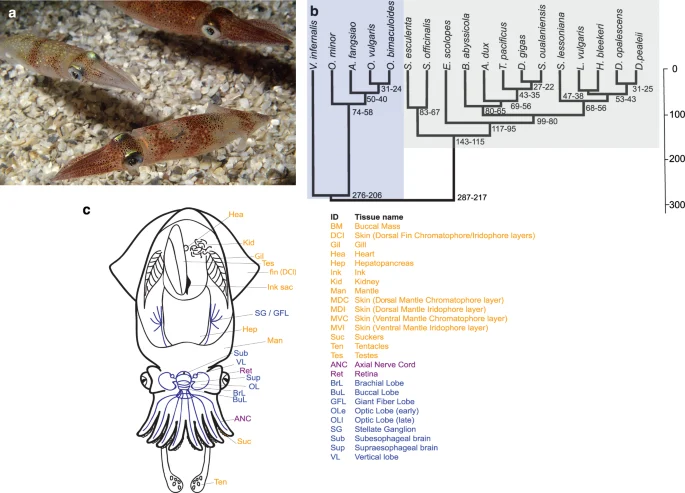
Doryteuthis pealeii photograph by Roger Hanlon, anatomical sampling schematic and coleoid phylogeny in Albertin and coauthors’ figure 1
Panel a shows adult Doryteuthis pealeii in Roger Hanlon’s photograph. The adjacent tree compares coleoid relationships, while the anatomical schematic identifies tissues sampled for the study. Its colours distinguish tissue categories, rather than natural body coloration. The photograph belongs to this squid species; the other species named in the tree are comparisons. The published composite is reproduced unchanged.
Overview
Doryteuthis pealeii, formerly placed in Loligo, is the Atlantic longfin inshore squid, also called the Boston market squid. It is a coleoid cephalopod, the group containing squids, cuttlefishes and octopuses. Loliginid squids have been important experimental animals in neuroscience: their giant axons carry signals from the stellate ganglion to the muscular mantle. Work using these preparations helped establish how nerve impulses propagate. The 2022 genomic study extends this experimental tradition by linking an individual squid’s DNA with RNA sampled from many of its tissues.
The reference animal was a male collected by trawl in Vineyard Sound in October 2015. Albertin and colleagues assemble about 4.59 billion DNA bases into 46 long chromosome-scale scaffolds, corresponding to the reported diploid chromosome count of 92. Their annotation predicts 24,911 protein-coding genes. The analysis accounts for differences between the two inherited copies of the genome so that alternative haplotypes are not simply mistaken for extra chromosomes. These are measurements and predictions for that reference assembly, not a complete survey of all Atlantic populations.
Comparison with the Hawaiian bobtail squid reveals a striking pattern: corresponding chromosomes preserve similar sets of genes, but their internal gene order has been extensively rearranged. Comparisons with octopus and other molluscs support an earlier episode of chromosome fragmentation and mixing in the coleoid lineage. The authors distinguish that restructuring from whole-genome duplication. A large or reorganized genome is therefore not evidence that the squid inherited the vertebrate mechanism of genome doubling.
The squid also edits many RNA messages after they are copied from DNA. Enzymes convert particular adenosines into inosines, which cellular machinery reads like guanosines. Some edits can change the encoded protein, while many occur in untranslated or repetitive regions. The study finds two broad patterns: editing concentrated in nervous tissues and editing shared more widely across tissues. It does not show that every edit is beneficial. Many sites are edited rarely, and the effect of an individual change can require a separate functional experiment.
Other gene families connect the genome with distinctive cephalopod structures. Reflectins are associated with iridescent tissues, suckerins with the toothed rings of squid suckers, and histidine-rich proteins with the beak. The researchers identify clustered genes and tissue expression consistent with these roles. Expanded protocadherin families may relate to neural organization, but the paper explicitly avoids proving their function from gene diversity alone. None of these counts provides a numerical measure of the animal’s intelligence.
Origins & earliest records
Albertin and colleagues published the 2022 chromosome-scale comparative study in Nature Communications 13,2427. Its reference male came from Vineyard Sound in October 2015; most RNA samples came from the same animal. It is a sequencing reference, not a species holotype.
Evidence & interpretation
Long- and short-read DNA sequencing, chromosome-conformation information, tissue RNA data and cross-species gene-position comparisons underpin the study. Comparing DNA and RNA from the same animal helps distinguish RNA edits from inherited sequence differences. Functional and adaptive explanations remain qualified.
Selected bibliography
Documented works and useful reading. This is not a list of every appearance.
- 01
Genome and transcriptome mechanisms driving cephalopod evolution
Nature Communications 13,2427; relevant main genomic, RNA-editing and innovation sections, complete sample/assembly, phylogeny, gene annotation, gene-family and RNA-editing Methods. Original adaptation of CC BY 4.0 article. https://creativecommons.org/licenses/by/4.0/.
Family, evolution & connections
Selected coleoid relationships in Albertin et al.’s 2022 mitochondrial analysis
Six retained coleoid species from Figure 1b. The study analysed 19 species including the Nautilus outgroup, which is not drawn in that panel. Other displayed octopods, squid and cuttlefish are pruned.
Scroll sideways to see all branches. With a keyboard, focus the tree and use the arrow keys.
- Selected coleoids
- Selected octopods
- Octopus minor
- Octopus vulgaris / bimaculoides pair
- Octopus vulgaris
- Selected decapodiforms
- Euprymna scolopes
- Doryteuthis opalescens / pealeii pair
- Doryteuthis opalescens
Concatenated mitochondrial protein-coding sequences, codon-based MUSCLE alignment and IQ-TREE maximum likelihood with ModelFinder partition/model selection and 1,000 ultrafast bootstrap replicates. Each species contributes one mitochondrial genome. Figure 1b prints molecular-clock age ranges, not branch support; none are relabelled as bootstrap values or species ages. No support values are inferred from the replicate count. The authors note difficulty resolving deep decapodiform relationships. This mitochondrial hypothesis differs in evidence from nuclear-genome or chromosome-linkage comparisons; no living species is treated as a direct ancestor.
Taxonomic classification
A hierarchy of classified groups, not a chain of direct ancestors.
- PhylumMollusca
- ClassCephalopoda
- GenusDoryteuthis
- SpeciesDoryteuthis pealeii
California two-spot octopus
Comparative chromosome-scale assemblies retain shared gene linkages between this squid and octopus, while gene order is extensively rearranged. Albertin and colleagues reconstruct changes in their shared coleoid history from these comparisons; neither living species is the other’s ancestor, and chromosome similarity alone does not establish a behavioral mechanism.
References
Sources supporting this profile. Linked pages have their own scope and editorial standards.
- ResearchAlbertin et al. 2022 primary squid genome and transcriptome studyResearch access: 2026-10-05
Image credits
Scientific animal photograph and anatomy figureDoryteuthis pealeii photograph by Roger Hanlon, anatomical sampling schematic and coleoid phylogeny in Albertin and coauthors’ figure 1
Panel a shows adult Doryteuthis pealeii in Roger Hanlon’s photograph. The adjacent tree compares coleoid relationships, while the anatomical schematic identifies tissues sampled for the study. Its colours distinguish tissue categories, rather than natural body coloration. The photograph belongs to this squid species; the other species named in the tree are comparisons. The published composite is reproduced unchanged.