
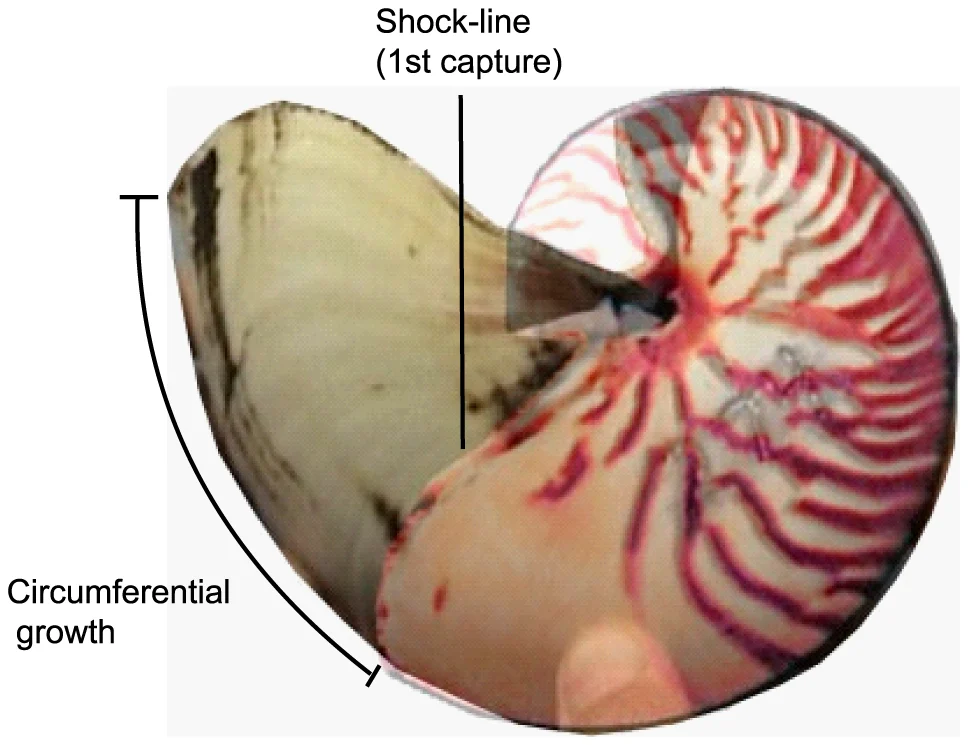
Overlaid capture and recapture photographs of Nautilus pompilius number 274, showing shell growth at Osprey Reef
The researchers overlaid photographs from initial capture and recapture of the same Osprey Reef individual, numbered 274, to demonstrate shell growth over two and a half years. The marked shock line and growth arc belong to this measurement figure. This is a composite of specimen photographs, rather than a single unaltered view of a swimming animal. The published figure is reproduced unchanged.
Overview
Nautilus pompilius carries its soft body in the outermost chamber of an external shell. The remaining chambers form a buoyancy apparatus, while the shell itself protects the animal. Its pearly inner layers consist of organized aragonite crystals, a form of calcium carbonate. This distinctive architecture belongs to a living marine predator, rather than a fossil species revived unchanged from the distant past. The 2021 genome study describes its Indo-Pacific distribution and its vertical movements into shallower water at night.
The eye has an adjustable opening but lacks a lens and cornea. Light reaches a retina containing rhabdomeric photoreceptor cells, producing a relatively dim spatial image. Zhang and colleagues investigate this arrangement by combining genome searches with tissue-specific RNA measurements. They identify most of the regulatory genes associated with lens development, alongside a missing large-Maf family member and a reduced repertoire of crystallin-like genes. The study proposes that changes and losses within developmental networks contributed to the lensless eye. It does not demonstrate that a single missing gene alone explains the entire organ.
The same investigation examines how the shell is built. Microscopy documents the arrangement of aragonite in its inner layers, and protein analysis identifies 78 shell-associated proteins recovered in two technical replicates. Some share recognizable components with shell proteins in other molluscs, while many appear specific to this lineage in the comparison. Most show particularly strong expression in the mantle. The authors interpret this combination as evidence that shared molecular tools and independently evolving proteins work together in shell formation.
For the genome, the researchers used one adolescent animal collected near the Nansha Islands in 2016. Their assembly spans about 730.58 million DNA bases and predicts 17,710 protein-coding genes. In the published comparison it is smaller than the sampled squid and octopus genomes. Those numbers refer to this assembly and annotation, not an immutable definition of the species or a survey of every nautilus population. Comparative sequence analyses also support slower rates of change in selected coding and noncoding regions; slower evolution does not mean no evolution.
A tree constructed from 423 single-copy genes places nautilus as the sister lineage of the sampled coleoids, the group containing squids and octopuses. The study’s estimated split around 422.6 million years ago is a model-based lineage divergence, not the age of Nautilus pompilius as a modern species. Its genomic history includes gene losses, expansions and other innovations. These results make it useful for studying cephalopod diversity while resisting the misleading claim that a living nautilus is simply an unchanged ancestral squid.
Origins & earliest records
Zhang and colleagues reported this genome in Nature Ecology & Evolution 5, 927–938 (2021), using an adolescent collected near the Nansha Islands in October 2016. The September 2021 correction adds gene-annotation accession GWHBECW00000000. The research individual is not a newly designated nomenclatural type.
Evidence & interpretation
Primary evidence combines DNA sequencing, tissue RNA measurements, shell microscopy and shell-protein analysis. Gene-loss explanations for the pinhole eye and evolutionary dates are comparative interpretations. The author correction changes data availability, not the described anatomy.
Selected bibliography
Documented works and useful reading. This is not a list of every appearance.
- 01
The genome of Nautilus pompilius illuminates eye evolution and biomineralization
Nature Ecology & Evolution 5, 927–938; main Results and Discussion, sample/assembly, phylogenetic and shell-proteomics Methods. Original adaptation of CC BY 4.0 article. https://creativecommons.org/licenses/by/4.0/.
- 02
Author Correction: The genome of Nautilus pompilius illuminates eye evolution and biomineralization
Nature Ecology & Evolution 5, 1637; complete correction text, adding annotation accession to data availability.
Family, evolution & connections
Selected cephalopod genomes — Zhang 2021
Six terminals pruned from Figure 1c: five cephalopods and the limpet Lottia gigantea. Aplysia and all other animal samples are omitted.
Scroll sideways to see all branches. With a keyboard, focus the tree and use the arrow keys.
- Selected molluscan subtree
- Lottia gigantea
- Sampled cephalopods
- Sampled coleoids
- Euprymna scolopes
- Sampled octopuses
- Octopus minor
- O. bimaculoides / O. vulgaris
- Octopus vulgaris
Maximum-likelihood analysis of 423 concatenated single-copy orthologues from 16 animals, using MUSCLE and RAxML. The study ran 1,000 rapid bootstraps; Figure 1c does not display their values, so none are supplied here. This sampled genomic topology does not make living Nautilus an ancestor of coleoids. Figure bars indicate modeled divergence-time intervals, and adjacent signed numbers count gene-family changes; neither is branching confidence. Dates and population-history curves are not transcribed.
Taxonomic classification
A hierarchy of classified groups, not a chain of direct ancestors.
- PhylumMollusca
- ClassCephalopoda
- GenusNautilus
- SpeciesNautilus pompilius
Sampled coleoid cephalopods
The 2021 concatenated-orthologue analysis places Nautilus beside the sampled squid and octopuses. This branching relationship does not imply that the living species is their direct ancestor or that the modeled lineage split is its species age.
Allonautilus scrobiculatus
Acoustic tracking at two Papua New Guinea sites found sampled adult Allonautilus shallower and more regular in daily depth changes than co-occurring Nautilus pompilius. The comparison involved only three Allonautilus and five Nautilus in the Figure 5 caption; it does not demonstrate competition or a universal difference between the species.
References
Sources supporting this profile. Linked pages have their own scope and editorial standards.
- ResearchZhang et al. 2021 primary genome studyResearch access: 2026-10-05
- Research2021 author correctionResearch access: 2026-10-05
Image credits
Scientific specimen photograph compositeOverlaid capture and recapture photographs of Nautilus pompilius number 274, showing shell growth at Osprey Reef
The researchers overlaid photographs from initial capture and recapture of the same Osprey Reef individual, numbered 274, to demonstrate shell growth over two and a half years. The marked shock line and growth arc belong to this measurement figure. This is a composite of specimen photographs, rather than a single unaltered view of a swimming animal. The published figure is reproduced unchanged.