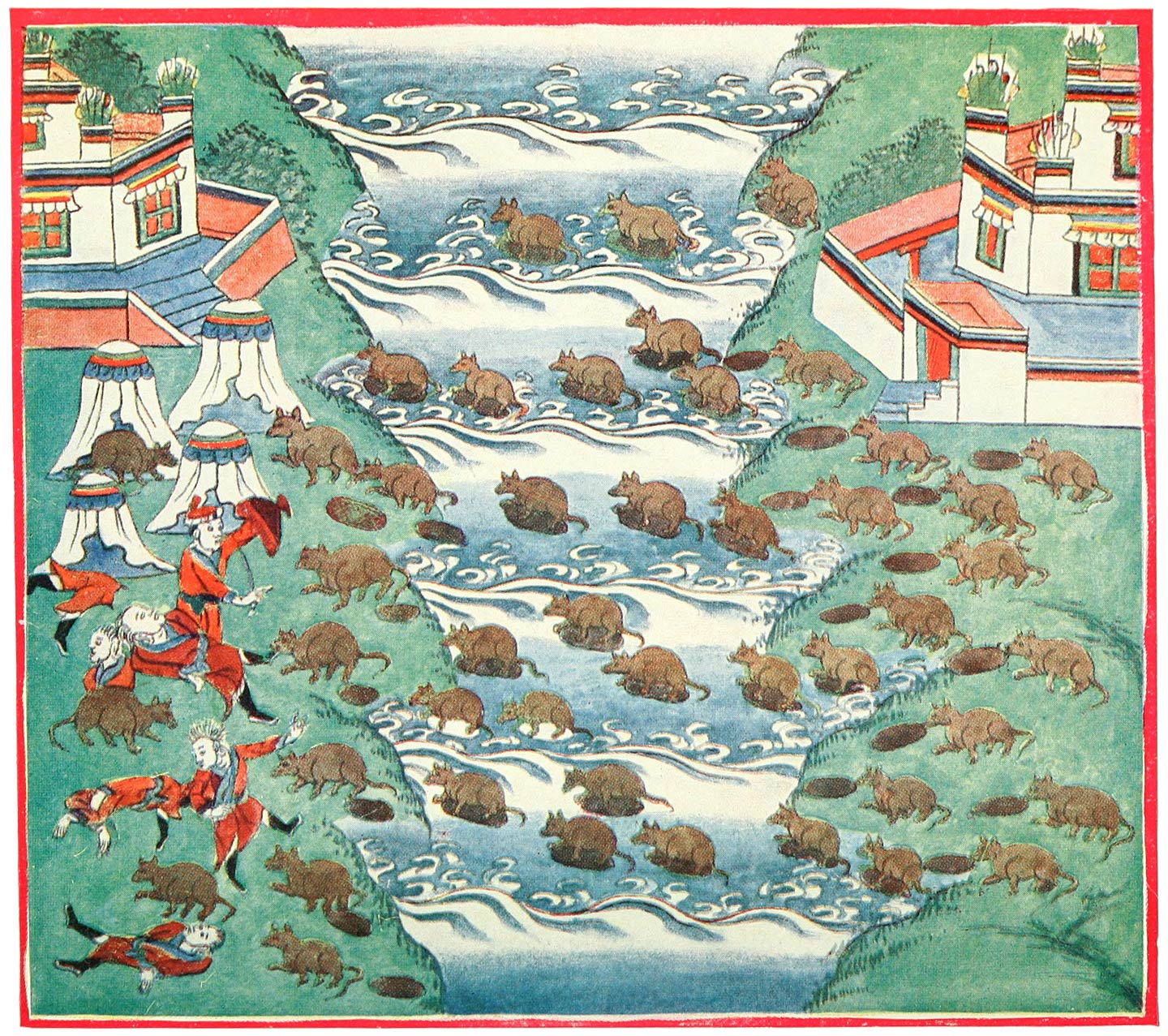
The mouse king’s subjects crossing the river on dung-cake rafts, Tibetan illustration published 1906
The mouse king’s subjects cross the river in the military-help episode. The round rafts follow the dried yak-dung-cake variant identified in O’Connor’s note; the main narrative uses sticks. No individual mouse in this crowded scene is identified as the king.
Overview
After a poor harvest, the mouse king petitions the human ruler for a granary of barley. He wears his best clothes and presents a silk thread in place of the ceremonial scarf. His subjects empty the store collectively and later repay the loan with interest. When a stronger neighbouring kingdom threatens invasion, he offers their assistance in exchange for a river embankment against flooding and the exclusion of cats.
The mice cross the frontier river on sticks provided by their ally, gnaw the sleeping invaders’ equipment and provisions, and return undetected. Their sabotage produces panic when the human king sounds an alarm. He then fulfils the bargain and gives the mice an annual granary of grain. A note records another telling in which the mice float on dried yak-dung cakes, the version followed by the illustration; no image inspection is claimed here. The tale depicts an organized speaking-animal polity, not magical military weapons or a human transformation.
Origins & earliest records
Tibet; collected historical narrative
Records & interpretation
Full relevant tale and collection preface directly read.
Selected bibliography
Documented works and useful reading. This is not a list of every appearance.
- 01
Folk Tales from Tibet
XIX, The Country of the Mice, pp. 133–140 and notes
Family & connections
A source-supported family tree or inspiration record has not yet been compiled for this profile. Related reading below indicates a connection in subject matter, not a proven lineage or creative influence.
Primary records and illustrations
W. F. O’Connor, Folk Tales from Tibet (1906)
XIX. XIX, The Country of the Mice, pp. 133–140 and notes
Complete XIX and both notes directly read. Sticks in main text distinguished from yak-dung raft variant in note. No source-image inspection. Original paraphrase; collection provenance and mediation retained.
References
Sources supporting this profile. Linked pages have their own scope and editorial standards.
- Historical tale collectionO’Connor, Folk Tales from Tibet (1906), XIX, The Country of the Mice, pp. 133–140 and notesResearch access: 2026-10-05
Image credits
Historical illustrationThe mouse king’s subjects crossing the river on dung-cake rafts, Tibetan illustration published 1906
The mouse king’s subjects cross the river in the military-help episode. The round rafts follow the dried yak-dung-cake variant identified in O’Connor’s note; the main narrative uses sticks. No individual mouse in this crowded scene is identified as the king.