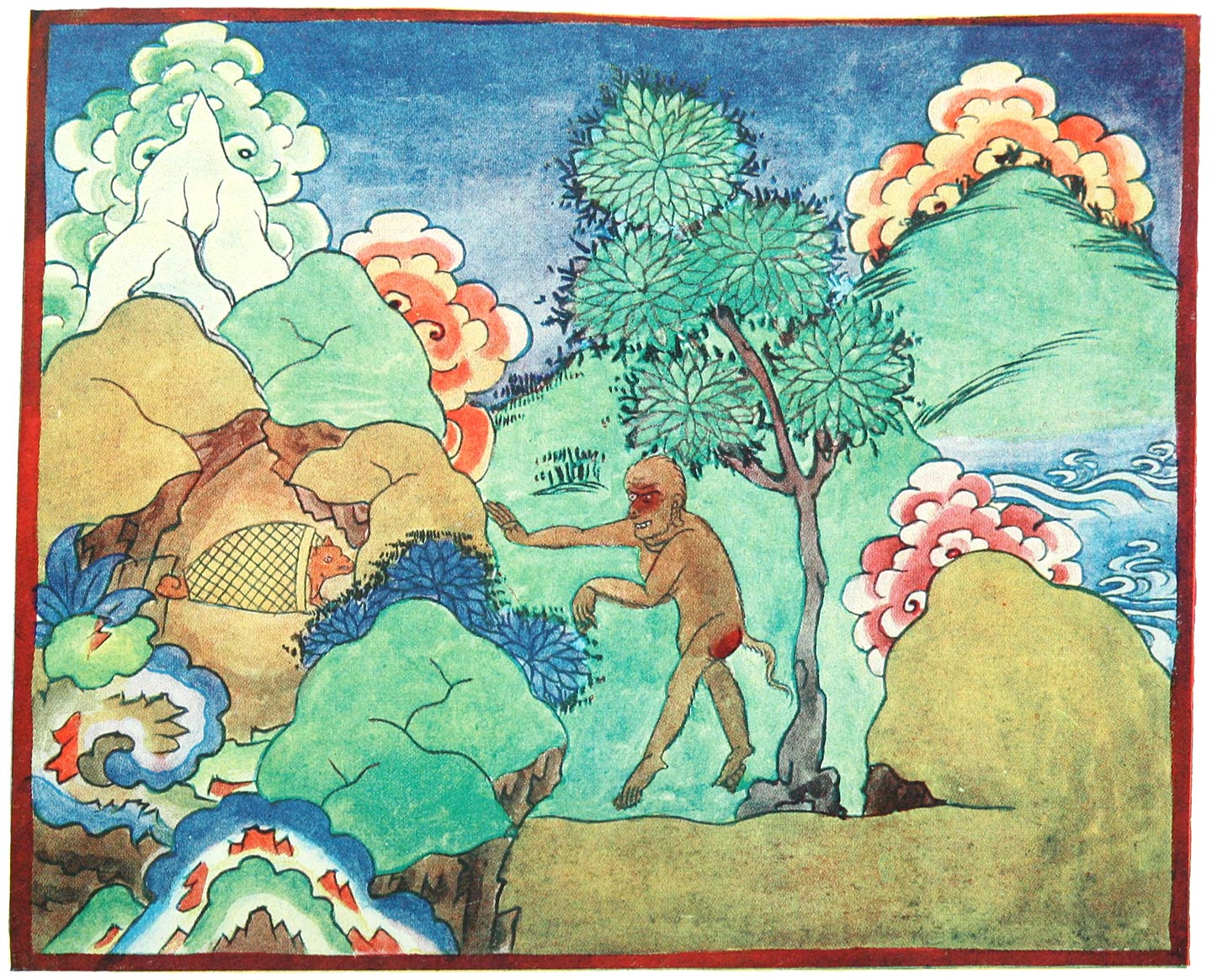
Monkey calling into the cave where the tortoise hides, Tibetan illustration published 1906
The monkey calls into the cave to test for an echo while the tortoise hides inside. Its reply exposes the trap. The cave itself is not a speaking being in the tale.
Overview
A monkey shares coconuts and a sleeping cave with a tortoise visiting the forest. Angered by her husband’s prolonged absence, the tortoise’s wife sends a message claiming that illness requires a monkey’s heart as medicine. The tortoise invites his host home and carries him across the lake, inadvertently revealing the supposed remedy along the way. The monkey suggests that several hearts would be better, persuading him to return to shore so that other monkeys can be fetched.
Once ashore, the monkey climbs a tree and exposes the betrayal. Later the tortoise hides in their cave hoping to catch him. The monkey calls into the cave and remarks loudly on the absence of its usual echo; the tortoise answers, exposing himself, and the monkey sleeps elsewhere. No heart is removed, no cure occurs, and the cave is not a speaking being. O’Connor’s footnote admits that the monkey’s actual abuse was not reproduced verbatim, a specific reminder that this English narrative is editorially mediated.
Origins & earliest records
Tibet; collected historical narrative
Records & interpretation
Full relevant tale and collection preface directly read.
Selected bibliography
Documented works and useful reading. This is not a list of every appearance.
- 01
Folk Tales from Tibet
XX, The Story of the Tortoise and the Monkey, pp. 141–146
Family & connections
A source-supported family tree or inspiration record has not yet been compiled for this profile. Related reading below indicates a connection in subject matter, not a proven lineage or creative influence.
Primary records and illustrations
W. F. O’Connor, Folk Tales from Tibet (1906)
XX, The Story of the Tortoise and the Monkey. XX, The Story of the Tortoise and the Monkey, pp. 141–146
Complete tale and all appended notes read from cached text. Animal speech and deliberate deception distinguished from magic; commentary and admitted translation omission explicitly attributed.
References
Sources supporting this profile. Linked pages have their own scope and editorial standards.
- Historical tale collectionO’Connor, Folk Tales from Tibet — XX, The Story of the Tortoise and the Monkey, pp. 141–146Research access: 2026-10-05
Image credits
Historical illustrationMonkey calling into the cave where the tortoise hides, Tibetan illustration published 1906
The monkey calls into the cave to test for an echo while the tortoise hides inside. Its reply exposes the trap. The cave itself is not a speaking being in the tale.