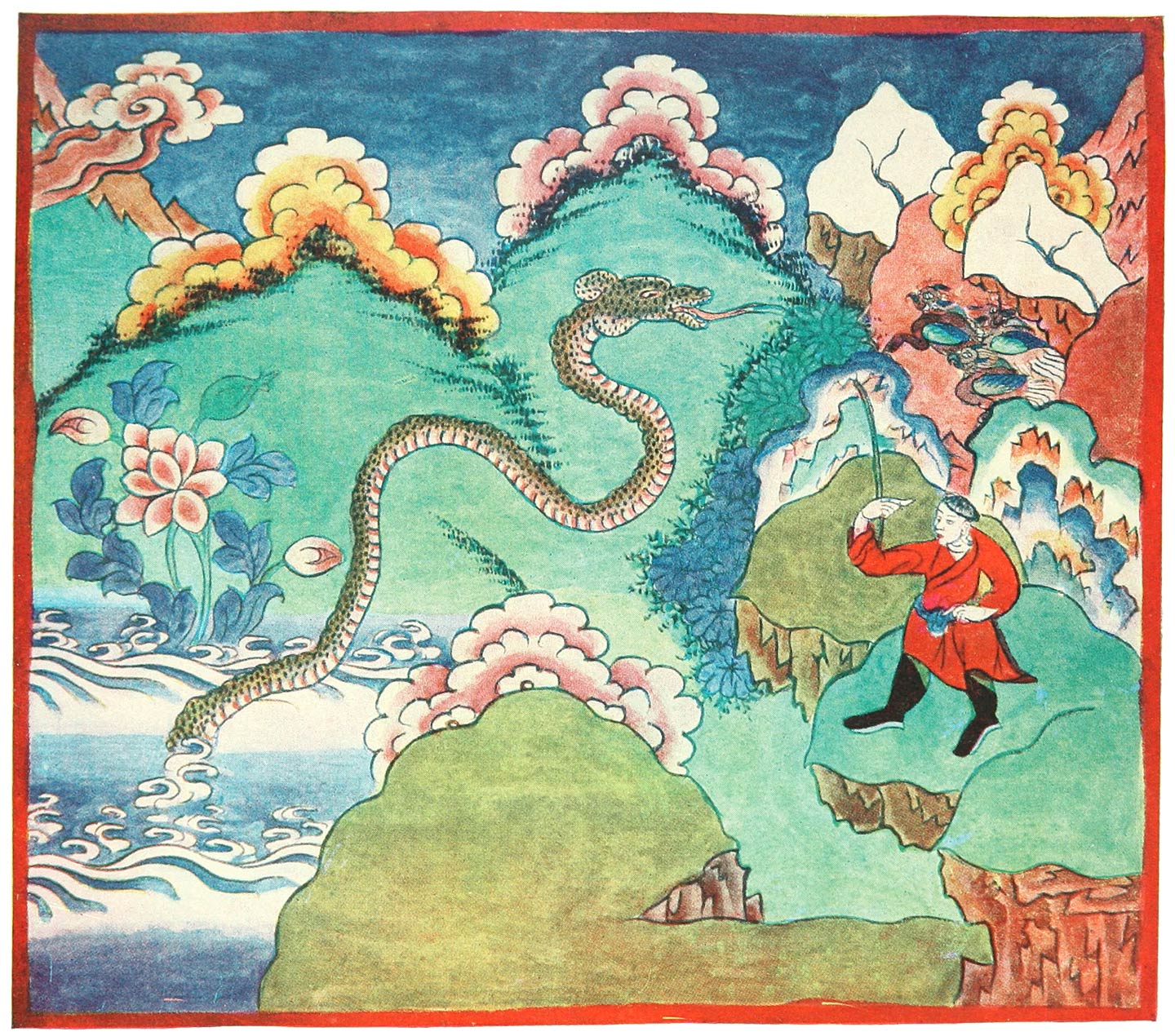
Three young Gryphons in a cliff nest at right as a lake dragon approaches, anonymous Tibetan illustration published 1906
The three nestlings appear at the upper right, above the sword-bearing rescuer. This scene shows the attack that earns the Gryphon parents’ gratitude; it does not establish a lion-bodied anatomy or identify these beings with Garuda.
Overview
A pair of Gryphons nests on a cliff above a lake with three young. A human traveler saves the nestlings from a dragon while their parents are away. On returning, the adults hear the children’s account and offer him hospitality. They initially find his lack of beak, claws and flight strange; the father carries him up to the nest.
After hearing of his lost fairy wife, the father flies him to the gods’ country and defends him before the angry assembly. He later carries both spouses back to earth. O’Connor uses the English word Gryphon and describes large wings and birdlike nesting; the passage does not supply a lion’s hindquarters, a Tibetan original term, or an explicit identification with Garuḍa.
Origins & earliest records
Tibet; collected historical narrative
Records & interpretation
Full relevant tale and collection preface directly read.
Selected bibliography
Documented works and useful reading. This is not a list of every appearance.
- 01
Folk Tales from Tibet
XV, The Story of the Boy with the Deformed Head, pp. 92–102
Family, evolution & connections
The Gryphon parents and young in O’Connor StoryXV
The nesting household in StoryXV, pp98–101; no wider Gryphon genealogy.
Scroll sideways to see all branches. With a keyboard, focus the tree and use the arrow keys.
- Joint parents: Mother Gryphon and Father Gryphon
- Three unnamed young Gryphons
Explicit mother, father and three young in the English narrative. The joint-parent grouping is not a new creature. Individual names and the young’s sexes are unstated. The human rescuer is a guest, not adopted offspring. Historical collector mediation remains explicit.
Three unnamed young Gryphons (O’Connor StoryXV)
The narrative explicitly identifies three young Gryphons and their mother and father. Their rescue motivates the father’s later assistance. No individual names or real bird species are supplied.
Primary records and illustrations
W. F. O’Connor, Folk Tales from Tibet (1906)
XV, The Story of the Boy with the Deformed Head. pp. 92–102
Complete tale and preface read. English fairy/Gryphon labels not given invented Tibetan equivalents. No lion-bodied anatomy inferred. Daughter’s initially coerced and later voluntary choices distinguished.
References
Sources supporting this profile. Linked pages have their own scope and editorial standards.
- Historical tale collectionO’Connor, Folk Tales from Tibet, XV, The Story of the Boy with the Deformed Head, pp. 92–102Research access: 2026-10-05
Image credits
Historical illustrationThree young Gryphons in a cliff nest at right as a lake dragon approaches, anonymous Tibetan illustration published 1906
The three nestlings appear at the upper right, above the sword-bearing rescuer. This scene shows the attack that earns the Gryphon parents’ gratitude; it does not establish a lion-bodied anatomy or identify these beings with Garuda.