
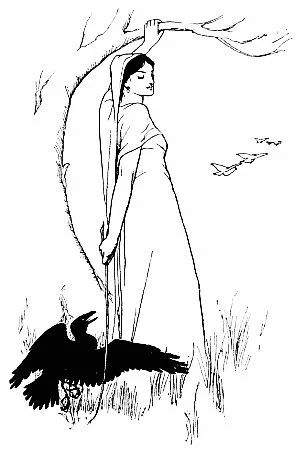
Batten’s rod-wielding wife changing Niall into a raven, 1895
Niall’s wife stands with the rod beside the black raven produced by her spell. The composition illustrates the first of the transformations he recounts in Morraha; it does not identify her with another tale’s enchantress.
Overview
The wife presses Niall to explain his laughter while listening to birds. Once he tells her that magical rods grow on a nearby tree, she insists on obtaining one. She demonstrates its power on a stone and then transforms her husband into a black raven. A reward for killed ravens forces him into hiding; later she changes him into a labouring white horse, fox and wolf as his efforts to resist each new condition inconvenience her.
During his wolf-form service in a royal household, a stranger woman hides the guarded infant and severed attacker’s hand, encouraging an accusation against the animal protector. Niall later says this woman is his wife, while she confirms his account in the frame scene. When he finds the child again, the boy uses the rod and restores him. She threatens to drown herself on seeing the returned husband, and he promises secrecy until a later circumstance forces the story out. Jacobs flags confusion between mother and wife elsewhere in the tale; that warning remains visible, and the profile does not invent a second secret biography to reconcile the adaptation.
Origins & earliest records
Jacobs’s selected 1895 Morraha adapts Larminie, whose inner tale is credited to Terence Davis of Rendyle. The editor’s explicit mother/wife warning is part of the transmission evidence. This witness does not justify treating all similar rod-enchantresses as this one named family member.
Records & interpretation
The successive animal transformations and concealed child are stated in the story. They attest a particular hostile enchantress, not historical proof of witchcraft accusations or a general description of women. The magical rod’s workings remain literary events.
Selected bibliography
Documented works and useful reading. This is not a list of every appearance.
- 01
More Celtic Fairy Tales: Morraha, pp. 85–93; note XXXIV
Complete Morraha frame, inner narrative and relevant note inspected. Earlier Larminie text is an attributed source, not falsely claimed as independently collated.
Family & connections
A source-supported family tree or inspiration record has not yet been compiled for this profile. Related reading below indicates a connection in subject matter, not a proven lineage or creative influence.
References
Sources supporting this profile. Linked pages have their own scope and editorial standards.
- Primary textMore Celtic Fairy Tales, selected 1895 edition: Morraha, pp. 85–93; note XXXIVResearch access: 2026-10-05
Image credits
Historical illustrationBatten’s rod-wielding wife changing Niall into a raven, 1895
Niall’s wife stands with the rod beside the black raven produced by her spell. The composition illustrates the first of the transformations he recounts in Morraha; it does not identify her with another tale’s enchantress.