
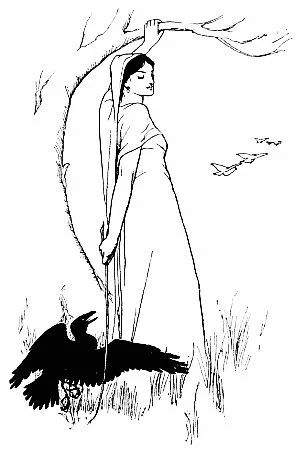
Niall in raven form beside his wife in Batten’s Morraha illustration, 1895
The black raven at the woman’s feet represents Niall after the first blow of her magical rod. Horse, fox and wolf are later forms in his account and are not shown in this illustration.
Overview
Niall says his mother taught him the language of birds. After he reveals that birds have discussed rods of magic mastery, his wife obtains one and changes him first into a raven. Subsequent forms are an old white horse, a fox and a wolf, each leaving him increasingly displaced. He reaches a king whose household accepts his humanlike handling of knife, fork and wine. Though called a dog at points in the account, he has not been explicitly changed out of wolf form.
While guarding a newborn, Niall bites off the immense hand reaching through the chimney. Blood initially suggests he killed the infant, but he leads the king to a locked room where the child and hand have been hidden together. Years later the boy disappears, and Niall finds him with the wife who enchanted him. A strike from her rod restores him to humanity. His voyage to return the child leads to the one-eyed captor of eleven older siblings, whom he defeats and frees. The outer story calls him Rough Niall and finally Blue Niall; those labels identify one narrated storyteller, not three separate beings.
Origins & earliest records
Jacobs cites Larminie’s West Irish Folk-tales and credits the inner story to Terence Davis of Rendyle, County Galway. His note expressly identifies confusion between Niall’s mother and wife in the introductory material. The selected 1895 adaptation is retained with that uncertainty rather than silently regularised.
Records & interpretation
The animal forms, retained human manners and restored body are literary attestations. The hand-cutting, accusations and rescue belong to the plot, not animal psychology or real child-protection evidence. Uneven name and kinship wording is disclosed.
Additional images
 View larger
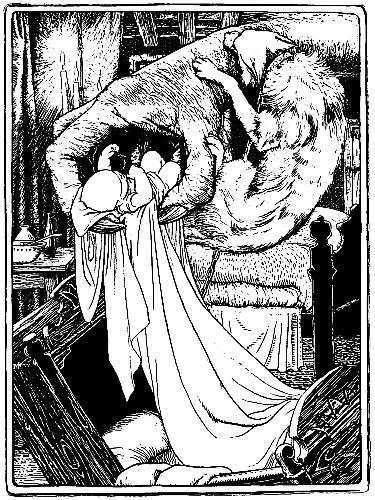
 Batten: Niall protects the infant in wolf form
Niall, still in wolf form, confronts the immense hand reaching toward the infant. The encounter belongs to his narrated guardianship; it does not show the attacker’s complete body.
 View larger
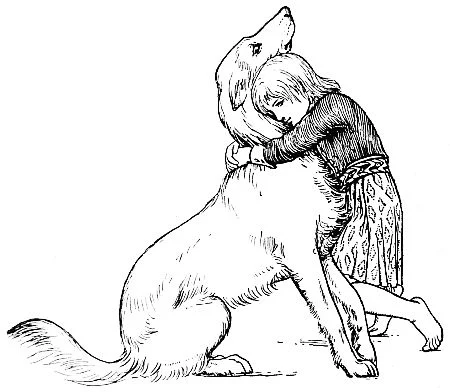
 Batten: Niall in wolf form greeted by the child
The child greets Niall while he remains in wolf form, before the rod restores his human body. Batten’s domestic scene follows the Morraha narrative’s recognition episode.
Selected bibliography
Documented works and useful reading. This is not a list of every appearance.
- 01
More Celtic Fairy Tales: Morraha, pp. 84–96; note XXXIV
Complete Morraha frame, inner narrative and relevant note inspected. Earlier Larminie text is an attributed source, not falsely claimed as independently collated.
Family & connections
A source-supported family tree or inspiration record has not yet been compiled for this profile. Related reading below indicates a connection in subject matter, not a proven lineage or creative influence.
References
Sources supporting this profile. Linked pages have their own scope and editorial standards.
- Primary textMore Celtic Fairy Tales, selected 1895 edition: Morraha, pp. 84–96; note XXXIVResearch access: 2026-10-05
Image credits
Historical illustrationNiall in raven form beside his wife in Batten’s Morraha illustration, 1895
The black raven at the woman’s feet represents Niall after the first blow of her magical rod. Horse, fox and wolf are later forms in his account and are not shown in this illustration.
Further credits appear with each additional image.