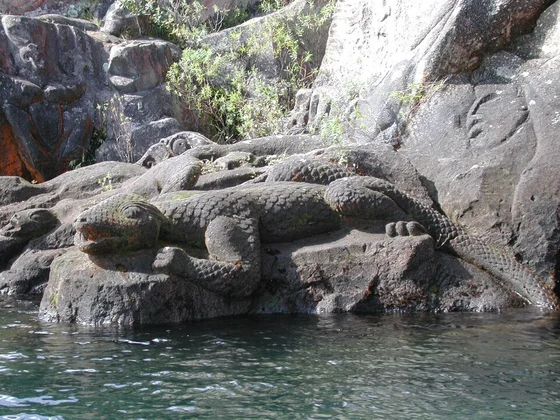
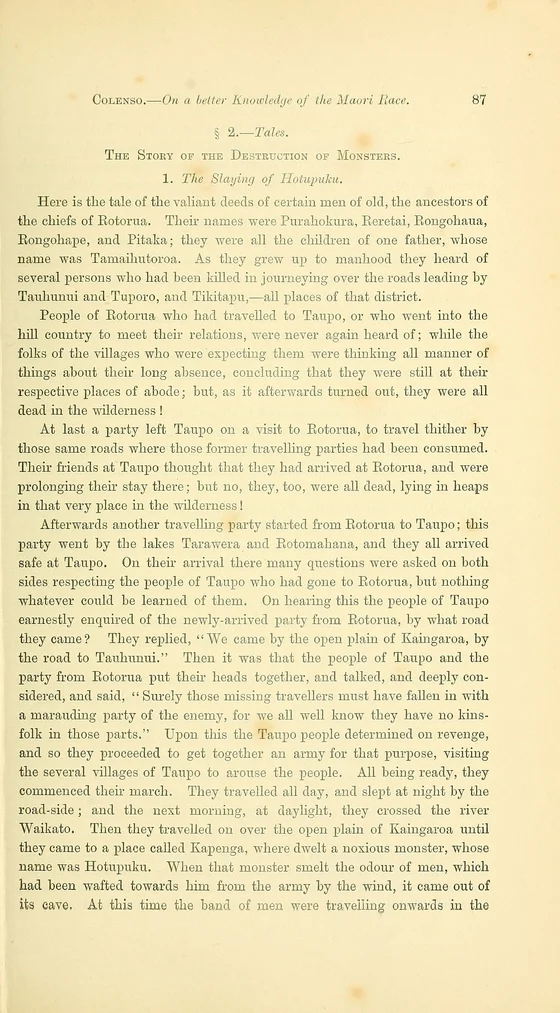
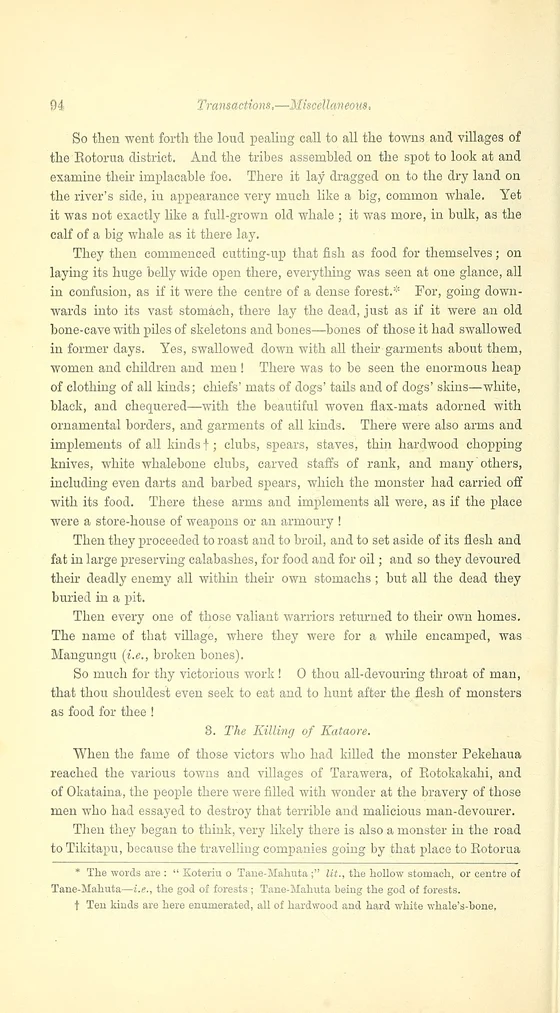
A sourced illustration has not yet been added. This gap is included in the coverage record.
Overview
Tunuiarangi's account begins at Waimārama, where Ngārara Huarau longs to visit his sister Pari-kawhiti in Wairarapa. He smells the winds, finds her scent and travels by sea and river. A waterfall initially defeats his leap; he climbs using forelegs and hind legs, then continues inland. Features of the route preserve names linked to his alarm, effort and tired back. At Kourarau he settles and swallows passing people together with their possessions.
Families initially assume missing travellers are delayed at other settlements, until the danger is discovered. Two runners use a dead dog as bait to draw the taniwha into a prepared forest. His swinging head and tail topple partly cut trees, pinning him so the community can kill him and recover the victims. Tunuiarangi also reports a stone identified as the dried head. That reported identification belongs to the narrative's landscape memory, rather than establishing fossil or anatomical evidence.
Origins & earliest records
H. P. Tunuiarangi's Māori account appeared in the Journal of the Polynesian Society 14(4), December 1905, pages 200–204, with S. Percy Smith's translation. Rangitāne o Wairarapa Education republishes both texts. The dated article witnesses an existing narrative, rather than proving an oral origin in 1905.
Records & interpretation
The Māori text and accompanying translation directly supply the journey, limbs, predation and forest trap. Their modern republication is a community transmission of that named historical witness. The author's reported stone-head identification is retained as an attributed cultural claim, not converted into zoological evidence or a verified fossil discovery.
In the literature
“all went down his capacious throat”
JPS 14(4), pp. 200–204; English paragraph describing swallowed travellers · S. Percy Smith
The English translation describes Ngārara Huarau swallowing travellers and their carried belongings.
Selected bibliography
Documented works and useful reading. This is not a list of every appearance.
- 01
Te korero mo Ngarara-huarau
Journal of the Polynesian Society 14(4), pp. 200–204; bilingual text inspected through Rangitāne education republication.
Family & connections
A source-supported family tree or inspiration record has not yet been compiled for this profile. Related reading below indicates a connection in subject matter, not a proven lineage or creative influence.
Located primary passages
Specific passages supporting details in this entry, grouped by their published witness.
Te korero mo Ngarara-huarau
Journal of the Polynesian Society 14(4), December 1905, pp. 200–204, original Tunuiarangi account and Smith translation republished by Rangitāne education, added 26 October 2015. Individual page boundaries are not marked in this web republication.
- Ngārara Huarau seeks his sister by scenting the winds, follows the coast and river, climbs a waterfall using his fore and hind legs and leaves named landscape marks before settling near her.
JPS 14(4), pp. 200–204; English translation, journey to Wairarapa
- He swallows travellers, children, carried loads and weapons; coastal and inland communities initially mistake the missing parties for guests delayed at the other settlements before identifying the danger.
- Two runners lure him with a lowered dog into partly cut trees. His own movements topple them and pin him for killing; the body holds victims’ remains, the head becomes stone, and the narrator closes by saying he and Buchanan saw it.
JPS 14(4), pp. 200–204; tree trap, destruction and witness conclusion
Specific public narrative retained with named local authorship. No ritual or karakia text reproduced; no claim that local variants are interchangeable or that this account establishes a general zoological type.
Encyclopedia background
An additional attributed reference, separate from the editorial profile above.
Read the open encyclopedia overview
In Māori mythology, taniwha (Māori pronunciation: [ˈtaniɸa]) are large supernatural beings that live in deep pools in rivers, dark caves, or in the sea, especially in places with dangerous currents or deceptive breakers (giant waves).
They may be considered highly respected kaitiaki (protective guardians) of people and places, or in some traditions as dangerous, predatory beings, which for example would kidnap women to have as wives.
Text from Wikipedia contributors, “Taniwha”. CC BY-SA 4.0. Extracted introduction; formatting changed. Retrieved 5 October 2026. The source article may have changed since retrieval.
References
Sources supporting this profile. Linked pages have their own scope and editorial standards.
- Primary textRangitāne o Wairarapa: Tunuiarangi's Ngārara Huarau textResearch access: 2026-10-05
Image credits
A sourced illustration has not yet been added. This gap is included in the coverage record.