Mula sem cabeça
Image associated with the exact linked encyclopedia article; consult credited file description for its interpretation.
Overview
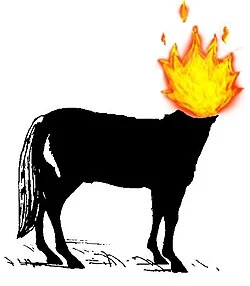
The familiar creature is a mule whose missing head is replaced by fire, galloping through darkness and frightening anyone nearby. That impossible image can remain vivid even when details such as the source of flames or the timing of transformation differ. Individual tellings give the being a human identity and a cause for the curse.
A widely circulated backstory condemns a woman’s relationship with a priest, revealing the gendered moral judgments embedded in the legend. Describing that plot does not endorse its judgment or treat an accusation as fact. The national folklore thesaurus records the transformation and fiery animal image, while performance and public retellings demonstrate how the legend continues to change.
Saul Delphino’s signed contribution to the 1918 Sacy inquiry offers a precise example of the priest-related moral story. It claims that the mule had been a woman who tried to corrupt a priest characterized as saintly. This is the contributor’s explanation of a curse, with responsibility assigned asymmetrically to the woman; it is not a verified allegation or the only recorded transformation plot. The complete short contribution places the mule among several beings with separate stories, rather than making those beings interchangeable.
Lobato supplies a different cause in chapter XXV of the 1941 eighth edition of O Saci. Saci describes a queen discovered consuming dead children and subsequently transformed into a headless mule, condemned to gallop. Pedrinho hears approaching hoofbeats, but the creature changes direction and does not come into view. Her former identity and transformation are therefore narrated by Saci, not witnessed by the boy. Pedrinho also challenges the claim that fire issues from the nostrils when the creature has no head, and Saci cannot explain the contradiction. The dialogue preserves the inconsistency instead of resolving it into plausible anatomy.
The national folklore thesaurus gives a broader catalogue description: a curse transforms a woman into a mule that gallops in darkness with fire issuing from nostrils and mouth. Its entry does not specify the priest-related cause. The three selected witnesses consequently support comparison among a moralized contribution, an authored tale and an institutional subject definition. None warrants imposing one cause, timetable or anatomical diagram on every regional telling.
A related headless-equine account appears in Nery’s 1889 São Paulo material, credited to Jorge Velho’s Campos Novos (1878). It specifically calls the being a headless horse, places it on open plains rather than in Caapora’s forest, and describes Friday-night wandering in moonlight. Its minute footprints are said to open into bottomless holes leading to hell. This is a comparison with a named horse account, not proof that it is the same mule or transformed woman as in the preceding sources. The short passage gives no origin through a relationship with a priest.
Origins & earliest records
Cascudo’s 1954 dictionary and other collected accounts provide selected ethnographic witnesses. Similar Iberian traditions invite comparison, but the precise routes and dates of transmission require stronger case-specific documentation. A surviving record dates its documentation, not the beginning of an oral tradition; earlier transmission cannot be timed precisely from this witness alone. The directly read selected witnesses include a signed1918 contribution and1941 literary chapter. Neither establishes the first oral telling or a documented single Iberian route. Nery’s 1889 volume adds a separately identified headless-horse comparison and credits the São Paulo material to Campos Novos (1878). That bibliographic credit is not a direct reading of the 1878 original.
Records & interpretation
The folklore thesaurus and narrative retellings document the fiery mule and curse motif. They are cultural evidence, and do not establish a biological headless animal or the truth of allegations against a woman. This is evidence for cultural expression and recorded interpretation, rather than a zoological specimen or independently verified supernatural event. Complete Saul Delphino contribution245–246 read in the1998facsimile, with both original page images checked. Complete1941chapterXXV read, including the unanswered anatomical question. CNFCP thesaurus record00000550 read separately; its general definition does not supply the priest backstory. Cascudo remains a bibliography lead, not a newly inspected full entry. Root read the complete Nery pp. 253–257 passage with all footnotes and inspected every corresponding original scan. Zero-based PDF pages 274–278 show printed 253–257; the title and Archive bibliographic metadata were checked. The preceding 1885 Amazon conversation, the Velho-derived São Paulo accounts and the collector’s literary comparisons remain distinct.
Selected bibliography
Documented works and useful reading. This is not a list of every appearance.
- 01
Dicionário do folclore brasileiro
Bibliographic reference retained; full dictionary entry not inspected in this pass.
- 02
O Sacy-Perêrê: resultado de um inquerito — Saul Delphino contribution
Complete245–246 in1998facsimile; contributor’s moral explanation attributed explicitly.
- 03
O Saci — eighth edition, chapter XXV
Complete selected chapter; first-edition textual collation pending.
- 04
Folk-lore brésilien — São Paulo headless-horse comparison
Comparative headless-horse witness, not an asserted identification with the mule. Selected pp. 254 note 3 and 256; original printed pages inspected. Campos Novos, Santos 1878, is cited by Nery but its original text has not been independently read here.
Family & connections
A source-supported family tree or inspiration record has not yet been compiled for this profile. Related reading below indicates a connection in subject matter, not a proven lineage or creative influence.
References
Sources supporting this profile. Linked pages have their own scope and editorial standards.
- ReferenceCentro Nacional de Folclore e Cultura Popular: Mula-sem-cabeçaResearch access: 2026-10-05
- Primary collecting contribution in facsimile1918 Sacy inquiry: Saul Delphino245–246Research access: 2026-10-05
- Primary literary dialogue; edition-specificO Saci1941: XXV, A mula-sem-cabeçaResearch access: 2026-10-05
- Historical French source; all five original pages and attribution footnotes inspectedF. J. de Santa-Anna Nery: Folk-lore brésilien (1889), pp. 253–257, especially p. 254 note 3Research access: 2026-10-05
Image credits
Reference illustrationMula sem cabeça
Image associated with the exact linked encyclopedia article; consult credited file description for its interpretation.