Boitatá
Image associated with the exact linked encyclopedia article; consult credited file description for its interpretation.
Overview
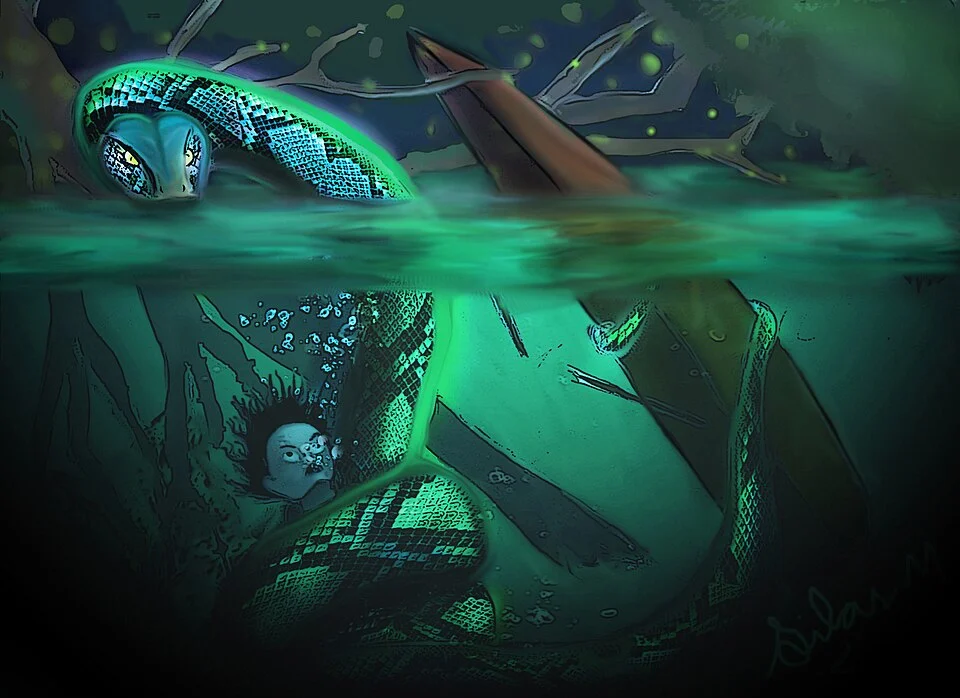
Boitatá’s familiar image is a luminous or flaming serpent moving through dark places. In some accounts its light is linked to eyes, while other stories emphasize protection, fear or punishment. Those features should be attributed to their tellings rather than combined into one official anatomy and a single national backstory.
The Centro Nacional de Folclore e Cultura Popular records a specific eye-and-light account, illustrating how detailed a local or collected version can be. The being also appears in children’s books and public cultural programs. Such retellings sustain recognition but may simplify older variation. Neither a proposed natural light phenomenon nor a modern environmental interpretation alone settles the narrative’s historical development.
J. Simões Lopes Neto’s A M’boi-tátá supplies a complete literary regional version in Lendas do sul (Pelotas, 1913). A prolonged night follows a deluge that displaces animals and wakes the great snake boi-guassú. As creatures die, it eats only their eyes. The narrator explains that each eye retains a trace of the last sunlight it saw. Those accumulated traces make the snake’s body transparent and luminous: a bluish blaze with yellow, sad, cold light, explicitly without flames. People no longer recognize the changed snake and name it boi-tátá. Its hunger eventually extends toward living human eyes, and the lapwing’s cries act as a warning in the surrounding darkness.
The body is full of eyes and light but receives no nourishment from them. The snake dies of weakness and decays, releasing its captive radiance. Dawn then returns, and the narration describes the gradual appearance of stars, coloured sky and rising Sun. This is not an indefinitely immortal serpent that survives every encounter. The later manifestation is the separated light: in summer it moves over fields curled like a ball, rolls and leaps, bursts apart and disappears, then reforms unexpectedly. It does not burn dry grass or warm spring water. That cold-fire behaviour is a defining contrast with the ordinary heat suggested by its name.
The author’s prefatory note explicitly presents a literary exposition of dispersed oral tradition, rather than a verbatim named-informant transcript. A printed letter from Coelho Neto dated 20 November 1909 likewise mentions sertanejo versions that differ considerably from this telling. The ending voices encounter fears and warnings about cattle, but those statements belong to the narrator’s folklore register. They do not demonstrate that the light causes blindness or livestock disease. Neither the letter’s regional comparisons nor the adaptation’s explanatory imagery establishes one universal account for every tradition called Boitatá.
Origins & earliest records
Colonial and later collecting records attest changing forms of the name and fire-being motif. Cascudo’s dictionary is a selected ethnographic source rather than the first appearance of every regional account. A surviving record dates its documentation, not the beginning of an oral tradition; earlier transmission cannot be timed precisely from this witness alone.
Records & interpretation
The CNFCP thesaurus records a particular eye-and-light account. Lopes Neto’s complete 1913 literary adaptation separately supplies the flood, accumulated eye-light, snake’s death and residual cold-fire sequence; the author and printed letter acknowledge variant tellings.
In the literature
“de pura fraqueza morreu”
A M’boi-tátá,VIII
During a long darkness and flood, a great snake called boi-guassú leaves its flooded lair and feeds only on eyes from animal carcasses. The eyes retain the last sunlight they saw, and their light accumulates within the snake, making its body transparent and luminous. People mistake it for another creature and call it boi-tátá, a fire snake. It roams hungry near settlements and covets living human eyes; a watchful bird warns people. Eventually it dies of weakness because the eyes supply bulk but no nourishment. Its body decomposes, releasing light, and daylight returns. The remaining light stays apart from its origin, lies dormant in winter and later rolls through the fields as a yellow-blue fireball that neither burns dry vegetation nor warms spring water. The final sections warn of blindness and dangerous grazing places.
Selected bibliography
Documented works and useful reading. This is not a list of every appearance.
- 01
Dicionário do folclore brasileiro
Selected relevant primary or ethnographic work; the online source below is separate.
- 02
Lendas do sul: A M’boi-tátá
Pelotas: Echenique & C. Complete sections I–XII; author’s Nota and preceding Coelho Neto letter dated 20 November 1909 distinguish literary treatment and variant traditions.
- 03
Lendas do sul — A M’boi-tátá, complete I–XII and preceding CoelhoNeto letter20November1909
Lendas do sul, Pelotas: Echenique & C.,1913, digital title/catalogue identified. Complete selected named narrative and preceding dated correspondent letter read. Author Nota states a literary presentation of transmitted oral tradition; no original scan-page claim or whole-volume review.
Family & connections
A source-supported family tree or inspiration record has not yet been compiled for this profile. Related reading below indicates a connection in subject matter, not a proven lineage or creative influence.
Located primary passages
Specific passages supporting details in this entry, grouped by their published witness.
Lendas do sul — A M’boi-tátá, complete I–XII and preceding CoelhoNeto letter20November1909
Lendas do sul, Pelotas: Echenique & C.,1913, digital title/catalogue identified. Complete selected named narrative and preceding dated correspondent letter read. Author Nota states a literary presentation of transmitted oral tradition; no original scan-page claim or whole-volume review.
- During a long darkness and flood, a great snake called boi-guassú leaves its flooded lair and feeds only on eyes from animal carcasses. The eyes retain the last sunlight they saw, and their light accumulates within the snake, making its body transparent and luminous. People mistake it for another creature and call it boi-tátá, a fire snake. It roams hungry near settlements and covets living human eyes; a watchful bird warns people. Eventually it dies of weakness because the eyes supply bulk but no nourishment. Its body decomposes, releasing light, and daylight returns. The remaining light stays apart from its origin, lies dormant in winter and later rolls through the fields as a yellow-blue fireball that neither burns dry vegetation nor warms spring water. The final sections warn of blindness and dangerous grazing places.
A M’boi-tátá, complete I–XII and preceding CoelhoNeto letter20November1909
The anatomical and nutrition explanations are this literary myth, not scientific properties. The light’s release and the sun’s return are sequentially associated; no independent universal creation doctrine inferred. CoelhoNeto’s preceding1909 letter explicitly acknowledges other substantially different variants. Encounter-avoidance practices are historical narrative, not safety instructions; no invocation copied.
Encyclopedia background
An additional attributed reference, separate from the editorial profile above.
Read the open encyclopedia overview
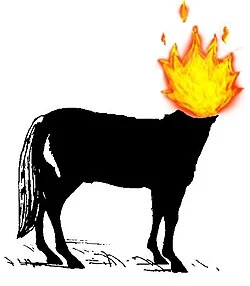
Boitatá (from Tupi language), in Brazilian native folklore, refers to either a will-o'-the-wisp, a mythical fire snake which guards against humans setting fire to the fields or forests, or a bull-like creature.
Snake-like will-o'-the-wisps also appear as "firedrake" in European folklore.
Text from Wikipedia contributors, “Boitatá”. CC BY-SA 4.0. Extracted introduction; formatting changed. Retrieved 5 October 2026. The source article may have changed since retrieval.
References
Sources supporting this profile. Linked pages have their own scope and editorial standards.
- ReferenceCentro Nacional de Folclore e Cultura Popular: BoitatáResearch access: 2026-10-05
- Primary literary regional adaptationLopes Neto, Lendas do sul: complete Portuguese narrativeResearch access: 2026-10-05
Image credits
Reference illustrationBoitatá
Image associated with the exact linked encyclopedia article; consult credited file description for its interpretation.