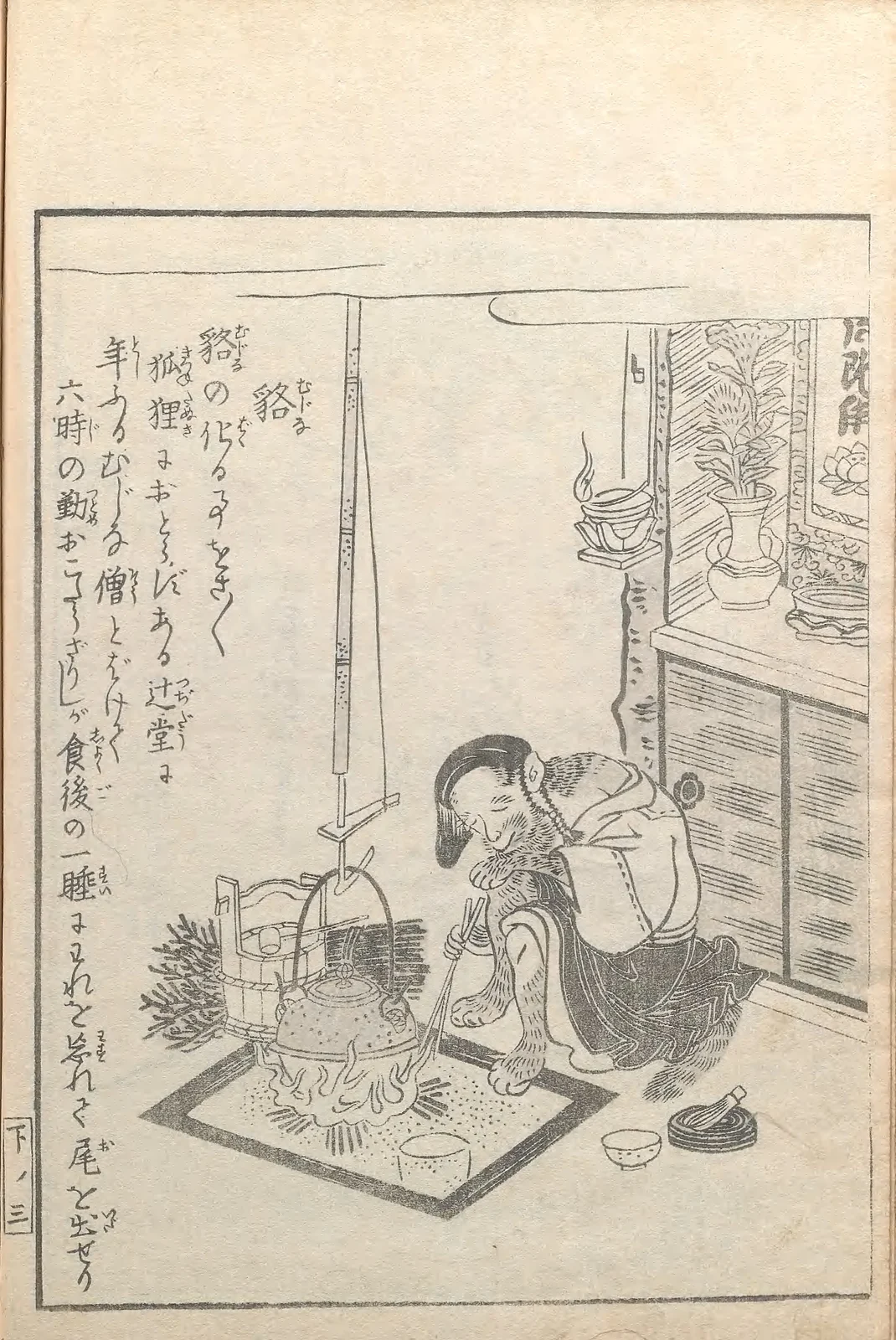
Mujina, named plate by Toriyama Sekien
Printed title貉 and actual illustration inspected. Description records visible composition, not an unchecked translation of cursive text.
Overview
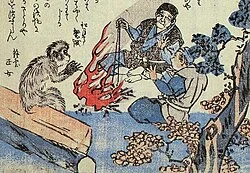
Sekien’s Mujina occupies a domestic hearth scene rather than an open forest. It wears a loose robe and kneels beside a suspended kettle above a small fire. The visible feet and a long tail expose an animal element beneath the human clothing. A religious alcove behind it contains a hanging panel, a flower vase and vessels. A scoop or ladle rests beside the hearth, while the figure seems absorbed in the kettle.
The printed label 貉 supplies the name for this animal taking a human household role. Its face, feet and tail remain visible despite the clothing. The combination offers a specific illustrated witness to an animal-like personification; it does not identify a named historical monk or establish the result of a particular encounter. Translating the name into one fixed modern zoological species would obscure that representational context.
Lafcadio Hearn’s “Mujina,” in Kwaidan, provides a markedly different named witness. At Kii-no-kuni-zaka in Tokyo, a merchant approaches a weeping woman beside a moat, believing she needs help. When she lowers her sleeve, her face lacks eyes, nose and mouth. He flees toward the reassuring light of a noodle seller. The seller then repeats the featureless-face revelation, and the light disappears.
The narrated transformation happens at the face. Hearn’s scene does not show an animal body emerging from the woman or vendor, and it does not identify them with the particular tailed figure beside Sekien’s kettle. The shared name therefore connects sources for comparison without making their pictured anatomy identical. A reader should retain the difference between an animal in human dress and an apparently human figure whose ordinary features vanish.
The two representations also organize fear differently. Sekien gives the viewer a settled interior in which human and animal details can be inspected together. Hearn makes attempted assistance and apparent companionship fail in succession, moving from the lonely moat to a roadside light. These are observations about the witnesses’ composition and narrative, not proof of an apparition’s historical existence. Full regional naming practices and zoological terminology remain outside this selected comparison.
Origins & earliest records
Toriyama Sekien includes the named illustration in Konjaku Gazu Zoku Hyakki, first published 1779. The inspected Smithsonian copy is a later historical edition; the first book appearance is not a claim of the earliest oral tradition.
Records & interpretation
Directly inspected historical illustration and printed name. Pictorial observations are distinguished from narrative claims that would require a separate checked text.
Selected bibliography
Documented works and useful reading. This is not a list of every appearance.
- 01
Konjaku Gazu Zoku Hyakki
Volume 3, IIIF canvas index 7 (zero-based); printed title 貉 directly inspected.
- 02
Kwaidan: Stories and Studies of Strange Things
“Mujina”; Kii-no-kuni-zaka, woman’s featureless face and noodle-seller revelation. Distinct from the animal-form plate.
Family & connections
A source-supported family tree or inspiration record has not yet been compiled for this profile. Related reading below indicates a connection in subject matter, not a proven lineage or creative influence.
Primary records and illustrations
Konjaku Gazu Zoku Hyakki
Volume3; Smithsonian Libraries copy. IIIF canvas index 7 (zero-based)
Printed title貉 and actual illustration inspected. Description records visible composition, not an unchecked translation of cursive text. Depth enrichment: named narrative sections directly read, with differences between witnesses retained.
Encyclopedia background
An additional attributed reference, separate from the editorial profile above.
Read the open encyclopedia overview
Mujina (Japanese: 貉) is an old Japanese term primarily referring to the Japanese badger, but traditionally to the Japanese raccoon dog (tanuki), causing confusion. Adding to the confusion, it may also refer to the introduced masked palm civet, and in some regions badger-like animals or Japanese raccoon dog are also called mami.
Text from Wikipedia contributors, “Mujina”. CC BY-SA 4.0. Extracted introduction; formatting changed. Retrieved 5 October 2026. The source article may have changed since retrieval.
References
Sources supporting this profile. Linked pages have their own scope and editorial standards.
- Institutional primary-book recordSmithsonian Libraries — historical illustrated volumeResearch access: 2026-10-05
- Direct primary illustrationNamed primary plate: 貉Research access: 2026-10-05
- Primary literary adaptation / named sectionKwaidan — “Mujina,” directly read primary narrativeResearch access: 2026-10-05
Image credits
Historical illustrationMujina, named plate by Toriyama Sekien
Printed title貉 and actual illustration inspected. Description records visible composition, not an unchecked translation of cursive text.