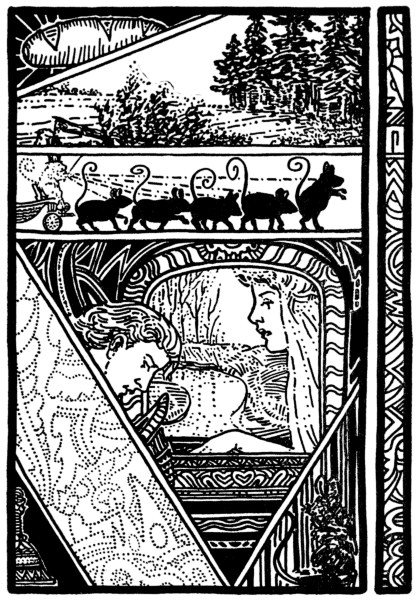
Mouse carriage and restored human princess in Van Everen’s1922 Forest Bride illustration
Van Everen combines the mouse-drawn nutshell carriage with the princess restored to human form, beckoning to Veikko. The caption identifies the later scene in Fillmore’s The Forest Bride; the mouse and human forms belong to successive stages of the enchantment.
Overview
Veikko’s father sends his three sons to find brides in the directions indicated by felled trees. Veikko’s tree points into the forest, where he meets a speaking mouse combing her whiskers in a hut. She asks to become his sweetheart, sings to cheer him and promises fidelity; he accepts despite his brothers’ anticipated mockery. When his father asks the prospective brides to bake bread, she summons mice with a silver bell and orders each to bring a grain of wheat. Her fine white loaf surpasses the rye and barley loaves brought by the older brothers.
For the second test she calls for fibres of flax. After her helpers prepare them, she weaves linen so fine that the folded cloth fits into a nutshell. Veikko then escorts her toward his father in a nutshell coach pulled by five black mice, with mouse coachman and footman. On a bridge, a stranger laughs at the procession and pushes it into the water. Veikko grieves what he believes is his sweetheart’s death, but a golden coach drawn by five horses emerges on the opposite bank with a human princess aboard.
She identifies herself as the same mouse and explains that the enchantment required both acceptance as a sweetheart and drowning by another human before it could end. The narrative provides no named enchanter or original offence. Veikko’s father blesses the pair, who marry in her kingdom. Fillmore’s final moral attributes the outcome to Veikko’s kindness rather than merely the fortunate direction of the tree. The text supplies a restored human princess without asserting a permanent death followed by a separate resurrection.
Origins & earliest records
Parker Fillmore, Mighty Mikko (1922), The Forest Bride, printed pp. 123–139; author’s note vii–xi.
Records & interpretation
Complete 1922 English retelling and collection note. Mouse form, speech, helpers, craft tests and stated release conditions are source-specific; the original Finnish narrative is not independently collated.
Selected bibliography
Documented works and useful reading. This is not a list of every appearance.
- 01
Mighty Mikko: The Forest Bride, pp. 123–139
Complete selected chapter. Author compares variants in his note but does not provide an individual Salmelainen source locator; caster of enchantment not named.
Family, evolution & connections
Veikko, youngest son of the farmer
After the enchantment ends, the princess and Veikko obtain his father’s blessing and marry in her kingdom. The account gives neither her royal parents nor children of their marriage.
The same princess before and after the enchantment
The restored princess identifies herself as Veikko’s former mouse sweetheart. Her mouse attendants are servants; the tale does not state that they are her relatives.
References
Sources supporting this profile. Linked pages have their own scope and editorial standards.
- Primary historical literary retelling of folkloreFillmore1922: The Forest BrideResearch access: 2026-10-05
Image credits
Historical illustrationMouse carriage and restored human princess in Van Everen’s1922 Forest Bride illustration
Van Everen combines the mouse-drawn nutshell carriage with the princess restored to human form, beckoning to Veikko. The caption identifies the later scene in Fillmore’s The Forest Bride; the mouse and human forms belong to successive stages of the enchantment.