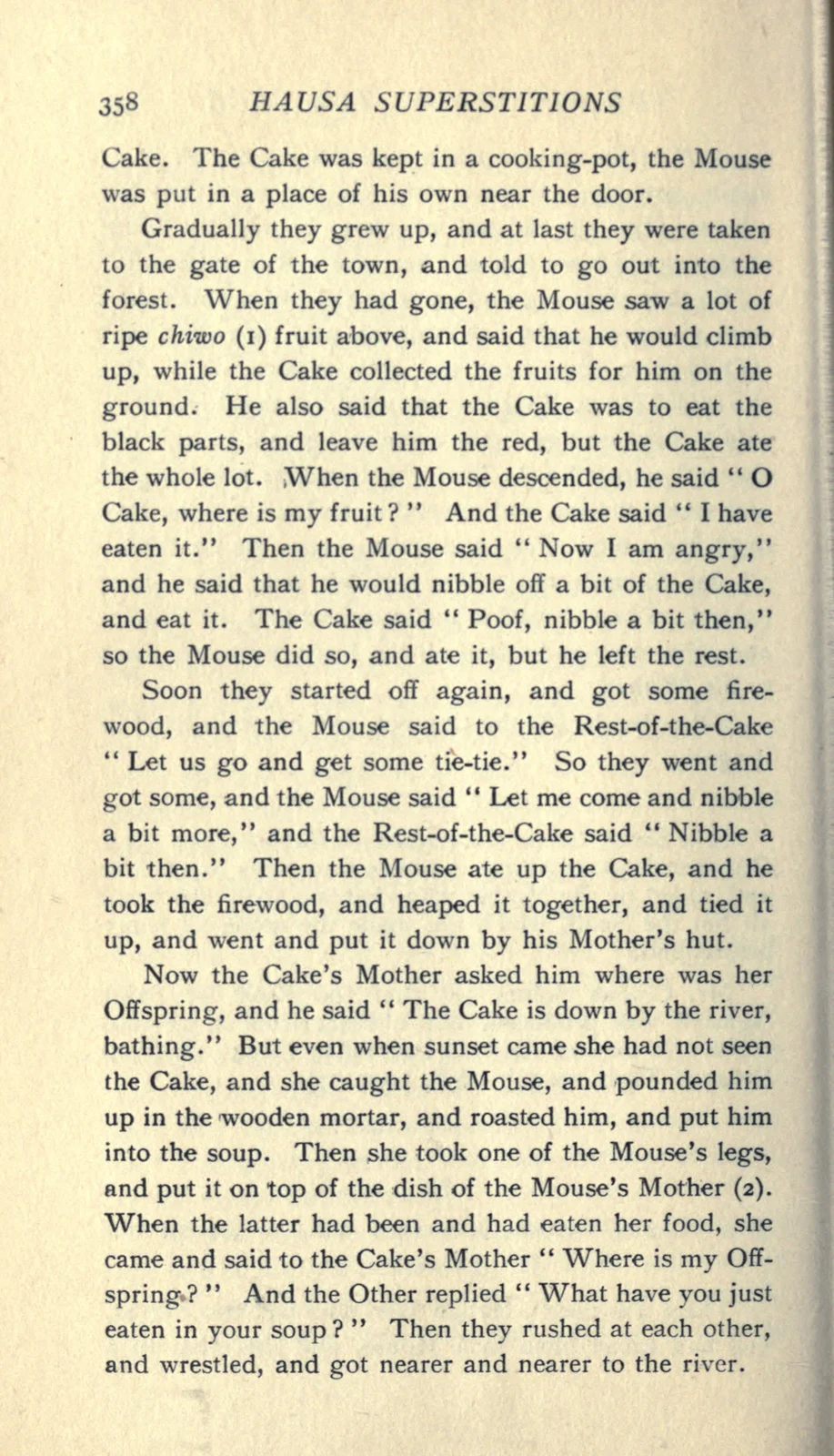
Mouse and Cake Offspring in the Hausa Tale:1913 documentary text page358; documentary source-page facsimile
Exact named narrative text facsimile, not a creature illustration. Printed page358; actual returned IIIF canvas403. Catalogue identifies1913 edition, author1877–1915, US NOT_IN_COPYRIGHT; historical translated text is life70 expired. Oral narrator attribution retained from profile. Actual scan directly inspected: exact named tale/episode text read, including printed page number and narrative features.
Overview
Two wives of one man have unusual offspring: a mouse and a cake. The cake is kept in a cooking pot, while the mouse has a place beside the door. They grow up and are sent together into the forest. Mouse climbs for ripe fruit and tells Cake to gather it below, eating only designated portions. Cake instead consumes everything. Angered, Mouse proposes nibbling part of his companion, and Cake dismissively permits it. The partially eaten being continues the journey as Rest-of-the-Cake, still speaking before a second permitted nibble consumes it completely.
Mouse carries their gathered firewood to his mother and tells Cake’s mother that her child is bathing at the river. When sunset brings no return, she kills Mouse and serves his body as food to his mother, making the truth evident afterward. The two mothers fight toward the river, where Spider cooks and eats both. The ending is a grim escalation from edible offspring through retaliatory household destruction. A printed variant involving Dog, Salt and Cake has a different sequence and reversal; it is a comparison rather than an additional identity or successful escape assigned to this consumed cake.
Origins & earliest records
Tremearne credits Sa(r)rikin Samari (S.S.), resolved from contents and introductory narrator key. Selected English translation records a narrative, not a historical birth or exact dated collection session.
Records & interpretation
Complete main tale 72, The Women whose Offspring were a Mouse and a Cake, pp 357–359 read directly. Explicit birth, speech, strength or embodied action supports admission; real species, clay anatomy and appended variant identities are not inferred.
Selected bibliography
Documented works and useful reading. This is not a list of every appearance.
- 01
Hausa Superstitions and Customs
Second edition; main tale 72, The Women whose Offspring were a Mouse and a Cake, pp 357–359
Family, evolution & connections
Mouse and Cake’s distinct mothers in Tremearne tale 72
Main tale 72, pp. 357–359, excluding the separately printed Dog/Salt/Cake comparison.
Scroll sideways to see all branches. With a keyboard, focus the tree and use the arrow keys.
- Two explicitly stated maternal branches (grouping, not an ancestor)
- Mouse’s unnamed mother
- Mouse
- Cake’s unnamed mother
- Cake
Each of the two wives is explicitly said to give birth to one offspring; later references identify each mother. The common husband is not separately asserted to father either child in this extracted topology. The root groups two maternal branches, not a shared ancestor. Partly eaten Cake remains the same child; Mouse and Cake are not real biological taxa.
Mouse’s unnamed mother in Tremearne tale 72
Tale 72 says one wife gives birth to Mouse and repeatedly identifies her as his mother. The animal child is a narrative character, not a modern rodent lineage.
Cake’s unnamed mother in Tremearne tale 72
The other wife gives birth to Cake, and the ensuing account explicitly identifies Cake’s mother. The edible child remains one individual when partly eaten; Rest-of-the-Cake is not an offspring.
References
Sources supporting this profile. Linked pages have their own scope and editorial standards.
- Collected primary narrative with named narrator attributionHausa Superstitions and Customs — tale 72, The Women whose Offspring were a Mouse and a Cake, pp 357–359Research access: 2026-10-05
Image credits
Historical text facsimileMouse and Cake Offspring in the Hausa Tale:1913 documentary text page358; documentary source-page facsimile
Exact named narrative text facsimile, not a creature illustration. Printed page358; actual returned IIIF canvas403. Catalogue identifies1913 edition, author1877–1915, US NOT_IN_COPYRIGHT; historical translated text is life70 expired. Oral narrator attribution retained from profile. Actual scan directly inspected: exact named tale/episode text read, including printed page number and narrative features.