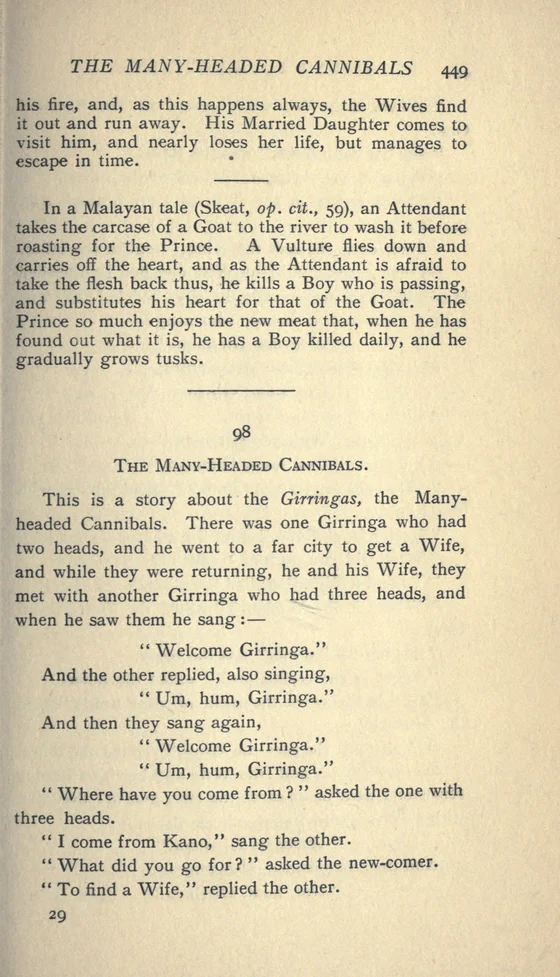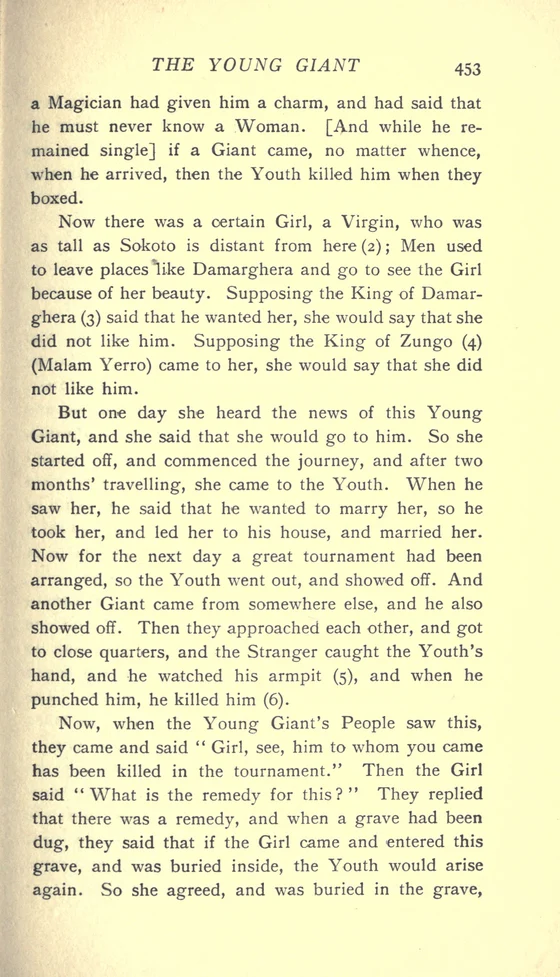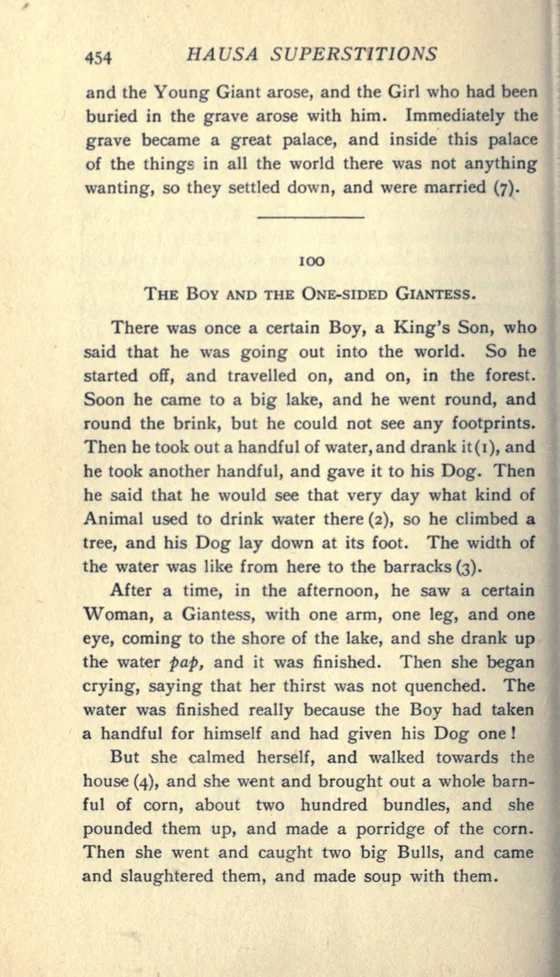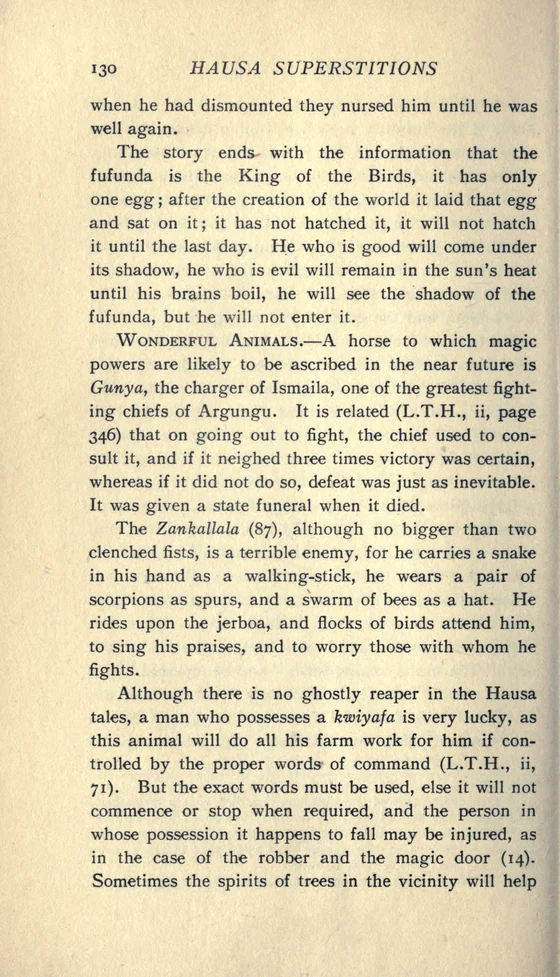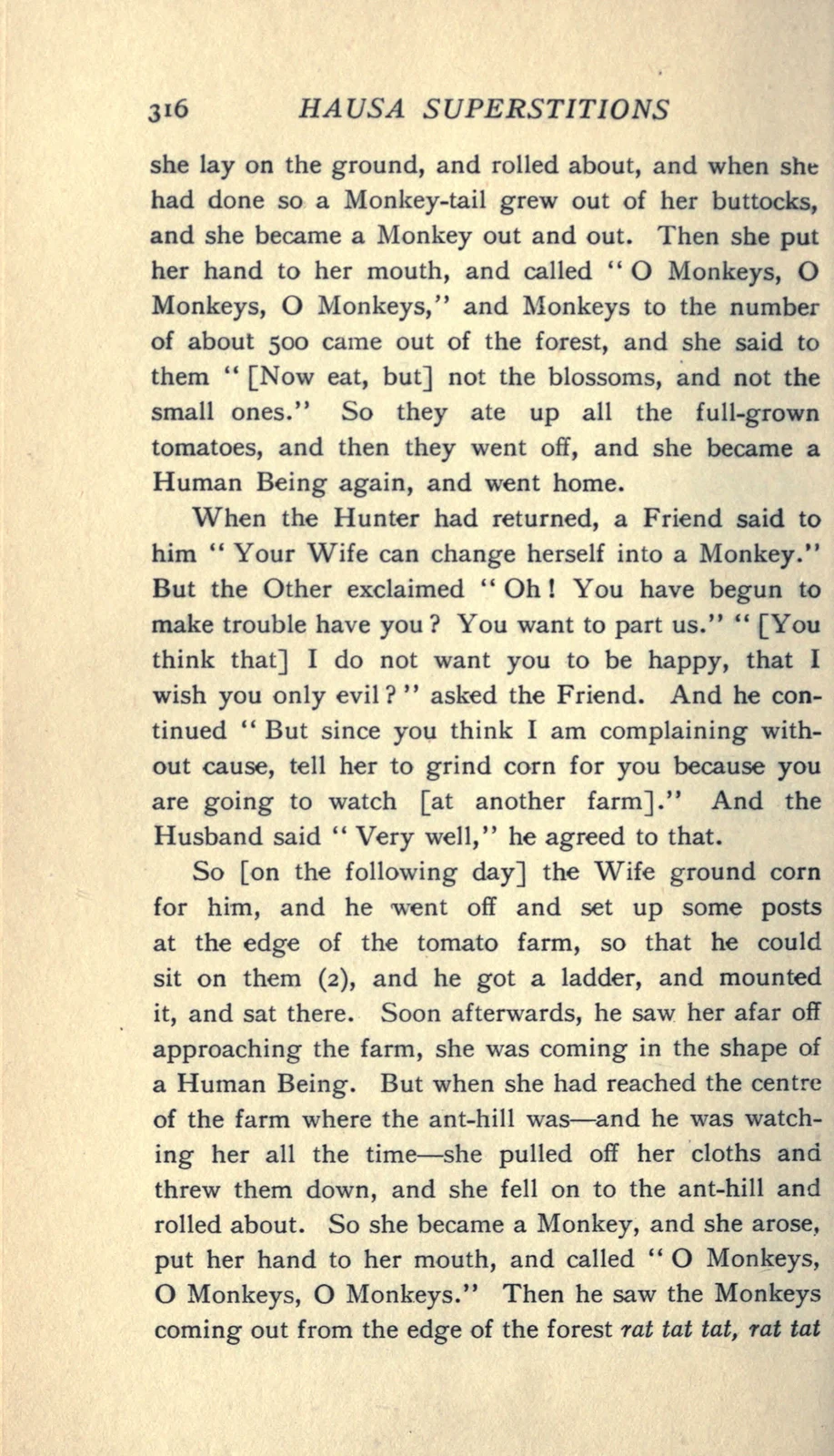
Monkey-Woman in the Hausa Tomato-Farm Tale:1913 documentary text page316; documentary source-page facsimile
Exact named narrative text facsimile, not a creature illustration. Printed page316; actual returned IIIF canvas359. Catalogue identifies1913 edition, author1877–1915, US NOT_IN_COPYRIGHT; historical translated text is life70 expired. Oral narrator attribution retained from profile. Actual scan directly inspected: exact named tale/episode text read, including printed page number and narrative features.
Overview
The hunter marries a widow who can change into a monkey and asks her to guard his tomato farm while he goes into the forest. Once alone, she places her clothes on an anthill, rolls on the ground and develops a monkey tail before becoming entirely animal. Calling with her hand to her mouth, she summons roughly five hundred monkeys from the forest. She directs them to eat the full-grown tomatoes while leaving blossoms and small fruit. After the raid she resumes human form, dresses and returns home, concealing the contradiction between her assigned guardianship and her leadership of the raiders.
A friend tells the husband what occurs, but he first interprets the warning as an attempt to break up their marriage. The friend proposes direct observation. The husband therefore builds a raised lookout beside the farm and watches the transformation, summoning and feeding repeat. After the troop leaves, she becomes a woman and puts her clothes on again. He follows her home and rejects her welcome, demanding that she leave. The tale’s exposure depends on witnessed bodily change rather than merely disliking an animal bride. A separate nearby story begins with a wife already called a female monkey; its feigned toothache episode is not silently substituted for this shapeshifting widow.
Origins & earliest records
Tale credited to Ba Gu(d)du (B.G.) in Tremearne’s contents; storyteller initials resolved by the introduction. Exact narrative collection session is unspecified. English translation and colonial collector mediation retained.
Records & interpretation
Complete main narrative 58, The Monkey-Woman, pp 315–317 directly read, including its conclusion. Appended variants and external comparisons remain separate. No modern monkey species or numerical anatomical measurement is inferred from the story.
Selected bibliography
Documented works and useful reading. This is not a list of every appearance.
- 01
Hausa Superstitions and Customs
Second edition; tale 58, The Monkey-Woman, pp 315–317
Family & connections
A source-supported family tree or inspiration record has not yet been compiled for this profile. Related reading below indicates a connection in subject matter, not a proven lineage or creative influence.
References
Sources supporting this profile. Linked pages have their own scope and editorial standards.
- Collected primary narrative with individual storyteller attributionHausa Superstitions and Customs — tale 58, The Monkey-Woman, pp 315–317Research access: 2026-10-05
Image credits
Historical text facsimileMonkey-Woman in the Hausa Tomato-Farm Tale:1913 documentary text page316; documentary source-page facsimile
Exact named narrative text facsimile, not a creature illustration. Printed page316; actual returned IIIF canvas359. Catalogue identifies1913 edition, author1877–1915, US NOT_IN_COPYRIGHT; historical translated text is life70 expired. Oral narrator attribution retained from profile. Actual scan directly inspected: exact named tale/episode text read, including printed page number and narrative features.