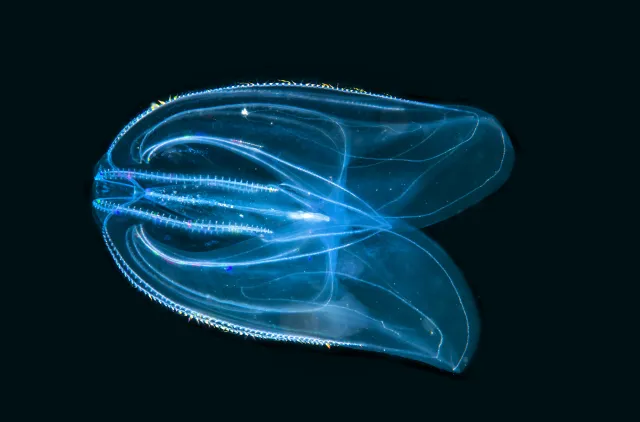
A translucent blue-lit Mnemiopsis leidyi against black water, showing two broad oral lobes and bright rainbow highlights along curved comb rows.
Mnemiopsis leidyi photographed by Erling Svensen / Ocean Photo. CC BY4.0, via Artsdatabanken. Blue illumination and iridescent comb rows belong to this photograph.
Overview
Mnemiopsis leidyi is a lobate ctenophore, or comb jelly. During its cydippid developmental stage, eight comb rows and paired tentacle structures surround a body organized between a mouth-bearing oral pole and an aboral sensory organ. It is an animal with muscular and nervous structures, rather than a jellyfish assigned to the cnidarian lineage. Pang and colleagues investigated its developing signalling system using adults collected around Woods Hole, Massachusetts, and embryos sampled from fertilization through the cydippid stage. Their study examines one developmental pathway; it does not treat the living species as an unchanged animal ancestor.
The researchers identified four Wnt ligand genes and several receptors and intracellular components of the Wnt/β-catenin pathway in the available genome. They also cloned selected sequences from embryo-derived material. Some expected components, including axin, were not recognized by their searches. This search result is bounded by the reference assembly, similarity thresholds and sequence divergence: failure to identify a familiar sequence is not equivalent to directly demonstrating that no protein could perform a comparable function. Sequence comparison also suggested unusual features in β-catenin, including missing recognizable transactivation motifs, but its ability to regulate transcription required further functional testing.
Whole-mount in situ hybridization located the relevant RNA transcripts across developmental stages. All four Wnt ligands became detectable relatively late, after gastrulation. Wnt9 appeared around three to four hours after fertilization in aboral regions that subsequently contributed to the tentacle bulb. Other Wnt expression occurred in the forming tentacle structures, the floor of the apical organ and the ciliated connections toward the comb rows. The spatial patterns suggested possible roles in later patterning or neural development, but expression in a region did not by itself demonstrate which cells received a signal or prove that the gene caused their developmental fate.
β-catenin transcripts were first detected around the oral region after the blastopore had already formed, whereas the Wnt ligands were concentrated mainly toward the opposite pole. The authors therefore questioned whether the pathway established the earliest body axis in the same way proposed for other animals. They explicitly could not exclude low transcript levels or maternally supplied protein acting before detectable expression. Protein localization and targeted functional experiments were needed to discriminate those alternatives. The study preserves a useful distinction between conserved molecular components, observed expression and demonstrated developmental function, without resolving the whole ctenophore position in the animal family tree.
Origins & earliest records
Selected embryos were obtained from Woods Hole adults; the study does not estimate the geographical or evolutionary origin of the species.
Evidence & interpretation
Genome searches, cloned sequences and staged transcript localization support molecular and expression comparisons. Search absence, early-axis function and inferred neural roles require separate testing.
Selected bibliography
Documented works and useful reading. This is not a list of every appearance.
- 01
Genomic insights into Wnt signaling in an early diverging metazoan, the ctenophore Mnemiopsis leidyi
EvoDevo 1:10, 4 October. Complete Background, receptor/expression Results, expression Discussion, Conclusions and Methods read; comparative ancestral-gene discussion not independently reviewed. CC BY2.0.
Family & connections
A source-supported family tree or inspiration record has not yet been compiled for this profile. Related reading below indicates a connection in subject matter, not a proven lineage or creative influence.
Look for a taxonomic record and classified relativesLocated primary passages
Specific passages supporting details in this entry, grouped by their published witness.
Primary source witness
2010 original article
- The authors searched a preliminary Mnemiopsis genome, cloned candidate transcripts and examined embryonic expression. They identified four Wnt ligands and many pathway components, while failing to identify axin and several familiar antagonists under their search criteria. Wnt transcripts appeared after gastrulation in domains associated with the aboral sensory organ and tentacle apparatus. These patterns motivate developmental hypotheses; they do not establish that canonical Wnt signaling specifies early body axes. Undetected maternal protein remains possible, and some gene-family assignments have weak or variable phylogenetic support.
No supplementary files, sequence reanalysis, experiment rerun or independent image inspection. Missing search hits are not unconditional proof of gene absence; this study does not settle the animal-tree branching order or represent every ctenophore.
References
Sources supporting this profile. Linked pages have their own scope and editorial standards.
- ResearchEmbryonic Wnt sequence and expression studyResearch access: 2026-10-06
Image credits
Whole organism photograph by Erling SvensenA translucent blue-lit Mnemiopsis leidyi against black water, showing two broad oral lobes and bright rainbow highlights along curved comb rows.
Mnemiopsis leidyi photographed by Erling Svensen / Ocean Photo. CC BY4.0, via Artsdatabanken. Blue illumination and iridescent comb rows belong to this photograph.