Mikoshi, named plate by Toriyama Sekien
Printed name 見越 and complete composition individually inspected at enlarged resolution. Actual URL copied from the IIIF manifest.
Overview
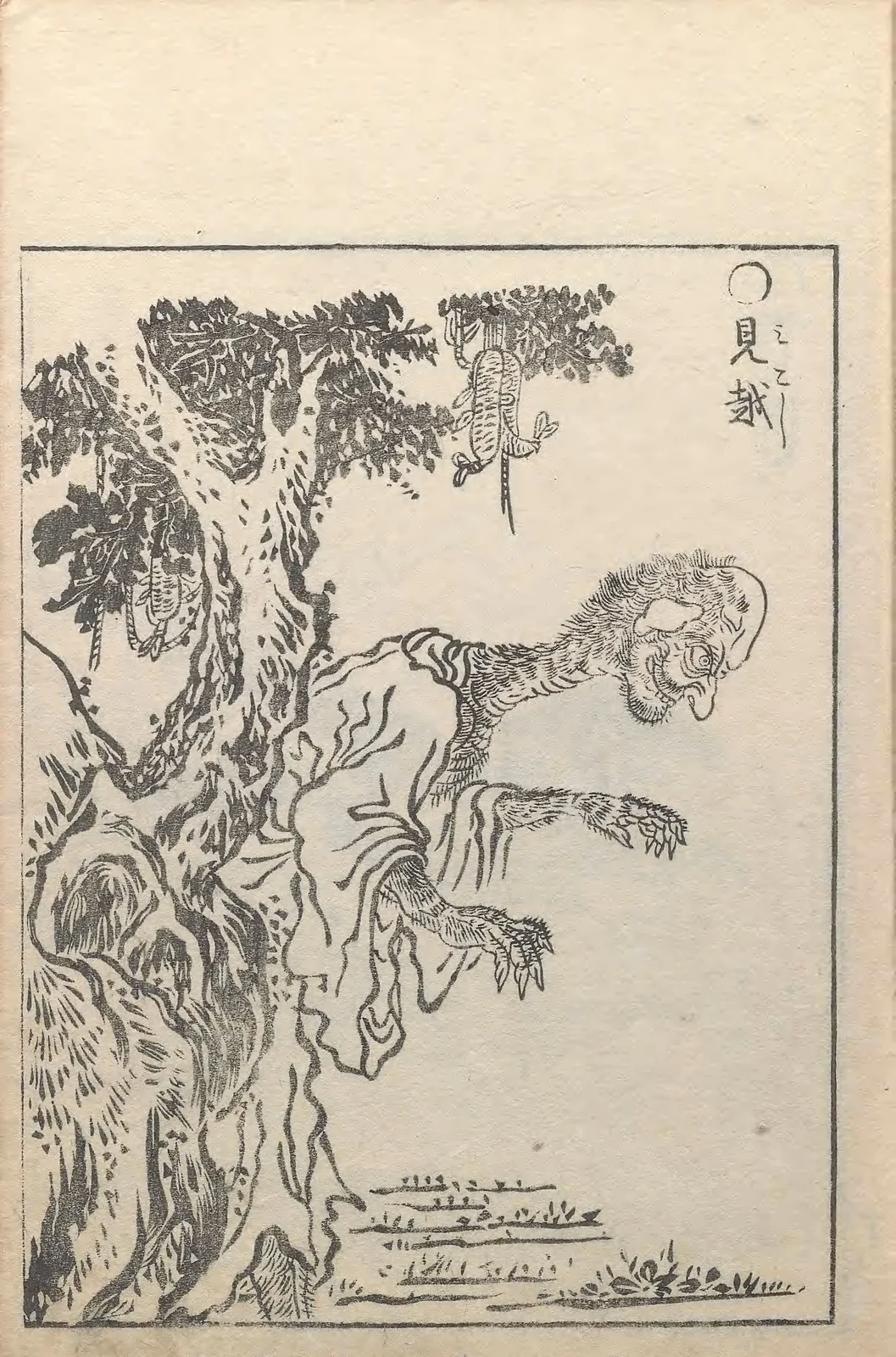
Mikoshi leans out beside a tree with an extraordinarily long, bent neck. A bald crown, bulging eye and a projecting tongue make the oversized face conspicuous. The lower body is wrapped in loose robes, but hairy forearms emerge from the sleeves and end in long pointed nails. The creature holds its hands before it while its neck extends beyond the normal proportions of the body. Small hanging objects occupy the tree branches above.
The printed name 見越 and its reading identify this particular apparition. The tree and low ground give a scale against which the stretched anatomy can be seen. The illustration does not show a human observer or a sequence in which the creature becomes taller. Its distinctive evidence is the combination of clothed body, hairy arms and elongated neck in one static image.
Origins & earliest records
Toriyama Sekien includes the named illustration in Gazu Hyakki Yagyō, first published in 1776. The inspected Smithsonian Libraries copy is the 1805 edition; publication is distinguished from the age of an oral tradition.
Records & interpretation
Printed title and composition individually inspected at enlarged resolution in the institutional digitization. Observations describe the historical image rather than an uncited encounter story.
Selected bibliography
Documented works and useful reading. This is not a list of every appearance.
- 01
Gazu Hyakki Yagyō
Volume 3; IIIF canvas index 6 (zero-based); printed name 見越.
Family & connections
A source-supported family tree or inspiration record has not yet been compiled for this profile. Related reading below indicates a connection in subject matter, not a proven lineage or creative influence.
Primary records and illustrations
Gazu Hyakki Yagyō
Volume 3; Smithsonian Libraries 1805 edition. IIIF canvas index 6 (zero-based)
Printed name 見越 and complete composition individually inspected at enlarged resolution. Actual URL copied from the IIIF manifest.
Encyclopedia background
An additional attributed reference, separate from the editorial profile above.
Read the open encyclopedia overview
A mikoshi (Japanese: 神輿) is a sacred religious palanquin (also translated as portable Shinto shrine). Shinto followers believe that it serves as the vehicle to transport a deity in Japan while moving between main shrine and temporary shrine during a festival or when moving to a new shrine. Often, the mikoshi resembles a miniature building, with pillars, walls, a roof, a veranda and a railing.
Often the Japanese honorific prefix o- (お) is added, making omikoshi (お神輿).
Text from Wikipedia contributors, “Mikoshi”. CC BY-SA 4.0. Extracted introduction; formatting changed. Retrieved 5 October 2026. The source article may have changed since retrieval.
References
Sources supporting this profile. Linked pages have their own scope and editorial standards.
- Institutional primary-book recordSmithsonian Libraries — historical illustrated volumeResearch access: 2026-10-05
- Direct primary illustrationNamed primary plate: 見越Research access: 2026-10-05
Image credits
Historical illustrationMikoshi, named plate by Toriyama Sekien
Printed name 見越 and complete composition individually inspected at enlarged resolution. Actual URL copied from the IIIF manifest.