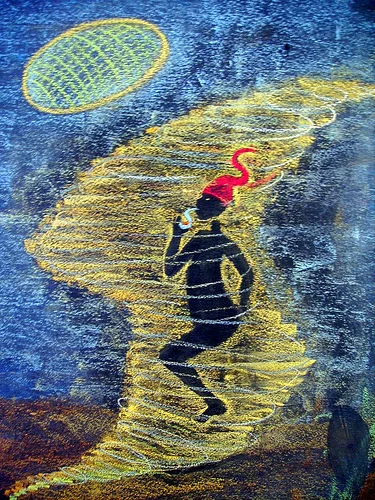
A sourced illustration has not yet been added. This gap is included in the coverage record.
Overview
In TV UFAM's Encantados account, a mysterious bird's piercing cry disturbs a household at night. A frightened resident promises tobacco, coffee or fish, and an elderly woman in dark clothing arrives in the morning to collect what was pledged. The retelling connects her with the bird and threatens spells when assistance is refused. Its sequence makes a nighttime disturbance the reason for a daytime obligation: what the resident promises in fear becomes something a recognizable visitor can claim. This is the university series' particular retelling, rather than an inventory of every Amazonian variant.
Frederico José de Santa-Anna Nery gives a different historical setting in Folk-lore brésilien, published in Paris in 1889. In chapter IV he recalls childhood fear of Matinta-Pereira in Pará: the broken, mournful calls of a small nocturnal bird were explained to children as an elderly woman's cry. He then describes a woman arriving in the morning to demand tobacco or sugarcane spirits, understood in the account as a payment to end her nocturnal visits. His framing racializes and disparages the women concerned and interprets their actions as an exploitation of fear. Those judgments belong to Nery's colonial-era explanation, not to this profile's description of real women. He also links the name to maty-tapérê and describes that figure as a small, limping dwarf; the linguistic derivation and identity are his claims, not independently verified conclusions. Compared with the UFAM adaptation, Nery's episode preserves a childhood urban setting and a different requested drink. A 2020 IHGP study situates such material in the author's racial and literary framing. The two witnesses share the call-and-collection pattern while leaving the collector's dwarf comparison and the later woman-to-bird transformation separately attributed.
Origins & earliest records
Nery's 1889 Folk-lore brésilien is now a directly inspected historical witness, not merely a title known through later research. Its Pará recollection does not establish the earliest oral record. TV UFAM's June 2016 adaptation supplies a later university retelling, and neither source dates the beginning of Matinta traditions.
Records & interpretation
The Nery passage was read directly in the archived original French OCR, chapter IV, including both the morning collection and the separate maty-tapérê comparison. The facsimile locators were independently checked as printed pages 58–59. The 2020 study contextualizes the collection; the TV UFAM episode's public description supplies the modern account.
In the literature
“un petit oiseau nocturne”
ChapterIV; p58; childhood bird cries
Nery recalls being frightened in Pará by a small nocturnal bird’s cries, explained by mothers as an old witch. Elderly beggars appear next morning requesting tobacco or cane spirit; the narrator treats them as exploiting the children’s fear. No actual bird-to-person change is witnessed in his account.
Selected bibliography
Documented works and useful reading. This is not a list of every appearance.
- 01
Encantados — Matinta Pereira
Modern university media retelling; claims checked against its public episode description.
- 02
Folk-lore brésilien
Chapter IV, pp. 58–59; directly read original French Pará childhood recollection and maty-tapérê comparison; page locators independently checked against facsimile.
Family & connections
A source-supported family tree or inspiration record has not yet been compiled for this profile. Related reading below indicates a connection in subject matter, not a proven lineage or creative influence.
Located primary passages
Specific passages supporting details in this entry, grouped by their published witness.
Folk-lore brésilien
F.-J. de Santa-Anna Nery, Folk-lore brésilien, Paris Perrin et Cie,1889 per IA/BnF catalogue metadata. Original title inspected; its damaged scan does not visibly establish year. ChapterIV selected narratives read in full; printed55, misprinted37 between56/58, and58 visually checked.
- Nery recalls being frightened in Pará by a small nocturnal bird’s cries, explained by mothers as an old witch. Elderly beggars appear next morning requesting tobacco or cane spirit; the narrator treats them as exploiting the children’s fear. No actual bird-to-person change is witnessed in his account.
ChapterIV; pp58–59; Pará childhood recollection and next-day demand
- Nery contrasts the city fear figure with his assertion that maty-tapérê in indigenous mythology is a little lame dwarf, and says the urban story is changing and disappearing. The proposed etymology and contrast are his interpretation, not an independently established identity across indigenous traditions.
Collector’s colonial framing and speculative etymology are not adopted as neutral facts. Selected narrative read; not entirebook. No songs or ritual formulas excerpted.
References
Sources supporting this profile. Linked pages have their own scope and editorial standards.
- ReferenceTV UFAM — Encantados series: Matinta PereiraResearch access: 2026-10-05
- ResearchCromotopia e História: Santa-Anna Nery and Afro-Indigenous folkloreResearch access: 2026-10-05
- ResearchSanta-Anna Nery 1889: Folk-lore brésilien, chapter IVResearch access: 2026-10-05
Image credits
A sourced illustration has not yet been added. This gap is included in the coverage record.