Mapinguari
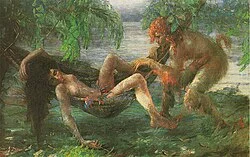
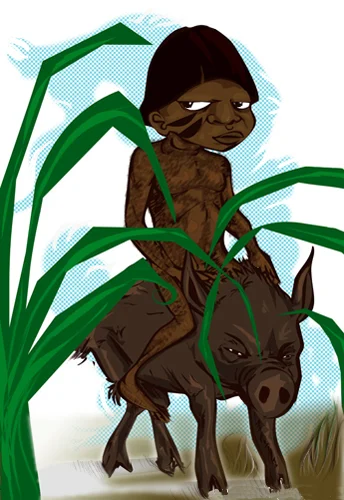
Image associated with the exact linked encyclopedia article; consult credited file description for its interpretation.
Overview
TV UFAM's Encantados retelling presents Mapinguari as a huge forest creature that knocks down trees and frightens hunters and workers. A disturbing roar draws a victim toward its sharp-toothed mouth, unusually placed in the stomach. The production places the being within stories told about the forest and river margins, while making its own choices about which visual and dramatic features to emphasise.
A Museu da Pessoa oral-history record, titled O mapinguari, preserves Roberto Carlos Dias dos Anjos's individual discussion of the figure. An interview and a produced university video are different kinds of witness: one should not silently substitute for the other. This profile therefore retains a specific attributed appearance and a named storyteller's contribution, without claiming that all Amazonian peoples share it or that a surviving prehistoric animal has been scientifically identified.
Valdir Vegini and Rebecca Louize Vegini publish a separate Kujubim witness recorded during the people’s December 2013 assembly at Costa Marques. Their anonymous speaker describes a tall, long-haired being with one forehead eye, large hands and a toothed mouth at the navel. It can hunt whenever it senses a person nearby. Yet the account’s final emphasis is auditory: relatives hear its terrifying cry and flee without seeing it. This distinction between described appearance and the reported experience should remain visible. The authors explain that recordings were adapted into standard written Brazilian Portuguese and that speakers’ names were withheld. The witness therefore identifies a community and recording occasion, while preserving the published narrator anonymity.
Origins & earliest records
The sources provide accessible modern witnesses rather than an established first attestation. Encantados was published by TV UFAM in June 2016; the museum record supplies a named oral-history contribution. These publication records cannot date the beginning of Mapinguari storytelling, identify one inventing community, or establish a prehistoric zoological origin for the figure.
Records & interpretation
The TV UFAM episode page explicitly supports the giant size, forest destruction, roar and stomach mouth in that retelling. The Museu da Pessoa indexed record identifies the storyteller and narrative topic; its full page returned an access denial during this research. No claim of a verified animal sighting or universal Indigenous anatomy follows from either witness. Vegini and Vegini’s complete section 4.9 and recording-method passages were read; this Kujubim witness is separate from the inaccessible museum interview.
Selected bibliography
Documented works and useful reading. This is not a list of every appearance.
- 01
Encantados — Mapinguari
University media adaptation; episode page inspected, video not claimed as watched.
- 02
O mapinguari
Named storyteller's account; indexed record verified, full interview page inaccessible.
- 03
Narrativas da tradição oral kujubiniana: memória, identidade e cultura
Revista Exitus 7(1), section 4.9 and recording context. DOI 10.24065/20177id190.
Family & connections
A source-supported family tree or inspiration record has not yet been compiled for this profile. Related reading below indicates a connection in subject matter, not a proven lineage or creative influence.
Encyclopedia background
An additional attributed reference, separate from the editorial profile above.
Read the open encyclopedia overview
The Mapinguari or Mapinguary is a cryptid from Brazilian folklore. The Mapinguari is often described as an extremely foul-smelling, hairy animal that is distinct from the North American Bigfoot. Descriptions further allege that the cryptid is a man-eating creature with hook-shaped nails, backwards-facing feet, a bipedal gait, a gaping mouth in its abdomen, and a single eye like the mythological Cyclops.
Text from Wikipedia contributors, “Mapinguari”. CC BY-SA 4.0. Extracted introduction; formatting changed. Retrieved 5 October 2026. The source article may have changed since retrieval.
References
Sources supporting this profile. Linked pages have their own scope and editorial standards.
- ReferenceTV UFAM — Encantados: MapinguariResearch access: 2026-10-05
- MuseumMuseu da Pessoa — Roberto Carlos Dias dos Anjos: O mapinguariResearch access: 2026-10-05
- ResearchVegini and Vegini — Kujubim narrativesResearch access: 2026-10-05
Image credits
Reference illustrationMapinguari
Image associated with the exact linked encyclopedia article; consult credited file description for its interpretation.