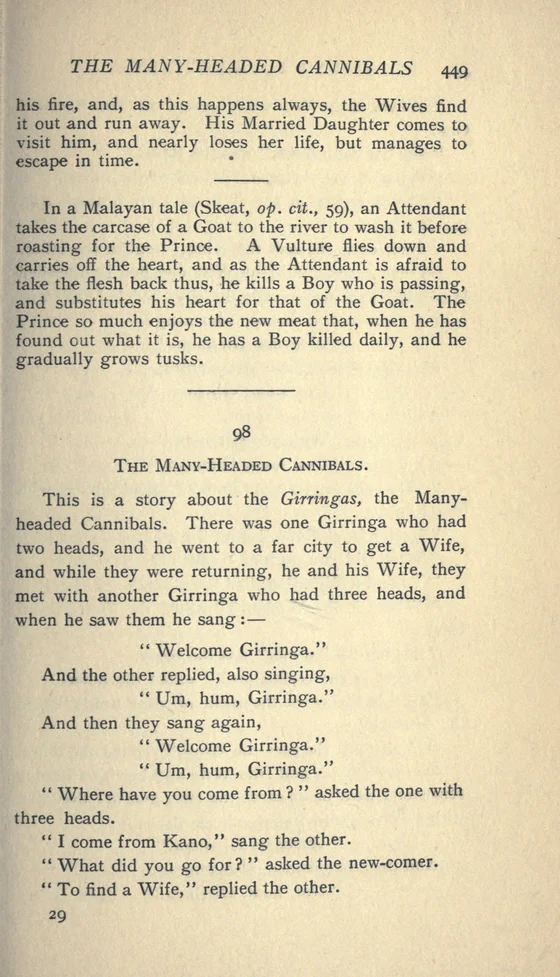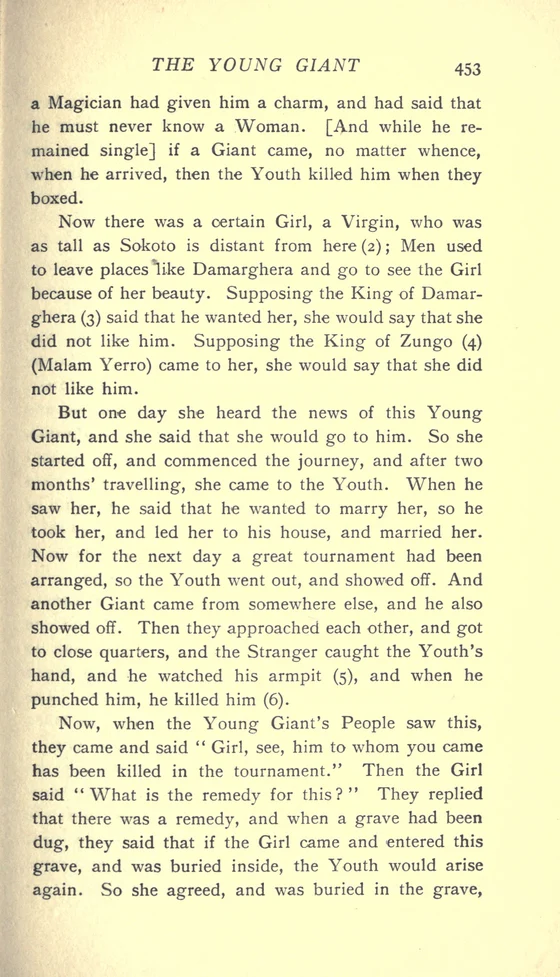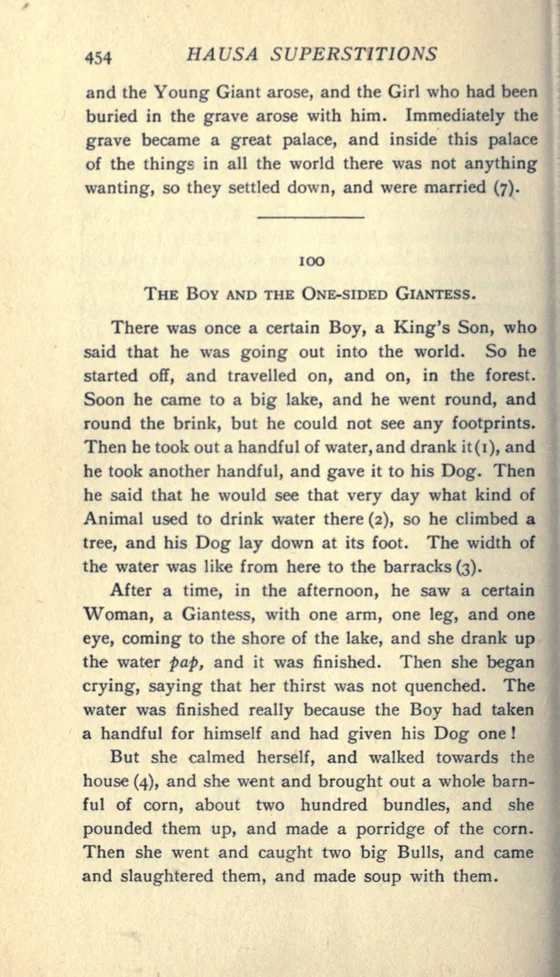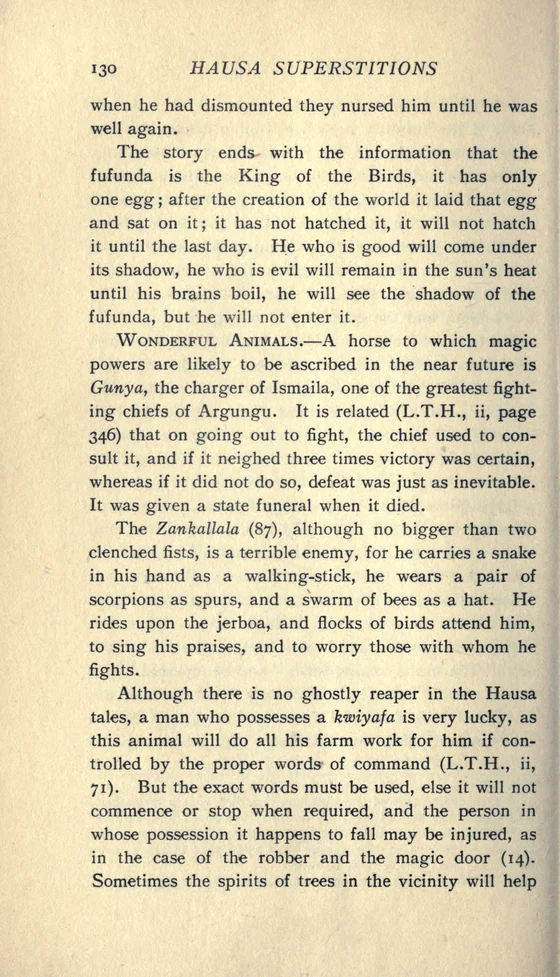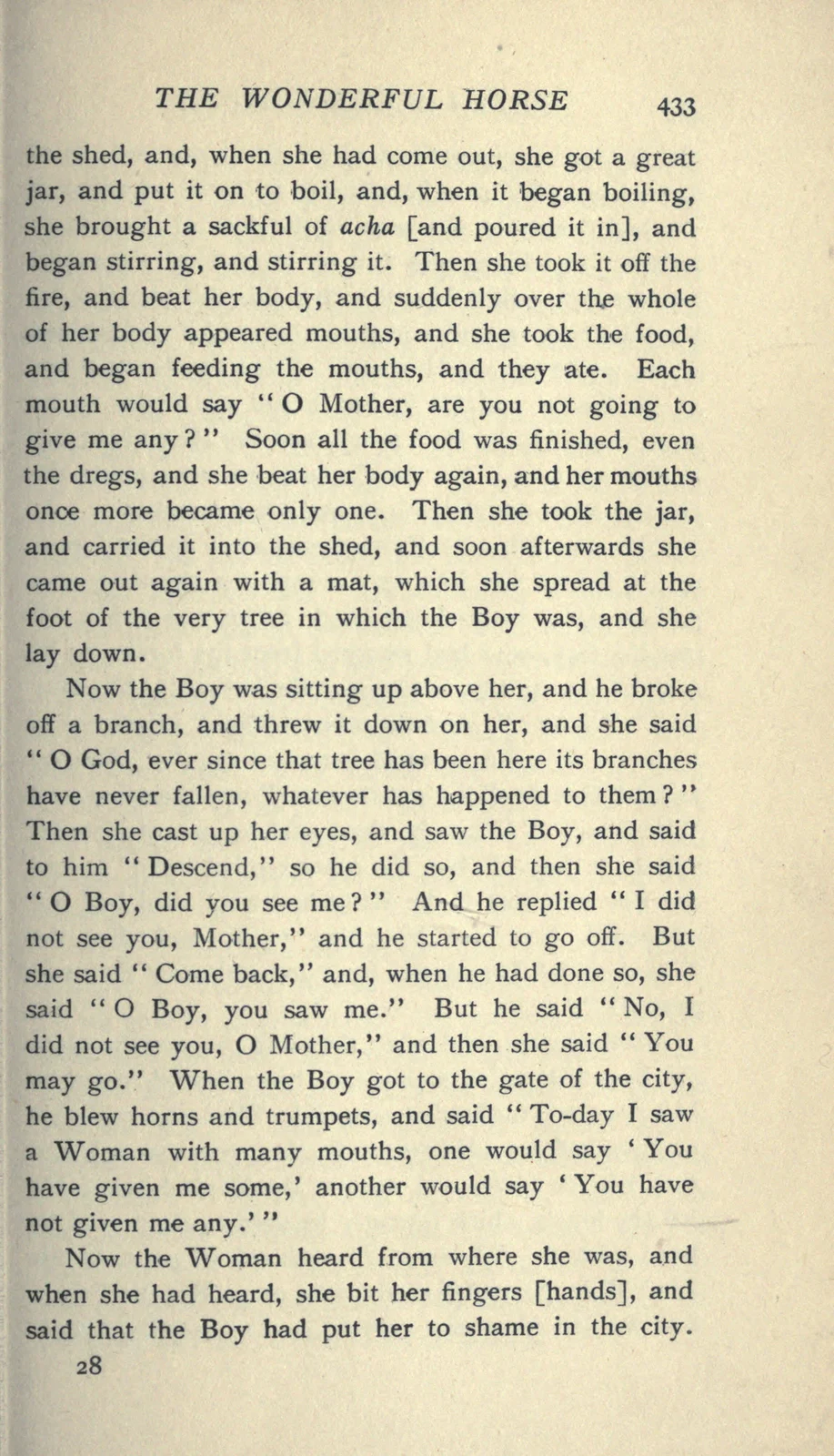
Many-mouthed Woman in the Hausa Hunter Tale:1913 documentary text page433; documentary source-page facsimile
Exact named narrative text facsimile, not a creature illustration. Printed page433; actual returned IIIF canvas484. Catalogue identifies1913 edition, author1877–1915, US NOT_IN_COPYRIGHT; historical translated text is life70 expired. Oral narrator attribution retained from profile. Actual scan directly inspected: exact named tale/episode text read, including printed page number and narrative features.
Overview
A young hunter watches a woman preparing a large pot of acha in a forest shed. After striking her body, she develops mouths over its surface and feeds them individually; each demands its share. Another blow reduces them to one mouth again. She questions the hidden witness, accepts his denial and lets him leave, but hears him announce her secret at the city gate. Transforming into a beautiful woman, she offers marriage to whoever can open a lidded basket with a thrown stone. The hunter succeeds. As his new wife, she tries to make him abandon horse, sword and protective equipment before traveling to her own distant home.
The attempted disarming is staged through ordinary-looking objections. She asks about the hunter's charms during their conversation, but his father stops him from revealing them. When departure comes, she accuses him in turn of intending to kill her with his horse, cut her with his sword and use his water-gourds for a charm against her. He leaves each item until his father insists that he take everything. During the journey she leads him past the very shed where he first saw her mouths, and he admits recognizing it. Six days later he no longer knows the surroundings; they finally arrive after ten days. For three days only the pair occupies the remote settlement, making her nighttime tooth-sharpening a threat from the person on whom his welcome depends.
There she prepares to consume him, sharpening her teeth at night, but his horse’s warning interrupts the attempt. A request for water in a basket buys time for escape; she eventually uses a charm to retain the water, discovers the flight and pursues. After the horse carries him to safety and dies from her attacks, she returns as a mass of flowers, then as a rideable horse that becomes wind and tries to carry him upward. He escapes by holding a branch. Her final disguise is a remarkable sword. Testing it against his own blade exposes her; his dogs consume her body and lick up the scattered blood. These successive traps turn apparent beauty, useful objects and attractive experiences into dangers.
Origins & earliest records
Tremearne credits Sa(r)rikin Samari (S.S.) in the contents, with initials resolved by the introduction/preliminary correction. His general 1908–1909 collection dates are not an exact session date for this narrative.
Records & interpretation
Complete main narrative 95, The Boy, the Witch, and the Wonderful Horse, pp 432–440 directly read. Appended comparative variants are not merged into these events. The title is an editorial locator where the narrative supplies no personal name; classification of spirit or animal forms follows explicit actions rather than modern zoological identification.
Selected bibliography
Documented works and useful reading. This is not a list of every appearance.
- 01
Hausa Superstitions and Customs
Second edition; tale 95, The Boy, the Witch, and the Wonderful Horse, pp 432–440
Family & connections
A source-supported family tree or inspiration record has not yet been compiled for this profile. Related reading below indicates a connection in subject matter, not a proven lineage or creative influence.
References
Sources supporting this profile. Linked pages have their own scope and editorial standards.
- Collected primary narrative with narrator attributionHausa Superstitions and Customs — tale 95, The Boy, the Witch, and the Wonderful Horse, pp 432–440Research access: 2026-10-05
Image credits
Historical text facsimileMany-mouthed Woman in the Hausa Hunter Tale:1913 documentary text page433; documentary source-page facsimile
Exact named narrative text facsimile, not a creature illustration. Printed page433; actual returned IIIF canvas484. Catalogue identifies1913 edition, author1877–1915, US NOT_IN_COPYRIGHT; historical translated text is life70 expired. Oral narrator attribution retained from profile. Actual scan directly inspected: exact named tale/episode text read, including printed page number and narrative features.