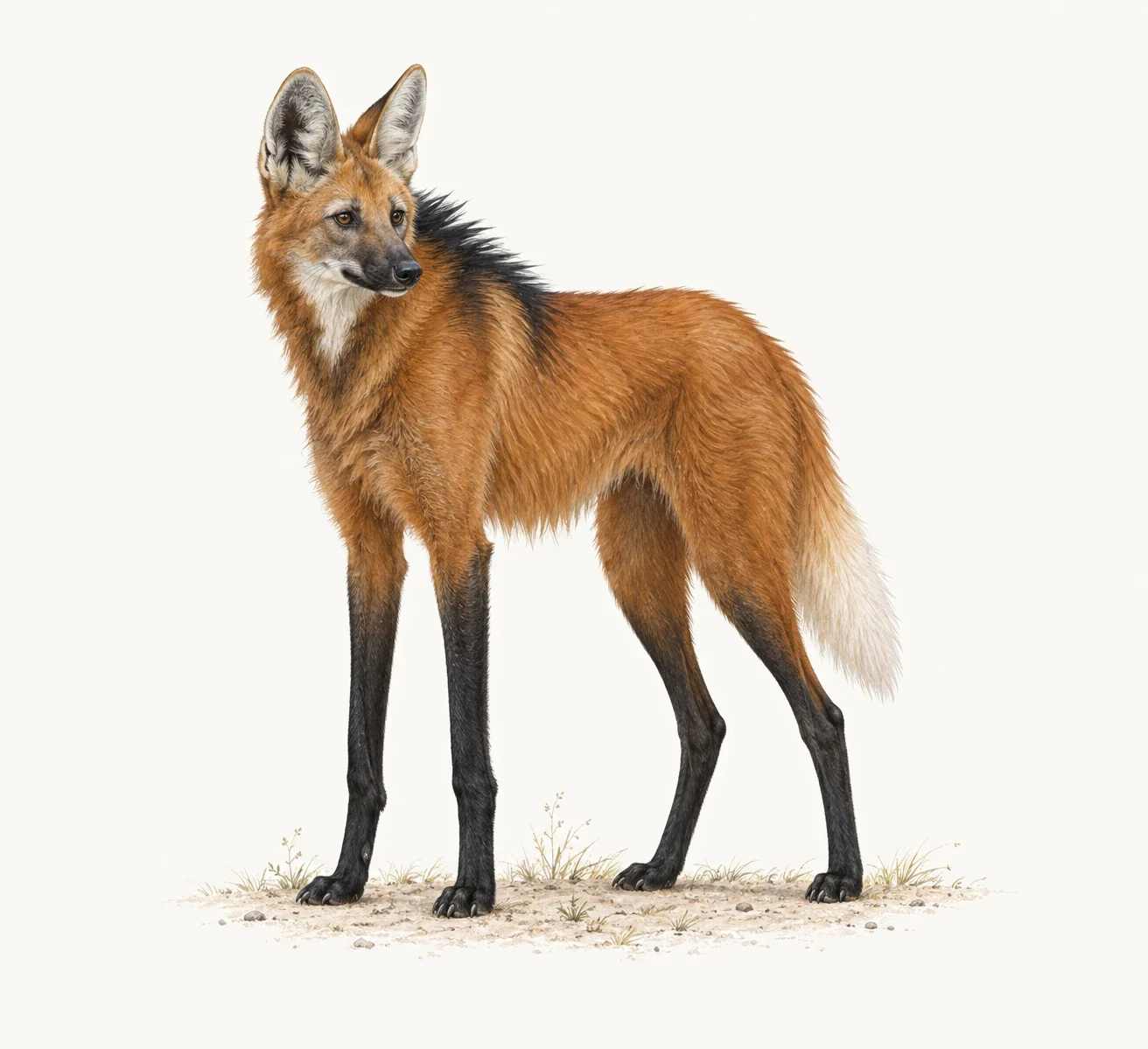
Maned wolf - AI-generated scientific interpretation.
Modern AI-generated scientific illustration. Diagnostic external features follow the selected sources; pose, individual pattern and fine details are interpretive. Not photography or independent anatomical evidence.
Overview
The maned wolf has long black legs, a russet body, tall ears and a dark mane across the neck and shoulders. Its proportions help it move through tall vegetation. The name wolf and foxlike face are familiar comparisons, but the species occupies its own genus within Canidae.
Fruit and small animal prey both contribute to feeding. This mixed diet distinguishes it from a generalized image of a large pack-hunting wolf. Scent marking and loud calls also contribute to communication, while most of the institutional account's reproductive measurements come from animals in human care.
A 2022 comparative genomic study used whole-genome sequences to investigate South American canid history and adaptation. It treated the maned wolf and bush dog as sister species with conspicuously different body forms. A long-legged solitary forager and a shorter, very different canid can be close relatives despite the contrast in silhouette.
Genomic relationships do not demonstrate that one living species evolved directly from the other. They imply a shared ancestral branch within the study's sampled history. Candidate adaptations, reconstructed demographic histories and present-day behaviour are different kinds of results, so neither a genome nor a zoo observation is used here to assign a precise evolutionary birthday or current population count.
Origins & earliest records
Chrysocyon brachyurus is the living maned wolf. Its placement in the South American canid radiation is supported by genomic comparison; the date of a publication does not date the origin of its distinctive legs.
Evidence & interpretation
The Smithsonian supplies morphology and a bounded behavioural account. The 2022 primary comparative-genomic account supports the maned wolf–bush dog relationship. Detailed molecular mechanisms and universal diet percentages are not inferred.
Selected bibliography
Documented works and useful reading. This is not a list of every appearance.
- 01
Maned wolf
Selected bibliography; bounded evidence and study-specific limitations retained.
- 02
Comparative genomics uncovers the evolutionary history, demography, and molecular adaptations of South American canids
Selected bibliography; bounded evidence and study-specific limitations retained.
Family, evolution & connections
Taxonomic classification
A hierarchy of classified groups, not a chain of direct ancestors.
Source note: Distinct genus does not mean unrelated to all other wolves or foxes: it remains a canid. Sister-species language denotes shared ancestry, not direct descent from the living bush dog.
- kingdomAnimalia
- phylumChordata
- classMammalia
- orderCarnivora
- familyCanidae
- genusChrysocyon
- speciesChrysocyon brachyurus
References
Sources supporting this profile. Linked pages have their own scope and editorial standards.
- InstitutionalManed wolfResearch access: 2026-10-10
- ResearchComparative genomics uncovers the evolutionary history, demography, and molecular adaptations of South American canidsResearch access: 2026-10-10
Image credits
AI-generated scientific interpretationManed wolf - AI-generated scientific interpretation.
Modern AI-generated scientific illustration. Diagnostic external features follow the selected sources; pose, individual pattern and fine details are interpretive. Not photography or independent anatomical evidence.