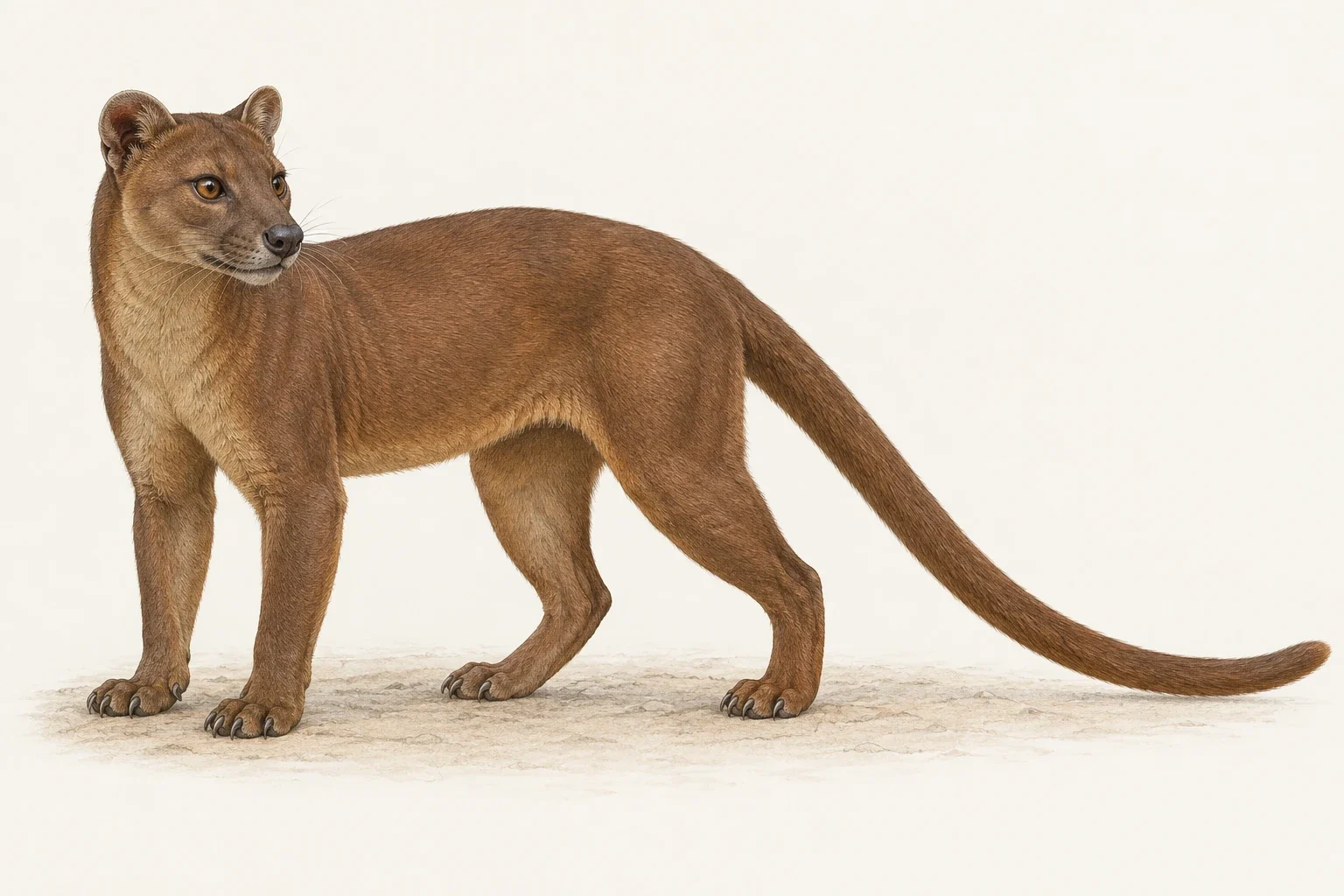
Fossa - AI-generated scientific interpretation.
Modern AI-generated scientific illustration. Diagnostic external features follow the selected sources; pose, individual pattern and fine details are interpretive. Not photography or independent anatomical evidence.
Overview
The fossa combines a slender muscular body, short brown coat, small rounded ears and an exceptionally long tail. Clawed paws and a catlike outline can make a first impression misleading. The San Diego Zoo account places it in Eupleridae, the family of Malagasy carnivorans, rather than Felidae.
The species is endemic to Madagascar and hunts in forest environments. Its long tail contributes to balance, connecting external form with climbing. The visible similarity to cats is not a test of common ancestry: body shapes can resemble one another where animals face comparable demands.
Yoder and colleagues tested the relationships of Malagasy carnivorans using multiple genes in 2003. Their analysis supported a monophyletic island radiation derived from an African ancestor, replacing classifications that had scattered superficially different Malagasy forms among separate families. This result concerns shared ancestry; it does not document an observed crossing of the ocean.
An ancestral colonization is an inference from phylogeny and biogeography. It should remain distinct from the naming of Cryptoprocta ferox and from the life of an individual fossa. The generated illustration selects a conservative adult outline and brown coat; exact hair colour, posture and tail curve are artistic decisions rather than new evidence about the lineage.
Origins & earliest records
Cryptoprocta ferox belongs to the Malagasy carnivoran radiation. The selected primary analysis supports a single ancestral colonization hypothesis without establishing a precise first-appearance date for this living species.
Evidence & interpretation
Zoo observations document external form. The 2003 primary multi-gene analysis supports monophyly and biogeographic interpretation. Resemblance to a cat is treated as a comparison of form rather than a molecular relationship.
Selected bibliography
Documented works and useful reading. This is not a list of every appearance.
- 01
Fossa
Selected bibliography; bounded evidence and study-specific limitations retained.
- 02
Single origin of Malagasy Carnivora from an African ancestor
Selected bibliography; bounded evidence and study-specific limitations retained.
Family, evolution & connections
Taxonomic classification
A hierarchy of classified groups, not a chain of direct ancestors.
Source note: Current family placement follows the institutional account, with the primary molecular analysis explaining why superficial resemblance is insufficient. The common name fossa must not be confused with the genus Fossa of the Malagasy civet.
- kingdomAnimalia
- phylumChordata
- classMammalia
- orderCarnivora
- familyEupleridae
- genusCryptoprocta
- speciesCryptoprocta ferox
References
Sources supporting this profile. Linked pages have their own scope and editorial standards.
- InstitutionalFossaResearch access: 2026-10-10
- ResearchSingle origin of Malagasy Carnivora from an African ancestorResearch access: 2026-10-10
Image credits
AI-generated scientific interpretationFossa - AI-generated scientific interpretation.
Modern AI-generated scientific illustration. Diagnostic external features follow the selected sources; pose, individual pattern and fine details are interpretive. Not photography or independent anatomical evidence.