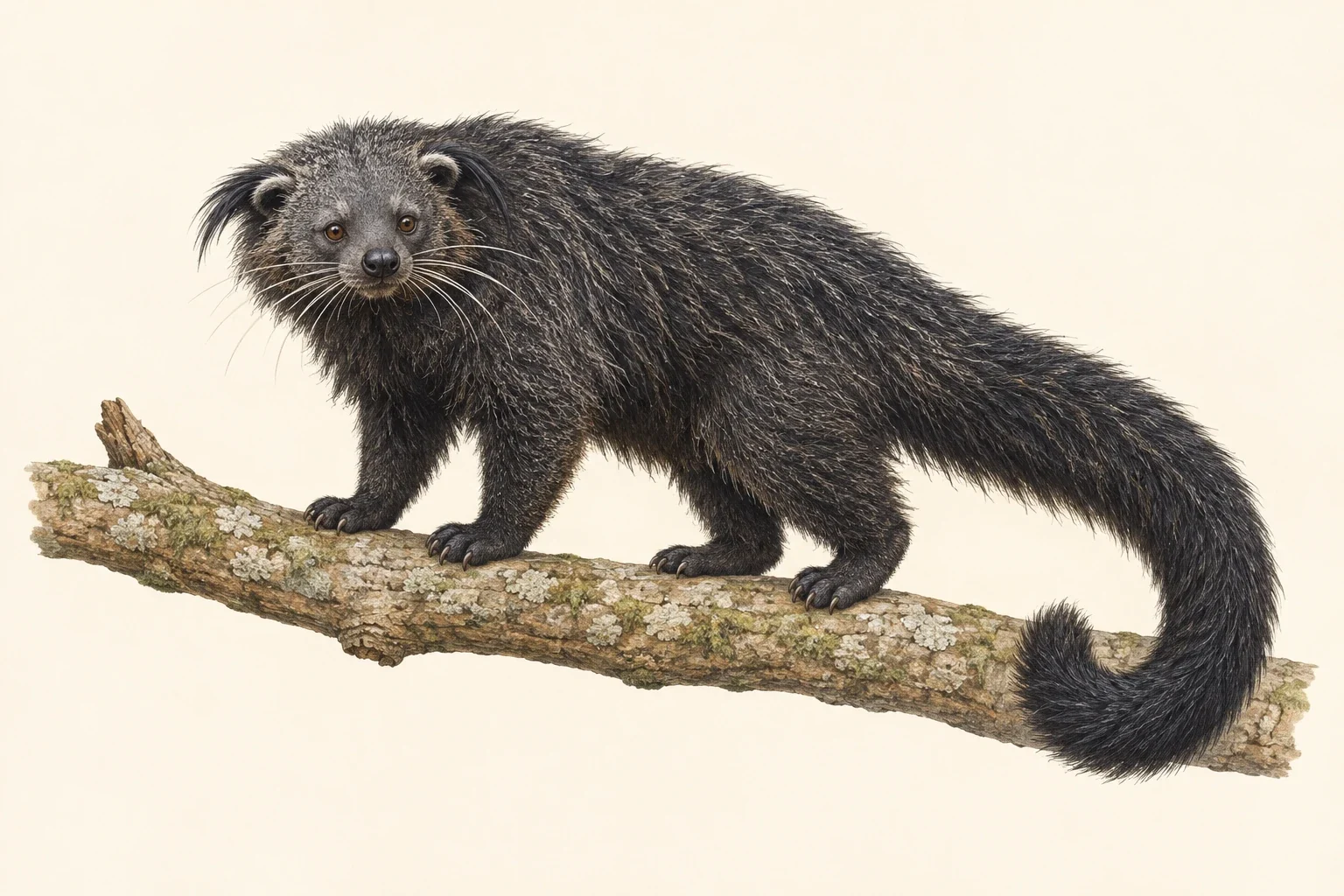
Binturong - AI-generated scientific interpretation.
Modern AI-generated scientific illustration. Diagnostic external features follow the selected sources; pose, individual pattern and fine details are interpretive. Not photography or independent anatomical evidence.
Overview
The binturong has a low, muscular body covered in shaggy dark fur, small tufted ears and conspicuous pale whiskers. It places the whole sole on the supporting surface and uses a strong prehensile tail while climbing. The nickname bearcat describes an impression of its appearance; it does not place the animal among bears or cats.
Fruit is an important part of its diet despite its placement in Carnivora. Smaller animals and other foods also occur in the institutional account. An order name records evolutionary relationships rather than requiring every member to eat only meat, and arboreal climbing does not make the animal a primate.
Greene and colleagues investigated the familiar popcorn-like scent in 2016. Chemical analyses of urine from 33 animals identified 2-acetyl-1-pyrroline in every sampled individual, with greater abundance in males and an association with an androgen measure. Its occurrence is an analytical result; the suggestion that scent conveys sex or reproductive information remains a functional interpretation.
How the aroma is produced requires separate evidence. The researchers discussed possible interactions with microorganisms rather than demonstrating that binturongs heat their bodies to the temperatures used in cooking. The sample came from managed animals, so its chemical findings should not be treated as an exhaustive survey of wild populations.
Origins & earliest records
The living species is Arctictis binturong, the sole species of its genus in the institutional account. Scientific recognition and the 2016 scent study are separate from the older evolutionary origin of the lineage.
Evidence & interpretation
External anatomy is documented by the Smithsonian account. The primary Duke publication abstract and the research team's report document sample scope and urinary chemical results. Production pathways and communicative functions are not treated as experimentally settled.
Selected bibliography
Documented works and useful reading. This is not a list of every appearance.
- 01
Binturong
Selected bibliography; bounded evidence and study-specific limitations retained.
- 02
Reproductive endocrine patterns and volatile urinary compounds of Arctictis binturong: discovering why bearcats smell like popcorn
Selected bibliography; bounded evidence and study-specific limitations retained.
- 03
Why Bearcats Smell Like Buttered Popcorn
Selected bibliography; bounded evidence and study-specific limitations retained.
Family, evolution & connections
Taxonomic classification
A hierarchy of classified groups, not a chain of direct ancestors.
Source note: Viverridae placement follows the named species. Erroneous generic spelling and loose family examples on a public page are not used to reclassify other carnivorans.
- kingdomAnimalia
- phylumChordata
- classMammalia
- orderCarnivora
- familyViverridae
- genusArctictis
- speciesArctictis binturong
References
Sources supporting this profile. Linked pages have their own scope and editorial standards.
- InstitutionalBinturongResearch access: 2026-10-10
- ResearchReproductive endocrine patterns and volatile urinary compounds of Arctictis binturong: discovering why bearcats smell like popcornResearch access: 2026-10-10
- InstitutionalWhy Bearcats Smell Like Buttered PopcornResearch access: 2026-10-10
Image credits
AI-generated scientific interpretationBinturong - AI-generated scientific interpretation.
Modern AI-generated scientific illustration. Diagnostic external features follow the selected sources; pose, individual pattern and fine details are interpretive. Not photography or independent anatomical evidence.