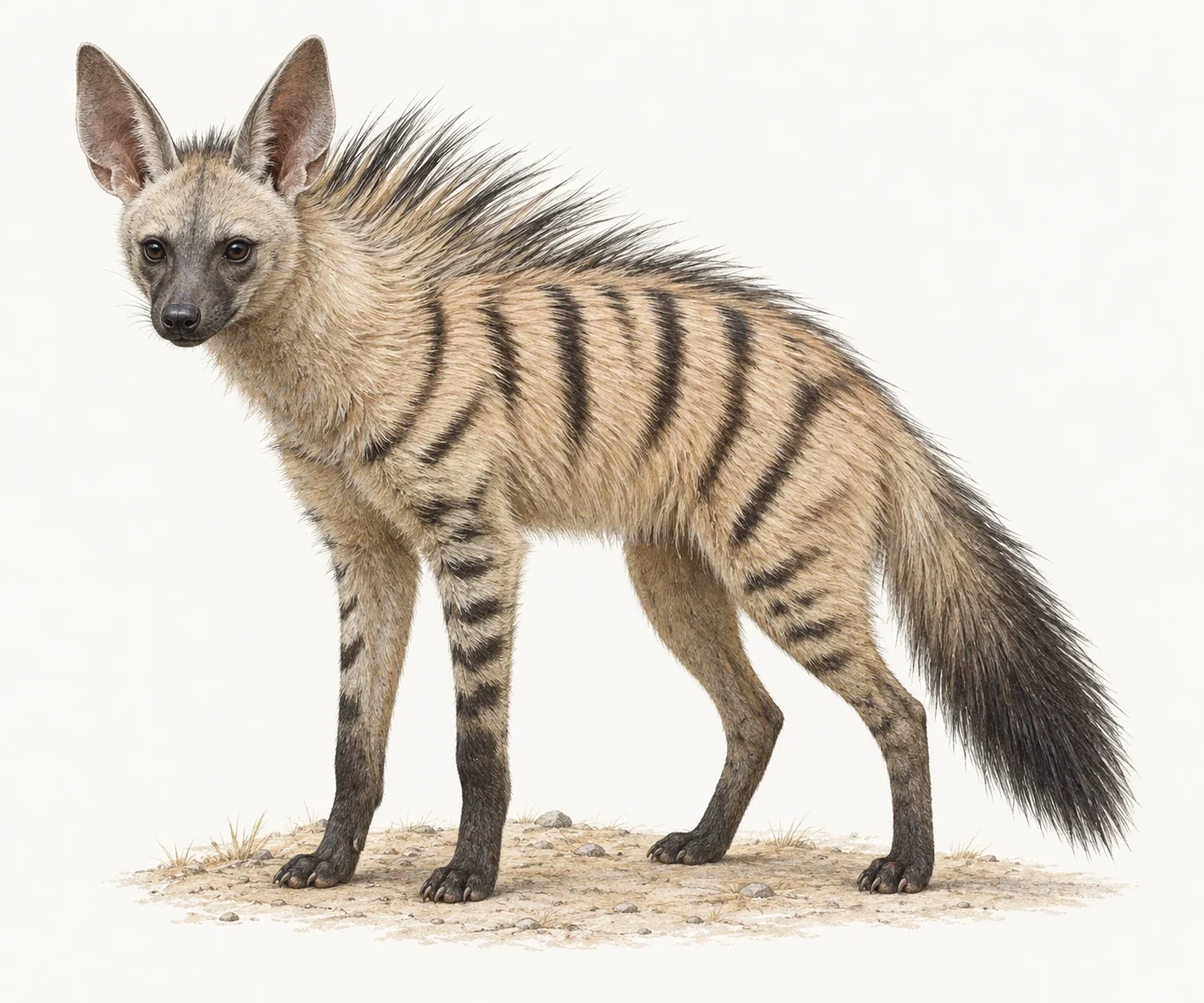
Aardwolf - AI-generated scientific interpretation.
Modern AI-generated scientific illustration. Diagnostic external features follow the selected sources; pose, individual pattern and fine details are interpretive. Not photography or independent anatomical evidence.
Overview
The aardwolf has large pointed ears, a narrow muzzle, dark stripes over a pale coat and a long dorsal mane. Its forelegs are longer than the hindlegs, producing a sloping outline. These features recall other hyenas, but its feeding specialization is very different from the familiar image of a heavy-jawed bone crusher.
A broad sticky tongue gathers termites from the surface. The university species account describes reduced grinding teeth, while a primary functional study examined the feeding apparatus and digestive tract. The animal does not need an anteater's extremely elongated snout and powerful digging forelimbs to exploit this food source.
Anderson's 1992 analysis identified a broad spatulate tongue, a broad palate, substantial salivary glands and a muscular stomach region among the specializations. This combination illustrates how similar diets can be reached through different anatomical arrangements. The paper's emphasis on Trinervitermes should not be expanded into a claim that every population consumes exactly one prey species throughout the year.
The older university account combines southern and northeastern populations and discusses an unproven possibility of resemblance-based protection. This profile selects the southern form and does not label the stripes as demonstrated Batesian mimicry. Nor does termite specialization justify a precise annual total consumed by every animal.
Origins & earliest records
The profile uses Proteles cristatus, as in the selected primary study, for the southern African aardwolf. Older accounts use the spelling P. cristata and a broader population scope; those differences are retained explicitly.
Evidence & interpretation
ADW supplies external morphology and a cited ecological account. The primary 1992 paper's accessible abstract supplies functional anatomy. Detailed prey totals and speculative mimicry are excluded.
Selected bibliography
Documented works and useful reading. This is not a list of every appearance.
- 01
Proteles cristata
Selected bibliography; bounded evidence and study-specific limitations retained.
- 02
Functional analysis of the feeding apparatus and digestive tract anatomy of the aardwolf Proteles cristatus
Selected bibliography; bounded evidence and study-specific limitations retained.
Family, evolution & connections
Taxonomic classification
A hierarchy of classified groups, not a chain of direct ancestors.
Source note: Southern African scope avoids automatically transferring the older account's northeastern population claims. P. cristata is a recorded spelling in older sources; no new taxonomic split is asserted here.
References
Sources supporting this profile. Linked pages have their own scope and editorial standards.
- InstitutionalProteles cristataResearch access: 2026-10-10
- ResearchFunctional analysis of the feeding apparatus and digestive tract anatomy of the aardwolf Proteles cristatusResearch access: 2026-10-10
Image credits
AI-generated scientific interpretationAardwolf - AI-generated scientific interpretation.
Modern AI-generated scientific illustration. Diagnostic external features follow the selected sources; pose, individual pattern and fine details are interpretive. Not photography or independent anatomical evidence.