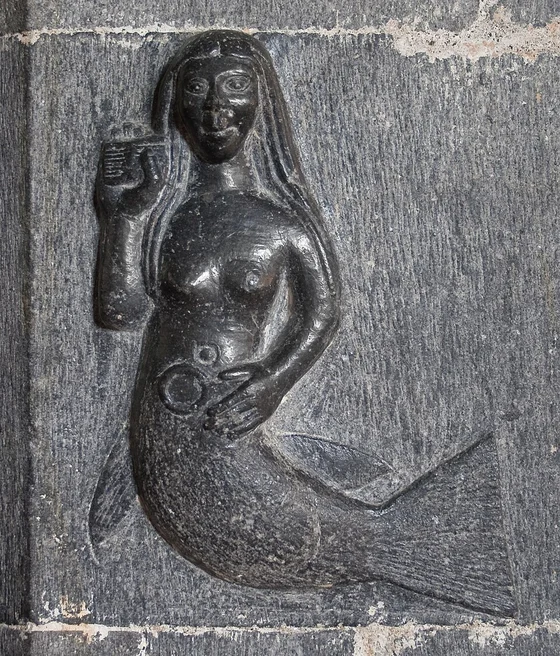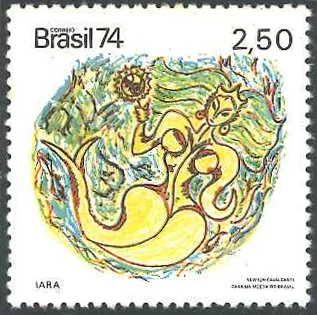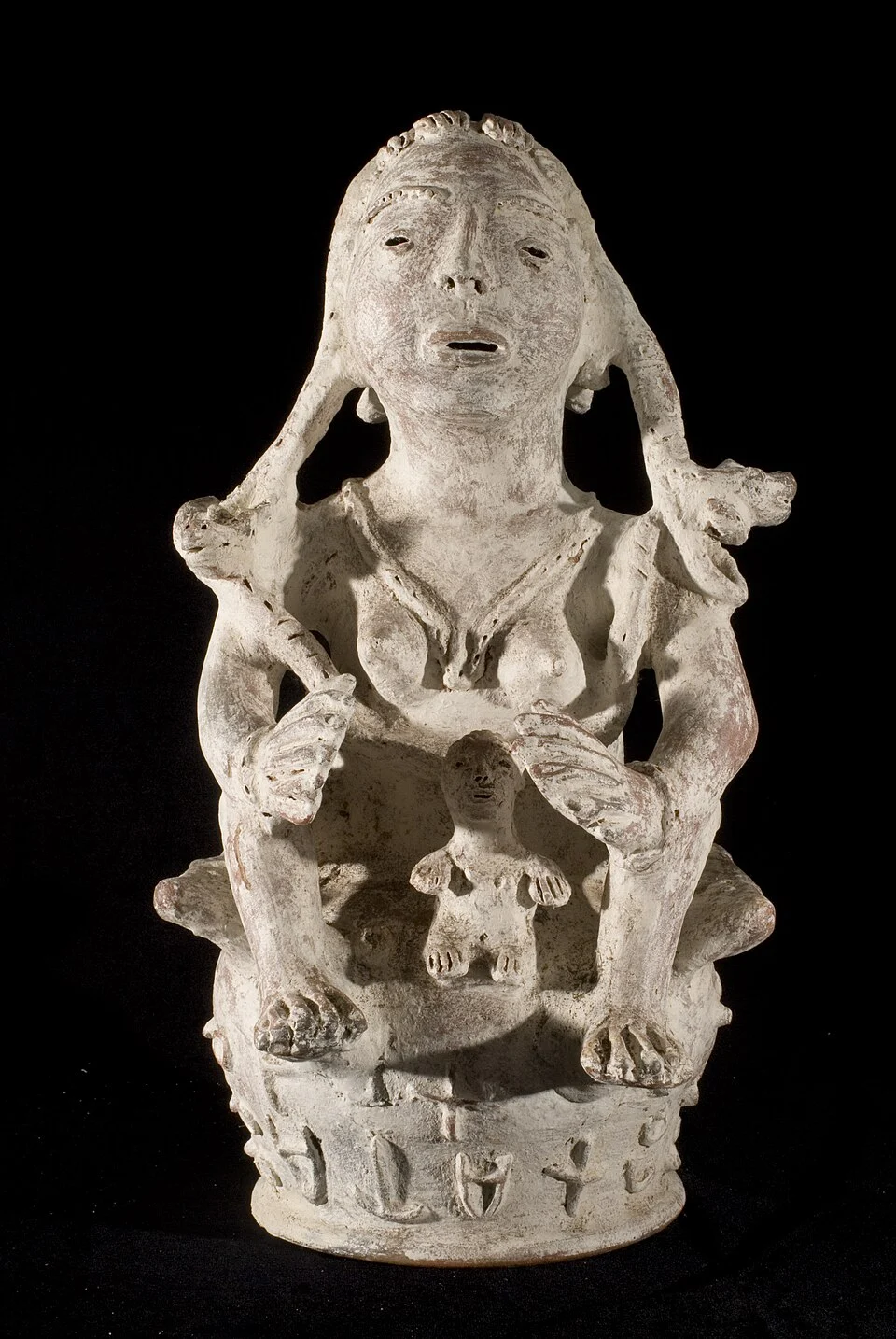
Twentieth-century Ewe Mami Wata sculpture from Ghana
Museum photograph with Commons VRT permission ticket 2015080410013731.
Overview
Mami Wata is neither one fixed mermaid character nor a single religion shared by all Africa. Local communities connect water spirits with different names, images and practices. The Smithsonian’s Anang-Ibibio figure combines a female body with snakes, showing a particular artistic interpretation rather than a universal description.
Imported snake-charmer imagery became part of some modern representations alongside earlier water-spirit concepts. That creative exchange does not mean imported art invented every underlying belief. Wealth and healing associations must also be attributed to their documented settings. Public sculpture and museum interpretation offer an accessible entry point while leaving initiatory or private knowledge to the communities that hold it.
The Smithsonian catalogues accession 2009-16-1 as late twentieth-century Nigerian work in wood, paint and raffia, with Anang-Ibibio attribution. One snake passes across the shoulders and another encircles the waist. The label connects this setting with wealth and fertility.
The Fowler’s 2008 exhibition account traces one influential snake-charmer image to a Hamburg poster around 1887 and records an African water-spirit headdress adaptation by 1901. It also discusses later engagement with imported Hindu devotional prints. These are routes through which representations changed; a poster date cannot establish the first existence of all underlying religious traditions.
The same account separates local uses. Baule and Guro public performances in Côte d’Ivoire could employ the imagery for elegance and modernity; other objects represented a private spirit spouse. Coastal Ghana, Togo and Benin examples concerned shrine offerings, protection and healing. Its discussion of Ghanaian films describes a particular Christian demonizing portrayal. Such portrayals reveal disagreement and adaptation, rather than an agreed character shared by all communities.
The Smithsonian’s 2009 presentation included Freetown Jolly masquerade headdresses from the 1970s and 1980s, large Beninese performance figures associated with the de Souza and de Nevis families, and contemporary works by artists including Alison Saar and Bruce Onobrakpeya. Its recreated altars from Benin, Haiti and the Dominican Republic represented Mami Wata, Lasirèn and Santa Marta la Dominadora. Their presence in one comparative exhibition does not make these names interchangeable. Objects, performances and curatorial interpretation provide different kinds of evidence for the traditions’ public representation.
Véronique Tadjo’s illustrated Mamy Wata et le monstre is a named literary treatment. The author’s posted opening presents a water queen moving among sea, waterfalls and rivers. The Institut Français du Burkina Faso catalogues a French edition published in Abidjan in 1993. Tadjo’s own bibliography separately lists Milet’s English and bilingual editions in 2000 and a Swedish translation by Matilda Wallin in 2008. These edition records establish a traceable literary history without assigning the entire story to an undifferentiated oral tradition.
C.J. “Fiery” Obasi’s film Mami Wata (2023) offers another distinct interpretation. Dekanalog’s official synopsis places Mama Efe between the water deity and the people of Iyi; a child’s death and the arrival of a rebel unsettle her authority. The distributor frames the conflict around religious leadership and promises of technological progress. This is a modern fictional community and narrative, not an ethnographic account of every place where Mami Wata is venerated.
Origins & earliest records
The selected evidence traces changing imagery in the late nineteenth and twentieth centuries, alongside later books, exhibitions and film. A print’s date and a museum object’s date do not establish the beginning of all water-spirit traditions.
Records & interpretation
Museum object record and full exhibition releases checked; author-posted opening and bibliography, institutional library metadata and distributor synopsis read. The complete Tadjo book and Obasi film were not newly read or viewed. These sources document representation and interpretation; they do not independently verify supernatural events.
Selected bibliography
Documented works and useful reading. This is not a list of every appearance.
- 01
Mami Wata: Arts for Water Spirits in Africa and Its Diasporas
Exhibition catalogue identified through museum bibliography and curator’s release. Associated 2008/2009 exhibition accounts read; complete catalogue not read.
- 02
Mamy Wata et le monstre
French Abidjan edition catalogued by the Institut Français du Burkina Faso. Author’s separately posted opening checked; full story not read.
- 03
Mamy Wata et le monstre — English and bilingual editions
Milet Publishing, London; edition group listed on the author’s own translations page. No complete edition reading claimed.
- 04
Mamy Wata och Monstret
Stockholm: Trasten, as listed in the author’s bibliography; bibliographic verification only.
- 05
Mami Wata
Film; official distributor synopsis and credits checked. Full film not newly viewed; its fictional setting is kept distinct from ethnography.
Family, evolution & connections
Mami Wata (2023 film), C. J. “Fiery” Obasi
The production company identifies the film as based on West African mermaid folklore and mythology. Its fictional Iyi community is a cinematic treatment, not evidence of a universal Mami Wata doctrine or genealogy.
Encyclopedia background
An additional attributed reference, separate from the editorial profile above.
Read the open encyclopedia overview
Mami Wata (also called Mammy Water and Bantu: Mami Muntu, Mamba Muntu) or similar is a mermaid, water spirit, and/or goddess in the folklore of parts of Western Africa, Central Africa, Eastern Africa, and Southern Africa. Historically, scholars trace her origins to early encounters between Europeans and West Africans in the 15th century, where Mami Wata developed from depictions of European mermaids. Mami Wata subsequently joined native pantheons of deities and spirits in parts of Africa.
Historically, Mami Wata is conceived of as an exotic female entity from Europe or elsewhere, often depicted as a fair-skinned woman with long, flowing hair and a particular interest in objects foreign to West Africans that her adherents place at her shrines. In the mid-19th century, Mami Wata's iconography became particularly influenced by an image of snake charmer Nala Damajanti spreading from Europe. This snake charmer print soon overtook Mami Wata's earlier mermaid iconography in popularity in some parts of Africa.
Mami is a goddess of wealth, fertility, healing, wisdom, and profound beauty. She holds the power to manipulate the oceans and rivers, and possesses the ability to transform in order to seduce and mesmerize humans with her alluring beauty.
Additionally, Hindu imagery from Indian merchants has influenced depictions of Mami Wata in some areas. Papi Wata, a male consort or reflection of Mami Wata sometimes depicted as modeled from the Hindu deity Hanuman, can be found in some Mami Wata traditions, sometimes under the influence of Hindu imagery.
Mami Wata is especially venerated in parts of Africa and in the Atlantic diaspora and has also been demonized in some African Christian and Islamic communities in the region. Mami Wata has appeared in a variety of media depictions and in literary works.
Text from Wikipedia contributors, “Mami Wata”. CC BY-SA 4.0. Extracted introduction; formatting changed. Retrieved 5 October 2026. The source article may have changed since retrieval.
References
Sources supporting this profile. Linked pages have their own scope and editorial standards.
- MuseumNational Museum of African Art: Mami Wata figureResearch access: 2026-10-05
- Museum object recordSmithsonian accession2009-16-1: Anang-Ibibio figureResearch access: 2026-10-05
- Curatorial exhibition accountFowler2008 Mami Wata exhibition releaseResearch access: 2026-10-05
- Museum exhibition accountSmithsonian2009 water-spirit exhibition releaseResearch access: 2026-10-05
- Author-hosted excerpt and publication detailsTadjo: Mamy Wata et le Monstre openingResearch access: 2026-10-05
- Author bibliographyTadjo: translations bibliographyResearch access: 2026-10-05
- Institutional library catalogueInstitut Français du Burkina Faso:1993 editionResearch access: 2026-10-05
- Official film distributorDekanalog: Mami Wata synopsis and creditsResearch access: 2026-10-05
Image credits
Exact subjectTwentieth-century Ewe Mami Wata sculpture from Ghana
Museum photograph with Commons VRT permission ticket 2015080410013731.