Iara
Image associated with the exact linked encyclopedia article; consult credited file description for its interpretation.
Overview
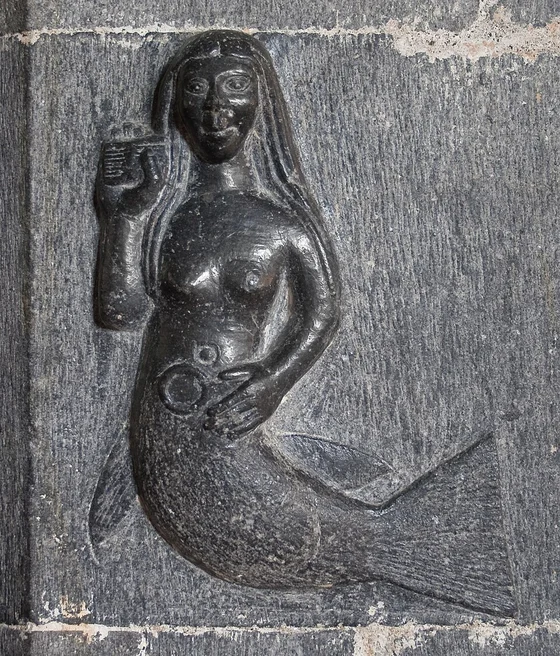
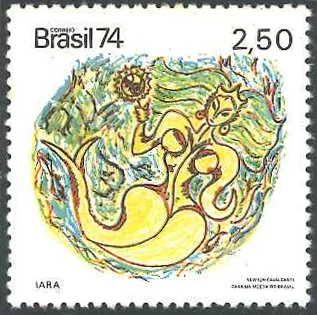
Iara’s familiar portrayal combines a woman’s upper body with a fishlike tail, locating an alluring figure within rivers and pools. Song and beauty can draw a listener toward the water. That recognizable mermaid form is part of a history shaped by oral accounts, collecting and literary adaptation, rather than a timeless description shared uniformly across Brazil.
The name and water-being traditions invite comparisons with Indigenous-language concepts, but a simple claim of an unchanged pre-contact mermaid would exceed this entry’s evidence. European and Brazilian literary images also affected public portrayals. The Paraná storytelling program is a modern witness to continued transmission, while a fuller history should compare dated texts, local narrators and visual representations.
Lobato’s O Saci offers an identifiable literary witness. In the eighth edition of 1941, chapter XIV presents Iara as queen of the waters through Saci’s dialogue with Pedrinho. Saci rejects the assumption that beauty guarantees goodness and describes opposing forest parties. Pedrinho questions his account. This perspective belongs to a character within the novel, not to a universal Indigenous theology.
In chapter XXXI, the companions find Iara beside a waterfall, combing green hair with a golden comb amid fireflies. Saci takes a hair, and she screams and dives into the water. Pedrinho ignores the warning against looking: her appearance overwhelms him, and Saci restores him with leaves. The scene does not explicitly describe a fish tail or a performed song. Those familiar attributes should not be inserted into this particular episode, nor should the boy’s entrancement be confused with Narizinho’s actual petrification elsewhere in the novel.
The next chapter establishes that Cuca’s hair quest was a trap intended to expose the rescuers to Iara. It was not a genuine requirement for undoing the spell. The passage does not establish that Iara and Cuca had jointly planned the deception. Literary conflict supplies a connection between the figures, not kinship or common biological ancestry.
Origins & earliest records
Cascudo’s 1954 dictionary is a selected ethnographic reference, and earlier literary accounts provide additional witnesses. The modern storytelling source documents reception without proving one precise origin or uninterrupted form. A surviving record dates its documentation, not the beginning of an oral tradition; earlier transmission cannot be timed precisely from this witness alone. Selected episodes are now checked in Lobato’s 1941 eighth edition. Its earlier publication history does not establish that every detail appeared unchanged in 1921.
Records & interpretation
Stories, literary adaptations and public cultural programs establish river-being imagery and narrative circulation. Similarity to European mermaids is a comparison, not evidence that every account has one source. This is evidence for cultural expression and recorded interpretation, rather than a zoological specimen or independently verified supernatural event. Complete selected chapters XIV, XXXI and XXXII read in the facsimile-linked Portuguese transcription, with the edition title checked. Cascudo remains a bibliographic lead; his complete dictionary entry was not inspected in this pass. The Paraná program is retained as a modern reception source, not a listened-to recording.
Selected bibliography
Documented works and useful reading. This is not a list of every appearance.
- 01
Dicionário do folclore brasileiro
Bibliographic reference retained; full entry not inspected during this expansion.
- 02
O Saci — eighth edition, chapters XIV and XXXI–XXXII
Selected complete literary episodes; first-edition collation pending.
Family & connections
A source-supported family tree or inspiration record has not yet been compiled for this profile. Related reading below indicates a connection in subject matter, not a proven lineage or creative influence.
Encyclopedia background
An additional attributed reference, separate from the editorial profile above.
Read the open encyclopedia overview
Iara, also spelled Uiara, Yara or Hiara (Portuguese pronunciation: [iˈaɾɐ], [wiˈaɾɐ], [ujˈaɾɐ]) or Mãe das Águas ([ˌmɐ̃j̃ dɐz ˈaɡwɐs], "mother of the waters"), is a figure from Brazilian mythology based on Tupi and Guaraní mythology.
The Iara may have developed from the lore of the carnivorous fish-man Ipupiara. Conflation with the European myth of the siren, or a beautiful mermaid probably is part of the Iara myth as the seductress of the Amazon River.
Some commentators believe the original version of Iara must have been dark-skinned and black-haired, black-eyed, like the indigenous populations. However the Iara in the 19th century were described as blonde and blue-eyed or green-eyed, or even green haired.
Text from Wikipedia contributors, “Iara (mythology)”. CC BY-SA 4.0. Extracted introduction; formatting changed. Retrieved 5 October 2026. The source article may have changed since retrieval.
References
Sources supporting this profile. Linked pages have their own scope and editorial standards.
- ReferenceBiblioteca Pública do Paraná: Lendas Brasileiras, IaraResearch access: 2026-10-05
- Primary literary dialogueO Saci 1941: XIV, A Iára e a CucaResearch access: 2026-10-05
- Primary literary encounterO Saci 1941: XXXI, Os apuros do PedrinhoResearch access: 2026-10-05
- Primary literary explanation of the deceptionO Saci 1941: XXXII, O Saci sabe tudoResearch access: 2026-10-05
Image credits
Reference illustrationIara
Image associated with the exact linked encyclopedia article; consult credited file description for its interpretation.