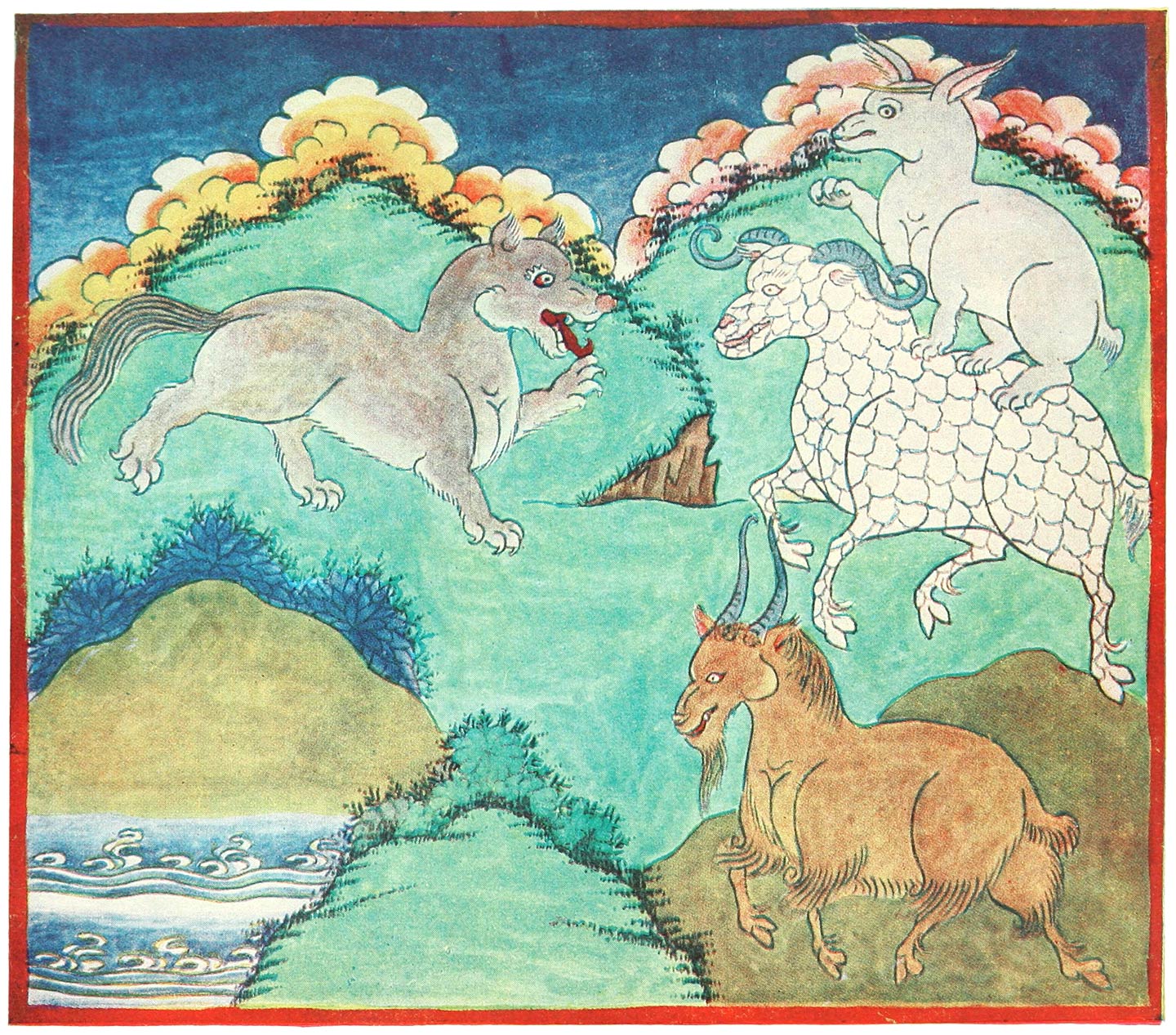
Lomden the Hare riding a sheep and confronting the wolf in a Tibetan illustration published 1906
Lomden rides the sheep with paper in hand while confronting the wolf. The accompanying smaller horned animal follows the sheep-and-goat variant identified in O’Connor’s note, rather than the sheep-and-lamb wording of the main tale.
Overview
A sheep and her lamb travel from a Tibetan valley to the northern plateau for summer grazing. Confronted by a wolf, the mother wins a reprieve by promising that they will be fatter on the autumn return. When they approach the appointed place, a hare learns why she is distressed and prepares a disguise: a woollen robe, a left-ear earring, a fashionable hat, a pen and a sheet of paper. He saddles the sheep and hangs two small bundles on the lamb.
Introducing himself as Lomden, he claims the emperor of China has sent him to India with a commission to present ten wolf skins to its king. He writes a large numeral one on his paper, frightening the wolf into flight. The sheep and lamb return safely home. O’Connor interprets the episode as satire of official arrogance and peasant timidity; this is the collector’s social reading, not an independent description of all Tibetan people. A note records a sheep-and-goat variant, while Lomden’s titles and mission remain a bluff rather than authentic divine or imperial authority.
The following tale is explicitly introduced as a continuation with a different ending, naming the rescued animals Da-gye the sheep and Pen-dzong the goat. Their taunting of the frightened wolf leads to both deaths. Learning this from a fox carrying the goat’s skin to his children, the hare vows revenge: he lures the wolf into a wedding larder, persuades him to put his head through a wine-jar handle and sing, then escapes while the jar prevents the wolf from following through the window. The wedding guests kill the trapped wolf. This continuation does not repeat the name Lomden, and its sheep-and-goat pair is distinguished from the sheep and lamb in Story X.
Origins & earliest records
Tibet; collected historical narrative
Records & interpretation
Full relevant tale and collection preface directly read.
Selected bibliography
Documented works and useful reading. This is not a list of every appearance.
- 01
Folk Tales from Tibet
X, The Sheep, the Lamb, the Wolf and the Hare, pp. 56–59
- 02
Folk Tales from Tibet
XI, The Story of how the Hare made a Fool of the Wolf, pp. 60–67
Family & connections
A source-supported family tree or inspiration record has not yet been compiled for this profile. Related reading below indicates a connection in subject matter, not a proven lineage or creative influence.
Primary records and illustrations
W. F. O’Connor, Folk Tales from Tibet (1906)
X, The Sheep, the Lamb, the Wolf and the Hare; XI, continuation variant. X pp. 56–59; XI pp. 60–67
Complete tale and all appended notes read from cached text. Animal speech and deliberate deception distinguished from magic; commentary and admitted translation omission explicitly attributed. Full XI continuation also read: name not repeated; sheep-and-goat alternate explicitly retained.
References
Sources supporting this profile. Linked pages have their own scope and editorial standards.
- Historical tale collectionO’Connor, Folk Tales from Tibet — X, The Sheep, the Lamb, the Wolf and the Hare, pp. 56–59Research access: 2026-10-05
- Historical tale collectionO’Connor, Folk Tales from Tibet — XI, continuation variantResearch access: 2026-10-05
Image credits
Historical illustrationLomden the Hare riding a sheep and confronting the wolf in a Tibetan illustration published 1906
Lomden rides the sheep with paper in hand while confronting the wolf. The accompanying smaller horned animal follows the sheep-and-goat variant identified in O’Connor’s note, rather than the sheep-and-lamb wording of the main tale.