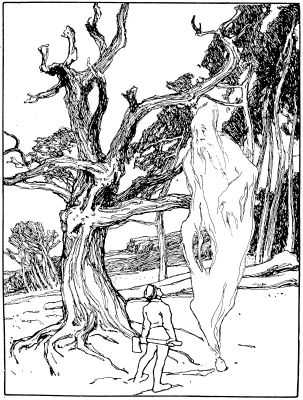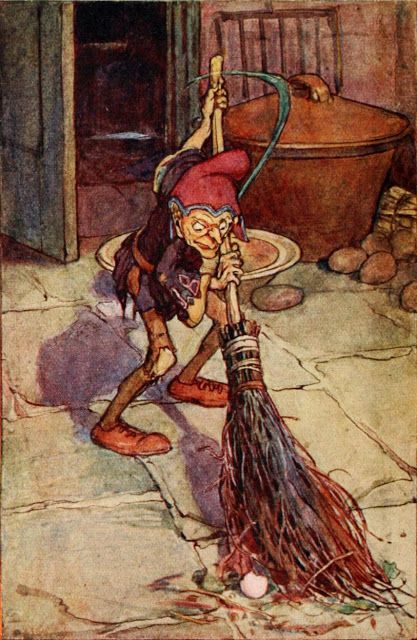
Batten: supernatural ploughman of Liddesdale
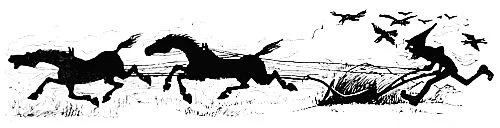
Exact Farmer of Liddesdale chapter-opening silhouette shows the ploughman and horses at impossible speed, with birds accompanying; artist representation, no devil anatomy supplied. Selected title-page edition1895; John Dickson Batten1860–1932 credited illustrator; Joseph Jacobs compiler/editor.
Overview
The farmer hires the stranger after losing his family and former ploughman, promising as much dry corn as the newcomer can carry in a single burden-withe. The labourer first plants a stake in each field and spends several days apparently idle. He repeatedly smells the stakes, judging a readiness the farmer cannot perceive. Once satisfied, he obtains the horses and plough and finishes ploughing, sowing and harrowing all three fields before sunset. His unusual knowledge of soil conditions precedes the display of impossible speed.
At harvest he again determines when the crop is ready, then gathers almost all its sheaves into one enormous load. The farmer’s careless agreement would therefore leave him destitute despite the successful cultivation. A prayer invoking the three Màrts breaks the carrying band with a report echoed by the surrounding rocks. The grain falls back over the field and the labourer vanishes upward in white mist. Jacobs’s note hints at a devil identification without naming it in the story; the profile preserves that editorial inference rather than supplying horns, a horse form or an explicit personal name.
Origins & earliest records
Jacobs identifies MacDougall’s Waifs and Strays, volume III, tale ix, pp. 216–221, as his source and compares Campbell’s The Master and the Man. The inspected witness is the selected 1895 More Celtic Fairy Tales, not direct access to those earlier tellings or a date for the oral beginning.
Records & interpretation
The narrated work, impossible load and mist departure attest a supernatural contract story. They are not evidence of agricultural experiments or an observed species. The editor’s suggested identity is explicitly distinguished from the unnamed stranger’s actions.
In the literature
“the Ploughman went away in a white mist in the skies”
The Farmer of Liddesdale, pp106–110; pp109–110; departure
The farmer’s religious appeal breaks the withe and scatters the grain, after which the worker departs in a white aerial mist and never reappears. Jacobs’s note implies a devil identity, but the body never directly names him as Satan or specifies ancestry.
Selected bibliography
Documented works and useful reading. This is not a list of every appearance.
- 01
More Celtic Fairy Tales: The Farmer of Liddesdale, pp. 106–109; note XXXVI
Selected episode and relevant source note inspected. Earlier works named by Jacobs are attributed references, not falsely claimed as independently collated texts.
- 02
More Celtic Fairy Tales
Joseph Jacobs, More Celtic Fairy Tales, selected1895 Nutt/Putnam edition, PG34453. Complete selected tale and respective compiler-note paragraph independently read.
Family & connections
A source-supported family tree or inspiration record has not yet been compiled for this profile. Related reading below indicates a connection in subject matter, not a proven lineage or creative influence.
Located primary passages
Specific passages supporting details in this entry, grouped by their published witness.
More Celtic Fairy Tales
Joseph Jacobs, More Celtic Fairy Tales, selected1895 Nutt/Putnam edition, PG34453. Complete selected tale and respective compiler-note paragraph independently read.
- The hired man tests stakes by smell, delays ploughing, then completes three fields’ ploughing, sowing and harrowing in one day. His stipulated wage is as much grain as he can carry in a single withe, which turns out to include almost the whole harvest.
The Farmer of Liddesdale, pp106–110; Delayed cultivation and immense wages
- The farmer’s religious appeal breaks the withe and scatters the grain, after which the worker departs in a white aerial mist and never reappears. Jacobs’s note implies a devil identity, but the body never directly names him as Satan or specifies ancestry.
The Farmer of Liddesdale, pp106–110; Broken carrying-withe and departure
Named narrative actions and compiler interpretations distinguished. No verse, prayer or ritual formula excerpts; no real-animal behavioural proof implied.
Primary source witness
Joseph Jacobs, More Celtic Fairy Tales, selected1895 Nutt/Putnam edition, PG34453. Complete selected tale and respective compiler-note paragraph independently read.
- Jacobs cites MacDougal’s Waifs and StraysIII, taleIX pp216–221 and Campbell’s Master and Man comparison. The implied devil identification is the compiler’s interpretation, distinguished from the body’s unnamed extraordinary worker.
No independent collation of the cited underlying editions claimed.
References
Sources supporting this profile. Linked pages have their own scope and editorial standards.
- Primary textMore Celtic Fairy Tales, selected 1895 edition: The Farmer of Liddesdale, pp. 106–109; note XXXVIResearch access: 2026-10-05
Image credits
Historical illustrationBatten: supernatural ploughman of Liddesdale
Exact Farmer of Liddesdale chapter-opening silhouette shows the ploughman and horses at impossible speed, with birds accompanying; artist representation, no devil anatomy supplied. Selected title-page edition1895; John Dickson Batten1860–1932 credited illustrator; Joseph Jacobs compiler/editor.