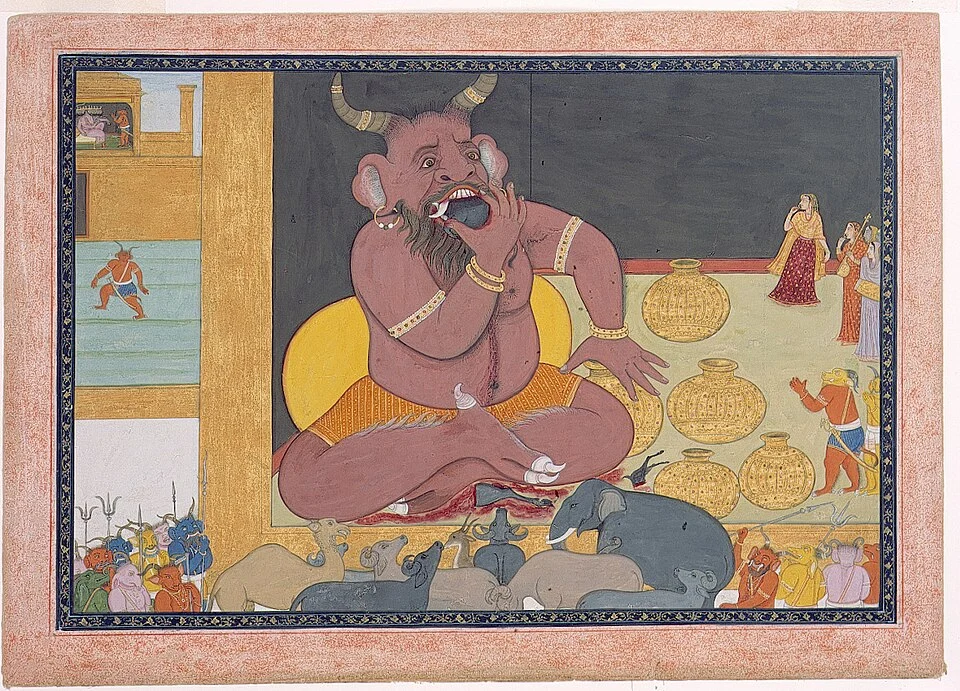
Kumbhakarna wakes and eats, ca1800
Actual enormous seated figure eats among tiny attendants and dishes. Museum accession1990.1282 identifies ca1800 Rama Journey series; uploader museum is custodian, not historical painter.
Overview
Kumbhakarṇa sleeps for months under Brahmā’s curse in the selected canto. His chamber is an immense cave, and his breath itself hinders those sent to wake him. Attendants gather meat and blood, use flowers and incense, sound instruments and strike his body with clubs and rocks. They pour water over him and send animals, including elephants, onto his limbs.
When the accumulated weight finally wakes him, he yawns with a cavernous mouth and consumes the waiting flesh, marrow, blood and wine. He demands an explanation for the intrusion. Learning of Rāma’s assault and Rāvaṇa’s defeat, he announces his intention to crush the enemy army. The episode combines sleep, bodily scale, appetite and military service without implying that sleep is a trait of rākṣasas generally.
Vibhīṣaṇa supplies a more precise account of the sleep in Book VI LXI. He says Kumbhakarṇa’s strength was natural from birth rather than merely a granted advantage. The infant already ate people, and his later attack on Indra drove the gods to seek Brahmā’s intervention. Brahmā imposed an inert condition like death; Rāvaṇa appealed on his brother’s behalf, and the sentence became six months asleep followed by one waking day. This is the explanation in this passage, without importing a different story about a misspoken boon.
His battle in LXVII continues the interplay of body size and appetite. Some swallowed vānara fighters escape through his nostrils and ears. He carries the stunned Sugrīva into the city, but the captive recovers, wounds him and leaps free. Rāma’s successive divine missiles sever the giant’s arms and legs, then his head. The falling head damages Laṅkā’s structures and the body crashes into the sea. The grotesque scale therefore affects fellow fighters, buildings and the water around the island, not simply the descriptive portrait.
Origins & earliest records
South Asian Rāmāyaṇa narrative tradition
Records & interpretation
Primary-text translation directly read by identified book/canto.
Selected bibliography
Documented works and useful reading. This is not a list of every appearance.
- 01
The Rámáyan of Válmíki
Title page gives translation span 1870–1874. Book VI LX, pp. 470–472. Selected historical verse witness. Also VI LXI and LXVII, pp. 472–473, 475–478.
Family & connections
A source-supported family tree or inspiration record has not yet been compiled for this profile. Related reading below indicates a connection in subject matter, not a proven lineage or creative influence.
Primary records and illustrations
The Rámáyan of Válmíki
Book VI. VI LX, pp. 470–472
Actual translated primary passages directly read. Checked HTML canto anchor. No new image bytes inspected.
Vibhīṣaṇa supplies a more precise account of the sleep in Book VI LXI. He says Kumbhakarṇa’s strength was natural from birth rather than merely a granted advantage. The infant already ate people, and his later attack on Indra drove the gods to seek Brahmā’s intervention. Brahmā imposed an inert condition like death; Rāvaṇa appealed on his brother’s behalf, and the sentence became six months asleep followed by one waking day. This is the explanation in this passage, without importing a different story about a misspoken boon.,His battle in LXVII continues the interplay of body size and appetite. Some swallowed vānara fighters escape through his nostrils and ears. He carries the stunned Sugrīva into the city, but the captive recovers, wounds him and leaps free. Rāma’s successive divine missiles sever the giant’s arms and legs, then his head. The falling head damages Laṅkā’s structures and the body crashes into the sea. The grotesque scale therefore affects fellow fighters, buildings and the water around the island, not simply the descriptive portrait.
References
Sources supporting this profile. Linked pages have their own scope and editorial standards.
- Historical primary-text translationGriffith Rāmāyaṇa — Book VI LX, pp. 470–472Research access: 2026-10-05
Image credits
Historical illustrationKumbhakarna wakes and eats, ca1800
Actual enormous seated figure eats among tiny attendants and dishes. Museum accession1990.1282 identifies ca1800 Rama Journey series; uploader museum is custodian, not historical painter.