Kraken
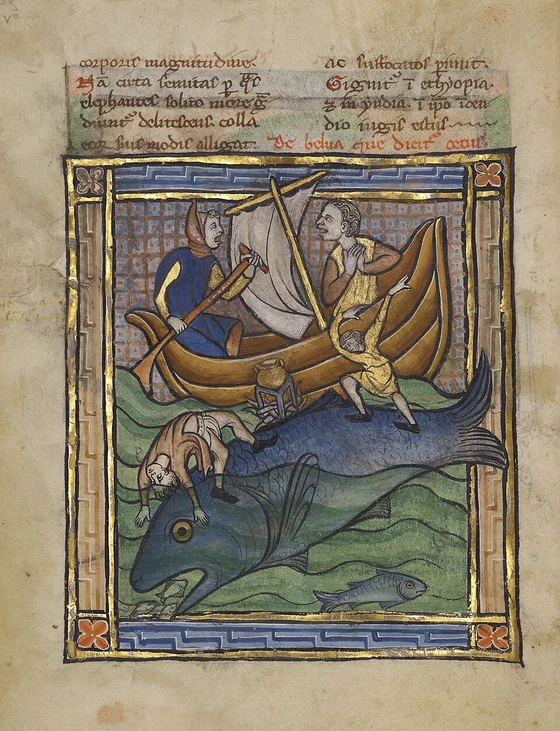
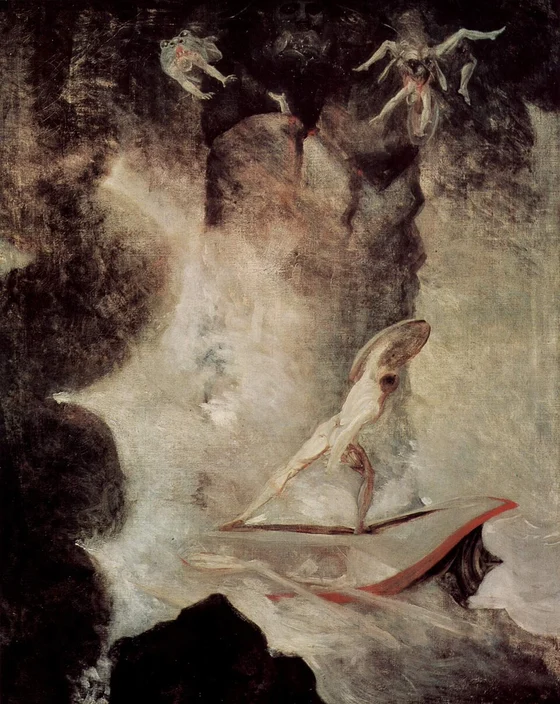
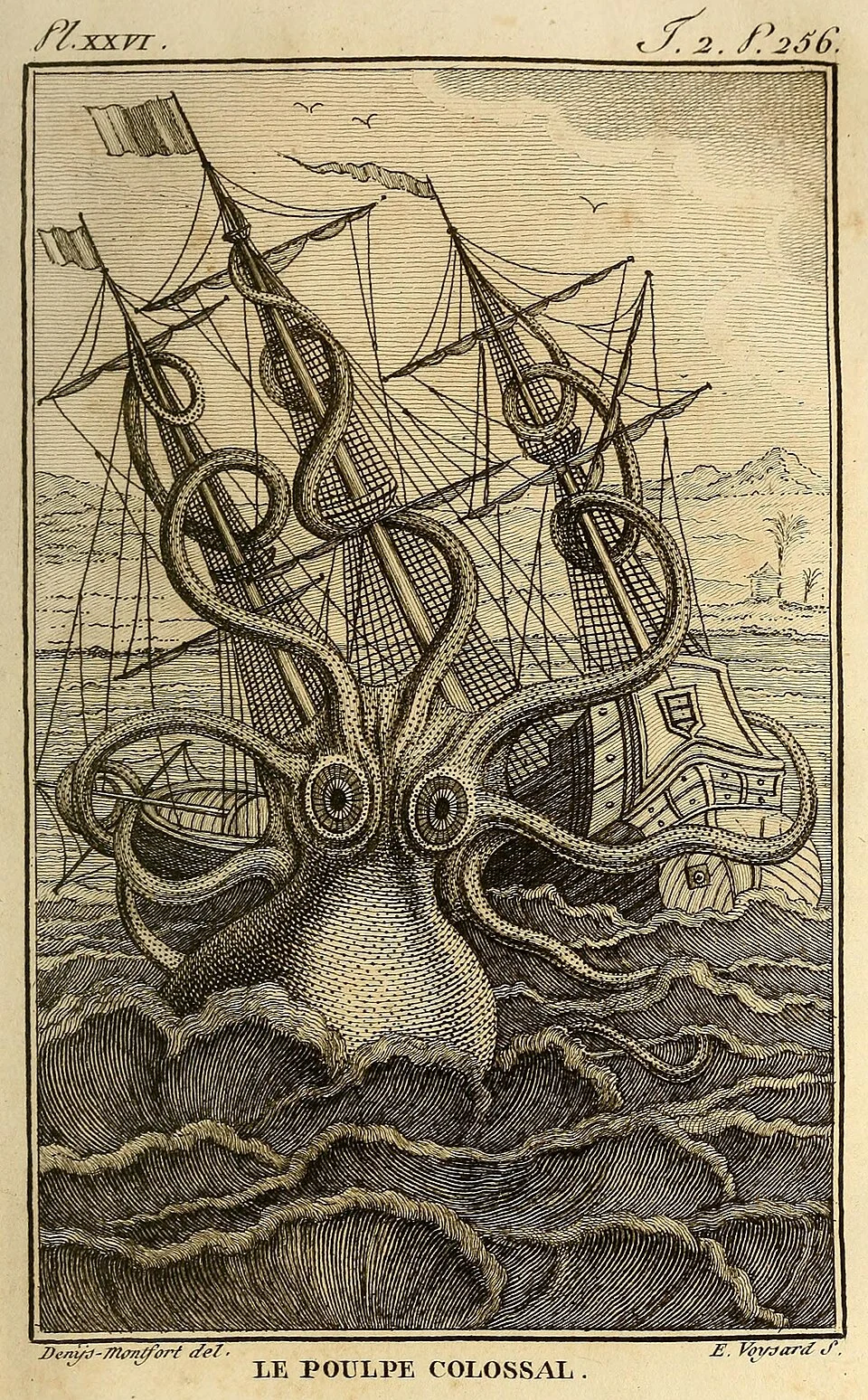
Image associated with the exact linked encyclopedia article; consult credited file description for its interpretation.
Overview
Pontoppidan’s Natural History of Norway presents the kraken as a vast, rounded, flattened marine creature with numerous arms or branches. In the 1755 English edition, part II, chapter VIII, sections XI–XIII, he lists Kraken, Kraxen, Krabben, Horven, Soe-horven and Anker-trold as names associated with the account. He says his information comes from correspondents and enquiries, and acknowledges that it falls short of a complete description. His confidence that the creature exists must therefore be distinguished from personal examination of a specimen.
The fishermen’s reported encounter begins with a fishing opportunity. Where they expect 80 or 100 fathoms, their lines reach only 20 or 30, with abundant cod and ling above the supposed creature. Several boats gather to fish and monitor the depth. If the apparent bottom rises, they row away before the kraken surfaces. Its exposed back resembles small islands or sandbanks, fringed by moving material like seaweed. Pontoppidan repeats an apparent circumference of about one and a half English miles, but this is a reported estimate rather than a measurement. Rising points become mastlike arms; the withdrawal creates the feared eddy or whirlpool.
The account distinguishes a claimed capacity to pull down a large warship from particular stories of harm. On page 213, Pontoppidan says he has heard only one such incident: two fishermen near Fridrichstad enter thick, slimy water, and an appendage damages the front of their boat. They escape on the wreck. He also repeats the Reverend Mr Friis’s report of a creature stranded at Alstahoug in 1680. In that story, arms catch trees and the body becomes trapped among rocks, dies and fouls the narrow channel as it decays. Pontoppidan explicitly transmits this on Friis’s credit; the passage does not establish that either Pontoppidan or Friis personally examined the carcass.
Feeding explanations have their own uncertainty. The text proposes a strong scent and describes alternating periods of feeding and excretion, with discoloured water attracting fish that the kraken catches. Pontoppidan says he cannot give this detail the same assurance he gives his belief in the creature’s existence. His proposed classification is equally historical: he compares it with polypes and starfish, especially the branching form called Stella arborescens or Medusa’s head. He reports a conjecture that small examples are young krakens. These comparisons are evidence for eighteenth-century reasoning, not an accepted evolutionary tree or a demonstrated life cycle.
In the final section, Pontoppidan interprets other writers’ vanishing islands through the kraken account. Yet he rejects as fabulous the story, attributed to Olaus Magnus, of sailors landing and cooking on a whale’s back. He also cautiously suggests the kraken as an explanation for some accounts of ships being stopped at sea. His text both accepts and disputes particular reports; it should not be flattened into an endorsement of every earlier island monster. Later cephalopod imagery is a further stage of reception, not proof that every creature he compares has one biological identity.
Tennyson’s 1830 poem relocates the creature to a deep, ancient sleep surrounded by marine growth. It feeds while sleeping and rises only at a final catastrophe, when its appearance at the surface ends in death. This is a distinct literary transformation; it does not narrate an ordinary attack on a ship. The poem’s imagery of surrounding polypi should not all be assigned to the kraken’s own anatomy. Real giant squid provide an important modern comparison, but the existence of a large cephalopod does not independently validate every island, whirlpool or ship-dragging claim in the historical literature. The folklore profile therefore preserves textual variation while allowing zoological comparisons to be examined separately.
Origins & earliest records
Pontoppidan’s Danish work appeared in 1752–53; the directly inspected English edition was printed in London for A. Linde in 1755. Its part II, chapter VIII, sections XI–XIII, pp. 210–218, is the principal selected historical witness here. The 1680 stranding date belongs to a later reported anecdote within that work, not a contemporary record newly inspected for this article. Tennyson’s 1830 poem supplies a separate literary reception. These witnesses do not establish the first maritime telling or prove that all earlier differently named sea creatures were krakens.
Records & interpretation
The complete 1755 English kraken section, pp. 210–218, was read from the publicly available digitized volume; the page images for 210, 212, 213 and 216 were also visually checked against the transcription. These pages preserve the author’s information chain, conjectural classification and differing levels of confidence. They document historical reports and interpretations, not authenticated specimens or independently confirmed ship attacks. Tennyson’s complete poem was read separately. Modern giant-squid evidence belongs to zoology and does not validate every feature of the historical kraken.
In the literature
“His ancient, dreamless, uninvaded sleep The Kraken sleepeth:”
Lines 3–4
A poetic image of a sleeping abyssal monster; the poem is a literary development of the kraken legend.
“like a number of small islands”
Part II §XII, p212; exposed back comparison; PDF page518 · A. Berthelson (Andreas Berthelson), attributed by Smithsonian/BHL catalogue
The reported exposed back resembles several small islands. This comparison belongs to Pontoppidan’s historically attributed monster account, not a verified modern animal measurement.
Selected bibliography
Documented works and useful reading. This is not a list of every appearance.
- 01
The Natural History of Norway, part II, chapter VIII, sections XI–XIII, pp. 210–218
Complete selected 1755 English section directly read, with four original page images checked. Reports, earlier writers quoted by Pontoppidan and his own conjectures remain distinguished. Translator attribution is catalogued, not claimed printed on the inspected title page.
- 02
The Kraken, in Poems, Chiefly Lyrical, p154
Full poem inspected; literary version distinguished from historical maritime reports.
- 03
“The Kraken”
Exact contiguous verse excerpt checked against Victorian Web’s primary poem text on 2026-10-05; line break normalized. Underlying 1830 poem is public domain; no modern critical commentary reproduced.
Family & connections
A source-supported family tree or inspiration record has not yet been compiled for this profile. Related reading below indicates a connection in subject matter, not a proven lineage or creative influence.
Located primary passages
Specific passages supporting details in this entry, grouped by their published witness.
The Kraken, in Poems, Chiefly Lyrical, p154
Exact contiguous verse excerpt checked against Victorian Web’s primary poem text on 2026-10-05; line break normalized. Underlying 1830 poem is public domain; no modern critical commentary reproduced.
- A poetic image of a sleeping abyssal monster; the poem is a literary development of the kraken legend.
This source represents its own literary or collected version. A novel or poem is evidence for depiction, not a universal definition or a zoological claim. Original source verification is preserved; attachment performed after exact generic profileID became available.
The Natural History of Norway, part II, chapter VIII, sections XI–XIII, pp. 210–218
Erich Pontoppidan, The Natural History of Norway, London: printed for A. Linde, 1755, Part II §§XI–XIII, pp210–218. Complete recovered section independently read; original printed pp210 and212 visually checked. Smithsonian/BHL catalogue attributes English translation to A. Berthelson (Andreas Berthelson, born circa1716); translator attribution is catalogue-derived, not claimed as visually read on the title page.
- Pontoppidan calls the creature Kraken/Kraxen/Krabben and gives other names, then says his account rests on correspondents and collected inquiries. He recognises its incompleteness. This is a located1755 English translation of his historical account, not his own recorded direct observation or proof that each alias has an independently established etymology.
- The author reports fishermen finding unexpected shallows and abundant fish, then withdrawing as the creature rises. Its exposed back is compared to islands and its circumference estimated at about an English mile and a half, with larger reports rejected for that account. Arms are described as mast-like; sinking is said to cause dangerous currents. He separately gives scent/excretion feeding claims and explicitly cannot assure these as firmly as he believes the creature’s existence. These are attributed historical claims, not zoological measurements.
- The Reverend Mr Friis is named as the intermediary for an alleged1680 Alstahoug stranding: a creature caught in rock clefts decays in the channel. Pontoppidan explicitly delivers it on Friis’s credit. A separate unnamed report near Fridrichstad describes two fishermen surviving a damaged boat. Neither report is an independently inspected carcass or first-person observation by Pontoppidan in this reading.
Part II §XII, p213; named secondary report and alleged boat damage
- The author links disappearing-island accounts with Kraken, rejects Olaus Magnus’s island-whale landing story as fabulous, and proposes a polyp/starfish affinity through older writers and Medusa’s-head comparisons. These are his historical hypotheses, not an established giant-squid identification or proof that modern basket stars are Kraken young. His speculation about stopping ships and the Anker-Trold name is explicitly submitted to better-informed readers.
Part II §XIII, pp214–218; comparative authorities and conjectural classification
Modern zoological truth not established. Original Danish edition and each cited earlier work not independently inspected. Long-s/OCR glyphs retained in evidence strings; translated1755 prose is public domain. Root-owned bibliography already supplies this work, so no duplicate works object added.
Encyclopedia background
An additional attributed reference, separate from the editorial profile above.
Read the open encyclopedia overview
The kraken (; from Norwegian: kraken, ) is a legendary cryptid of enormous size, per its etymology something akin to a cephalopod, said to appear in the Norwegian Sea off the coast of Norway. It is believed that the legend of the Kraken may have originated from sightings of giant squid, which may grow to 10.5 metres (34 ft) in length.
The kraken, as a subject of sailors' superstitions and mythos, was first described in a Norwegian glossary by Christen Jensøn in 1646. Later this creature appears in a travelogue by Francesco Negri in 1700, followed in 1734 by an account from Dano-Norwegian missionary and explorer Hans Egede, who described the kraken in detail and equated it with the hafgufa of medieval lore. However, the first description of the creature is usually credited to the Danish bishop Pontoppidan (1753). He described the kraken as an octopus (polypus) of tremendous size, and wrote that it had a reputation for pulling down ships. The French malacologist Denys-Montfort, of the 19th century, is also known for his pioneering inquiries into the existence of gigantic octopuses.
The great man-hunting octopus entered French fiction when Victor Hugo introduced the pieuvre octopus of Guernsey lore in his 1866 novel Toilers of the Sea, which he identified with the kraken of legend. This led to Jules Verne's depiction of the kraken in his novel Twenty Thousand Leagues Under the Seas, although Verne did not distinguish between octopuses and squids.
Carl Linnaeus may have indirectly written about the kraken. Linnaeus wrote about the Microcosmus genus (an animal with various other organisms or growths attached to it, comprising a colony). Subsequent authors have referred to Linnaeus's writing, and the writings of Thomas Bartholin's cetus called hafgufa, and Christian Franz Paullini's monstrum marinum as "krakens". That said, the claim that Linnaeus used the word "kraken" in the margin of a later edition of Systema Naturae has not been confirmed.
Text from Wikipedia contributors, “Kraken”. CC BY-SA 4.0. Extracted introduction; formatting changed. Retrieved 5 October 2026. The source article may have changed since retrieval.
References
Sources supporting this profile. Linked pages have their own scope and editorial standards.
- Primary text / digitized bookPontoppidan, The Natural History of Norway (1755), part II pp. 210–218 — original scanned volumeResearch access: 2026-10-05
- ReferenceBiodiversity Heritage Library, Release the Kraken: selected historical passagesResearch access: 2026-10-05
- ReferenceBHL, Natural History of Norway,1755 English edition catalogueResearch access: 2026-10-05
- Primary textTennyson, The Kraken,1830 primary poemResearch access: 2026-10-05
- Library catalogueSmithsonian/BHL volume catalogue and translator attribution, hosted by Internet ArchiveResearch access: 2026-10-05
Image credits
Reference illustrationKraken
Image associated with the exact linked encyclopedia article; consult credited file description for its interpretation.