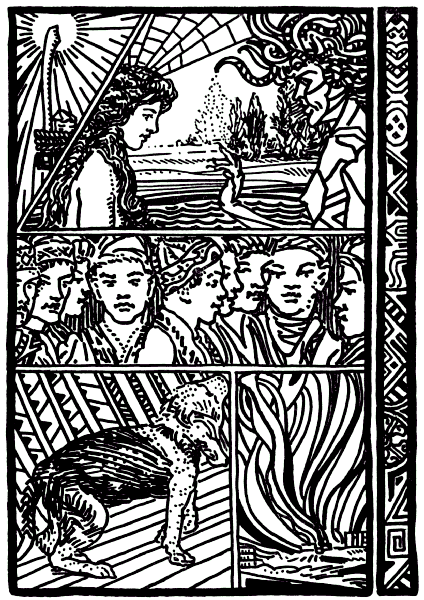
Suyettar bewitching Kerttu beside the lake, Jay Van Everen, 1922
The printed caption names Suyettar bewitching Kerttu in Fillmore’s The Little Sister. Van Everen combines the lake encounter, the brothers and other story motifs in one composition; it is a narrative illustration rather than a fixed portrait of Kerttu’s enchanted appearance.
Overview
Kerttu is born after nine sons who had promised to remain home if their mother had a daughter. Suyettar changes the birth announcement from a spindle to an axe, making the boys believe another son was born and causing their departure. When Kerttu later learns the cause of her mother’s grief, she searches for the brothers with Musti, her speaking dog, following a rolling cake made by her mother. Suyettar joins her on the road and repeatedly urges her to bathe in a lake. Musti prevents this until the witch kills him.
Once Kerttu is persuaded to enter the water, Suyettar forces her to splash the witch’s face. A spell exchanges their appearances: the witch becomes a pretty girl while Kerttu looks like an old woman. Suyettar takes her speech and memory, impersonates her among the brothers and presents her as a foolish servant. Each morning she returns those faculties when sending Kerttu to herd a cow, then removes them at the evening gate. The girl expresses her identity and suffering in a song, which the youngest brother overhears. All nine eventually question her and recognise the deception.
They trick Suyettar into washing Kerttu’s apparently sore eyes, allowing a counter-spell to return their respective appearances. The brothers pretend not to notice the reversal, then lead the witch into the sauna and burn it. Kerttu and her nine brothers return to their mother, who recognises them when the girl announces their shared parentage. Fillmore’s narrative is a 1922 retelling, not an independently collated original Finnish account. Kerttu’s lost speech and memory are reversible enchantments, not a medical diagnosis.
Origins & earliest records
Parker Fillmore, Mighty Mikko (1922), The Little Sister, printed pp. 101–120; author’s note vii–xi.
Records & interpretation
Complete English retelling, including the restored appearance, sauna destruction and reunion. The author explicitly offers his own versions rather than literal translations.
Selected bibliography
Documented works and useful reading. This is not a list of every appearance.
- 01
Mighty Mikko: The Little Sister, pp. 101–120
Complete selected narrative. Nine brothers share Kerttu’s mother; Suyettar impersonation is not biological sisterhood. Musti’s death remains unreversed.
Family, evolution & connections
Kerttu and nine older brothers — Fillmore’s retelling
The complete Little Sister retelling, pp.101–120.
Scroll sideways to see all branches. With a keyboard, focus the tree and use the arrow keys.
- Unnamed mother and father (father dies early)
- Nine unnamed older sons (collective sibling group)
Explicit shared mother and father in the opening, followed by reunion with the surviving mother. Parents and brothers have no personal names. The younger brother who investigates is one of the nine, not an additional son. Suyettar’s false sisterhood and Musti’s companionship are excluded. This is Fillmore’s literary retelling, not a literal transcript of a Finnish narrator.
Her mother and father
The opening identifies the nine boys as the couple’s sons and Kerttu as their later daughter. Their father dies early; their mother survives to welcome the children home.
Her nine older brothers
Kerttu is the younger sister the nine brothers wanted. Her changed appearance does not alter that family relationship; the youngest brother first investigates her account.
Suyettar impersonating Kerttu in The Little Sister
Suyettar steals Kerttu’s appearance and claims to be the brothers’ sister. Their acceptance is a mistake later exposed, not evidence that Suyettar is a biological sibling or that the women share an identity.
References
Sources supporting this profile. Linked pages have their own scope and editorial standards.
- Primary historical literary retelling of folkloreFillmore1922: The Little SisterResearch access: 2026-10-05
Image credits
Historical illustrationSuyettar bewitching Kerttu beside the lake, Jay Van Everen, 1922
The printed caption names Suyettar bewitching Kerttu in Fillmore’s The Little Sister. Van Everen combines the lake encounter, the brothers and other story motifs in one composition; it is a narrative illustration rather than a fixed portrait of Kerttu’s enchanted appearance.