Jorinde’s Owl Witch
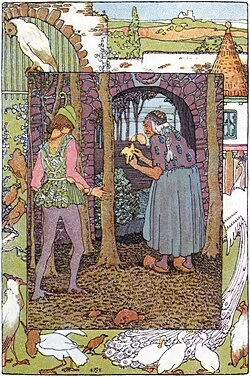
Actual Vogeler image individually inspected: old witch holds captive bird while Joringel approaches with red flower, rows of birds below. Named Jorinde/Joringel source and profile scene agree; human-form witch, not owl depiction.
Overview
The witch inhabits a forest castle and takes cat or screech-owl shape during the day, returning to human form at evening. Anyone within a hundred paces cannot move until she releases them; young women are changed into birds and placed in cages. The story counts about seven thousand such cages. When Jorinda approaches, she becomes a nightingale and Joringel is immobilised.
The owl circles with glowing eyes before the witch emerges as a lean, crooked woman with large red eyes and a hooked nose reaching her chin. She removes the bird and rejects Joringel's pleas. He later finds a red flower with a pearl-like dew drop, which allows him to enter without paralysis. Touching the hidden cage restores Jorinda; touching the witch removes her power to enchant. The source does not narrate her death.
Origins & earliest records
The witch appears in Grimm's tale69, Jorinde und Joringel, selected through Margaret Hunt's1884 translation, which renders the maiden's name Jorinda. The profile preserves that edition distinction while using the more familiar searchable name. It is a recorded shapeshifting antagonist; the literary date does not establish the origin of all owl-witch or captive-bird traditions.
Records & interpretation
The primary narrative states the daily forms, hundred-pace boundary, physical human features and flower counterspell. Its cage total is narrative scale, not an observed census. The final touch removes enchantment power but does not explicitly kill her. This supplies textual evidence for one fairy-tale witch, not zoological evidence or a historical description of real women.
In the literature
“she changed herself into a cat or a screech-owl”
Tale 69, Jorinde and Joringel; Opening account of the witch’s daylight forms · Margaret Hunt
The text gives two animal forms and distinguishes them from her nighttime human appearance.
Selected bibliography
Documented works and useful reading. This is not a list of every appearance.
- 01
Household Tales, tale 69: Jorinda and Joringel
Specific numbered primary tale inspected. English translation terms and literary transmission remain distinct from oral origin.
- 02
Household Tales — Jorinde and Joringel
Margaret Hunt historical English translation (1884); Project Gutenberg5314. Exact numbered tale and observed HTML anchor used; no inferred printed page or earliest oral date.
Family & connections
A source-supported family tree or inspiration record has not yet been compiled for this profile. Related reading below indicates a connection in subject matter, not a proven lineage or creative influence.
Located primary passages
Specific passages supporting details in this entry, grouped by their published witness.
Household Tales, tale 69: Jorinda and Joringel
Margaret Hunt historical English translation (1884); Project Gutenberg5314. Exact numbered tale and observed HTML anchor used; no inferred printed page or earliest oral date.
- The castle witch takes cat or screech-owl form by day and human form at night. People within a hundred paces become immobile; maidens become caged birds. Jorinde becomes a nightingale while Joringel cannot move, and the owl returns to human shape at sunset.
Tale 69, Jorinde and Joringel; Day and night forms, captive maidens and boundary
- Joringel follows a dream and finds a blood-red flower after nine days. It protects him from immobilization, opens the castle and defeats the witch’s approach. Touching Jorinde and the witch with it restores Jorinde and breaks the witch’s power; this selected text does not narrate a separate restoration of the other captives.
Tale 69, Jorinde and Joringel; Flower quest and restoration of the captives
Complete named tale read. Original narrative curse causes and modern species identities are not inferred; prose only, no song or ritual-formula excerpts.
References
Sources supporting this profile. Linked pages have their own scope and editorial standards.
- Primary textHunt's Household Tales — 69 Jorinda and JoringelResearch access: 2026-10-05
Image credits
Historical illustrationJorinde’s Owl Witch
Actual Vogeler image individually inspected: old witch holds captive bird while Joringel approaches with red flower, rows of birds below. Named Jorinde/Joringel source and profile scene agree; human-form witch, not owl depiction.