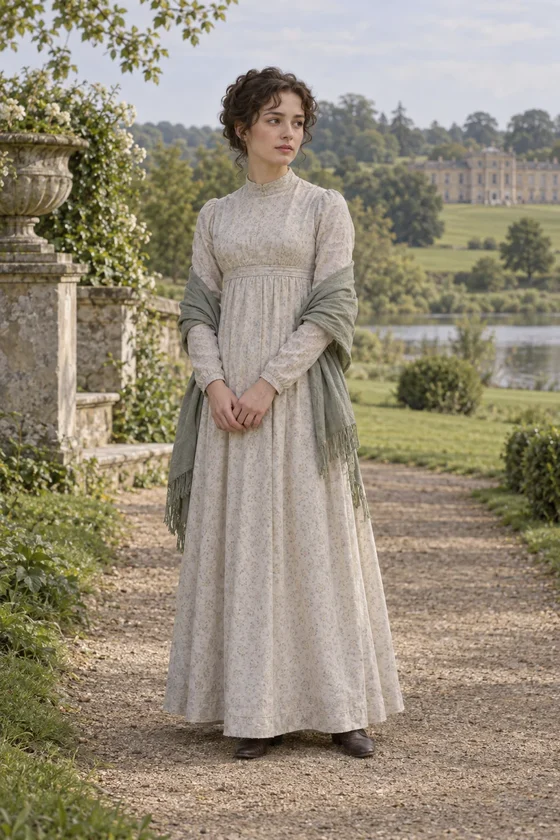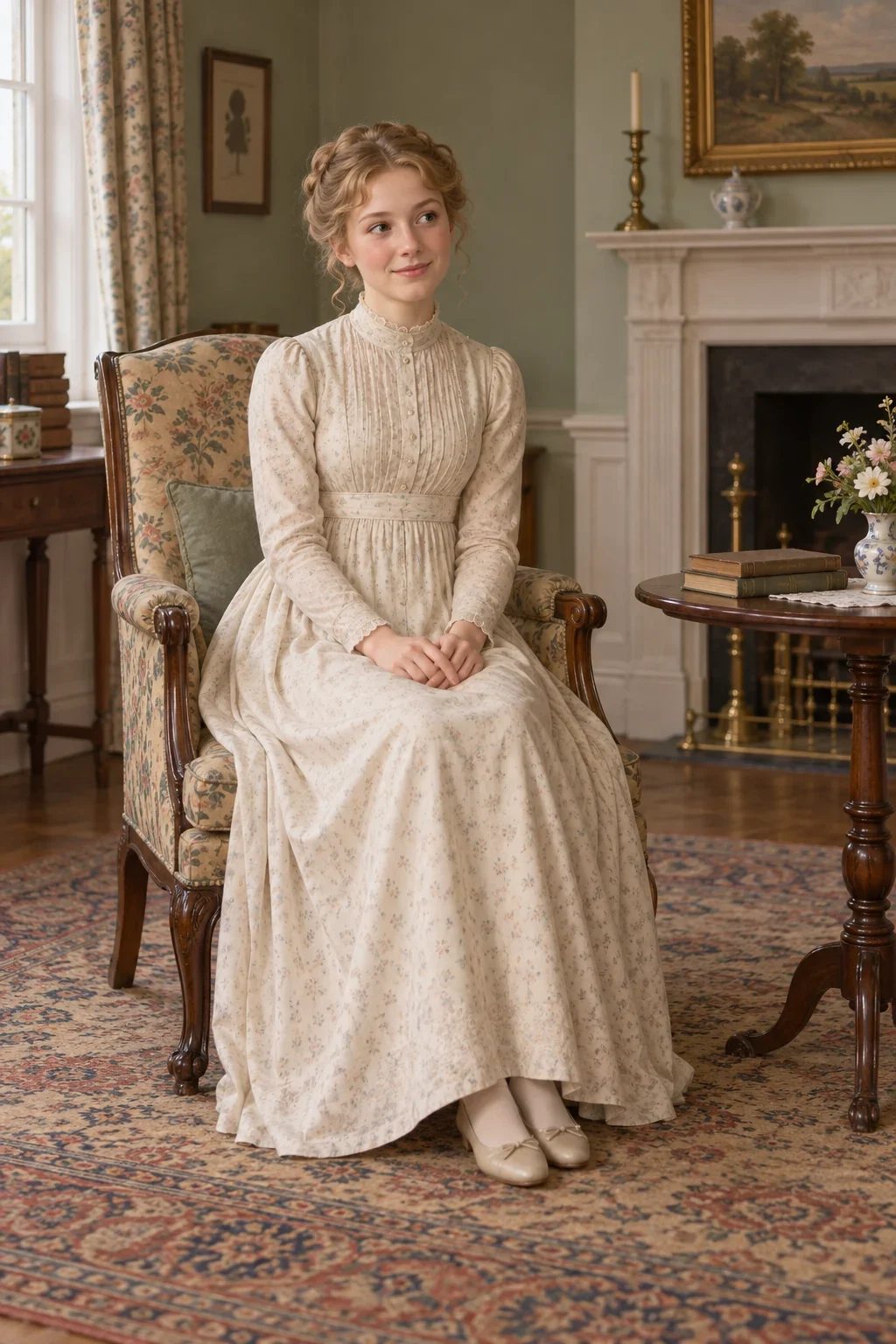
Imagined Jane Bennet in a quiet original-novel portrait.
Unofficial AI interpretation. Jane pauses in Longbourn’s sitting room. Selected object or posture follows the original novel; exact portrait, unmentioned clothing and scene arrangement are imagined, without an adaptation likeness claim. Full-frame display derivative; no upscaling.
Overview
Jane Bennet is the eldest Bennet daughter and Elizabeth’s closest family confidante in Pride and Prejudice. Her beauty attracts Bingley at the first assembly, while her kindness and reluctance to condemn others shape the conversations in which Elizabeth tries to interpret events. She is not simply a silent decoration in her sister’s story: her attachment, illness, disappointment and eventual engagement drive important changes in the family’s prospects. Her reserved expression also creates a gap between what she feels and what observers think they can read. The novel makes that gap consequential without establishing that she deliberately deceives Bingley about her affection.
A visit to Netherfield is prolonged by illness after she travels there in bad weather. Elizabeth comes to care for her, making the episode a test of relations among the Bennets, Bingley’s sisters and Darcy. Bingley’s evident attention gives the family grounds for expectation, but his departure to London interrupts the courtship. Caroline Bingley’s letters present prospects that Elizabeth distrusts more quickly than Jane does. Jane tries to avoid blaming others and gradually accepts that her hopes may not be fulfilled. This restraint coexists with real pain; it should not be mistaken for a lack of interest or a complete absence of self-understanding.
Her stay with the Gardiners in London provides an opportunity for renewed contact, but Caroline’s delayed and cool visit makes the friendship’s limits clearer. Darcy later admits that he concealed Jane’s presence from Bingley and that he had judged her indifferent. The separation is therefore produced partly by intervention and misreading, not by a demonstrated decision that the pair are incompatible. Jane’s generosity also influences her response to other family crises. When Lydia leaves with Wickham, she hopes for a less damaging explanation longer than Elizabeth does and helps manage communication while the family waits for news.
Bingley’s return to Hertfordshire renews the acquaintance, and their engagement eventually makes her happiness openly visible. Elizabeth shares the relief while recognising how much had been concealed behind Jane’s composed manner. The concluding chapter describes their married life and a later move closer to Pemberley, maintaining the connection between the two sisters. This profile follows the original novel’s marriage and family relationships, rather than supplying a later sequel’s children or an adaptation’s fixed fair-haired portrait. Jane’s habitual good will remains an important trait with practical limits: it can preserve affection, but it can also delay recognition of manipulative conduct. Her kindness and vulnerability belong to the same character, not to separate simplified roles.
First appearances & development
Jane Austen’s Pride and Prejudice establishes this character through the Bennet sisters’ courtships and changing judgments. This profile follows the selected original narrative and does not combine adaptation continuity with it.
Canon & continuity
Original narrative.
Selected bibliography
Documented works and useful reading. This is not a list of every appearance.
- 01
Pride and Prejudice
Original.
Family & connections
A source-supported family tree or inspiration record has not yet been compiled for this profile. Related reading below indicates a connection in subject matter, not a proven lineage or creative influence.
References
Sources supporting this profile. Linked pages have their own scope and editorial standards.
- PrimaryPride and PrejudiceResearch access: 2026-10-12
Image credits
Unofficial modern AI interpretationImagined Jane Bennet in a quiet original-novel portrait.
Unofficial AI interpretation. Jane pauses in Longbourn’s sitting room. Selected object or posture follows the original novel; exact portrait, unmentioned clothing and scene arrangement are imagined, without an adaptation likeness claim. Full-frame display derivative; no upscaling.