Jami, named plate by Toriyama Sekien
Printed title邪魅 and actual illustration inspected. Description records visible composition, not an unchecked translation of cursive text.
Overview
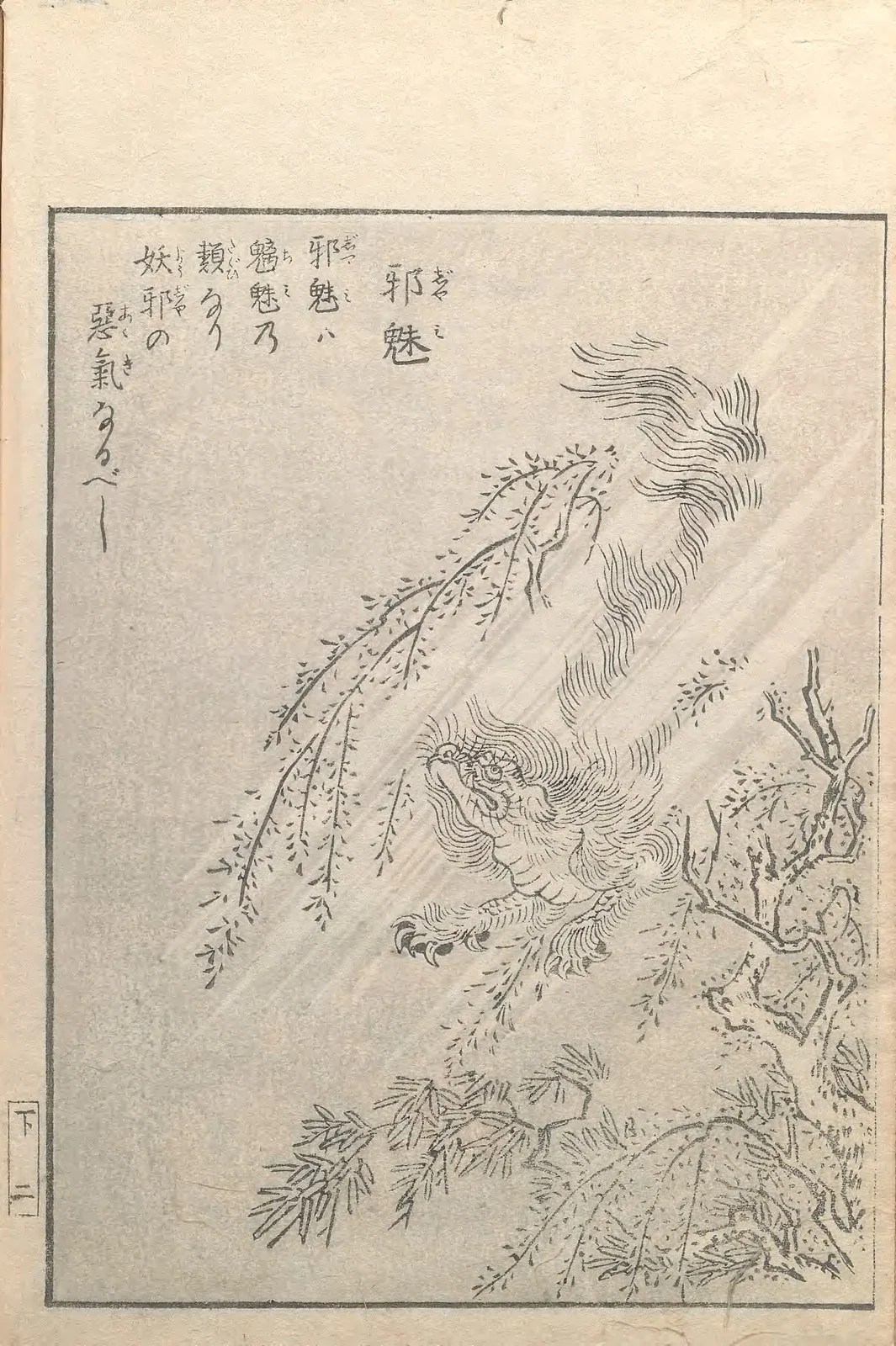
Jami appears as a small, shaggy creature suspended above vegetation. Its long hair streams upward and outward, while a face with a projecting mouth looks toward the lower edge. The arms reach down to visibly hooked fingers. A bare tree stands at the right, and leafy branches lean into the scene from above. Sekien leaves much of the surrounding paper open, so the figure reads as an apparition among plants rather than an animal resting on a defined branch.
The printed title 邪魅 supplies the name. This record preserves that specific depicted creature without converting the broader written category of malign influences into a biological species. The scan supports its illustrated hair, face and claws; exact behavior and geographical distribution remain outside the visible evidence.
Origins & earliest records
Toriyama Sekien includes the named illustration in Konjaku Gazu Zoku Hyakki, first published 1779. The inspected Smithsonian copy is a later historical edition; the first book appearance is not a claim of the earliest oral tradition.
Records & interpretation
Directly inspected historical illustration and printed name. Pictorial observations are distinguished from narrative claims that would require a separate checked text.
Selected bibliography
Documented works and useful reading. This is not a list of every appearance.
- 01
Konjaku Gazu Zoku Hyakki
Volume 3, IIIF canvas index 5 (zero-based); printed title 邪魅 directly inspected.
Family & connections
A source-supported family tree or inspiration record has not yet been compiled for this profile. Related reading below indicates a connection in subject matter, not a proven lineage or creative influence.
Primary records and illustrations
Konjaku Gazu Zoku Hyakki
Volume3; Smithsonian Libraries copy. IIIF canvas index 5 (zero-based)
Printed title邪魅 and actual illustration inspected. Description records visible composition, not an unchecked translation of cursive text.
Encyclopedia background
An additional attributed reference, separate from the editorial profile above.
Read the open encyclopedia overview
Nūr ad-Dīn 'Abd ar-Rahmān Jāmī (Persian: نورالدین عبدالرحمن جامی; 7 November 1414 – 9 November 1492), also known as Mawlanā Nūr al-Dīn 'Abd al-Rahmān or Abd-Al-Rahmān Nur-Al-Din Muhammad Dashti, or simply as Jami or Djāmī and in Turkey as Molla Cami, was a Sunni poet who is known for his achievements as a prolific scholar and writer of mystical Sufi literature. He was primarily a prominent poet-theologian of the school of Ibn Arabi and a Khwājagānī Sũfī, recognized for his eloquence and for his analysis of the metaphysics of mercy. His most famous poetic works are Haft Awrang, Tuhfat al-Ahrar, Layla wa Majnun, Fatihat al-Shabab, Lawa'ih, Al-Durrah al-Fakhirah. Jami belonged to the Naqshbandi Sufi order.
Text from Wikipedia contributors, “Jami”. CC BY-SA 4.0. Extracted introduction; formatting changed. Retrieved 5 October 2026. The source article may have changed since retrieval.
References
Sources supporting this profile. Linked pages have their own scope and editorial standards.
- Institutional primary-book recordSmithsonian Libraries — historical illustrated volumeResearch access: 2026-10-05
- Direct primary illustrationNamed primary plate: 邪魅Research access: 2026-10-05
Image credits
Historical illustrationJami, named plate by Toriyama Sekien
Printed title邪魅 and actual illustration inspected. Description records visible composition, not an unchecked translation of cursive text.