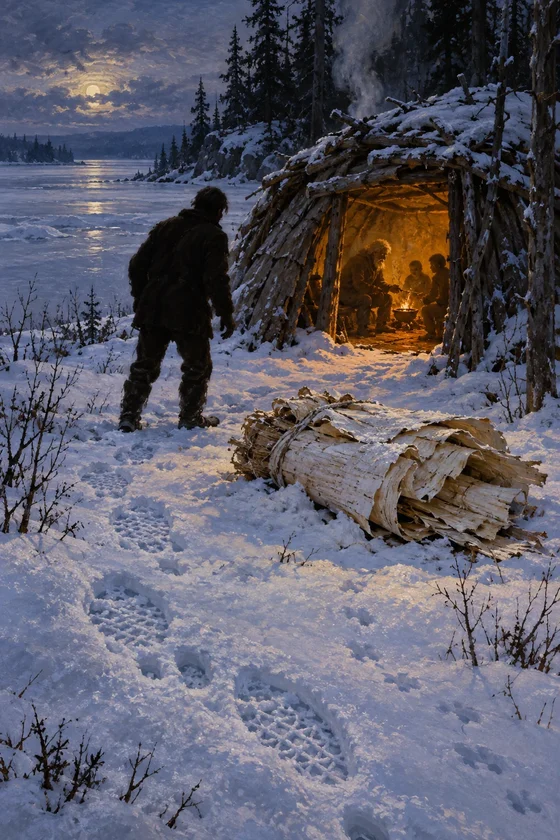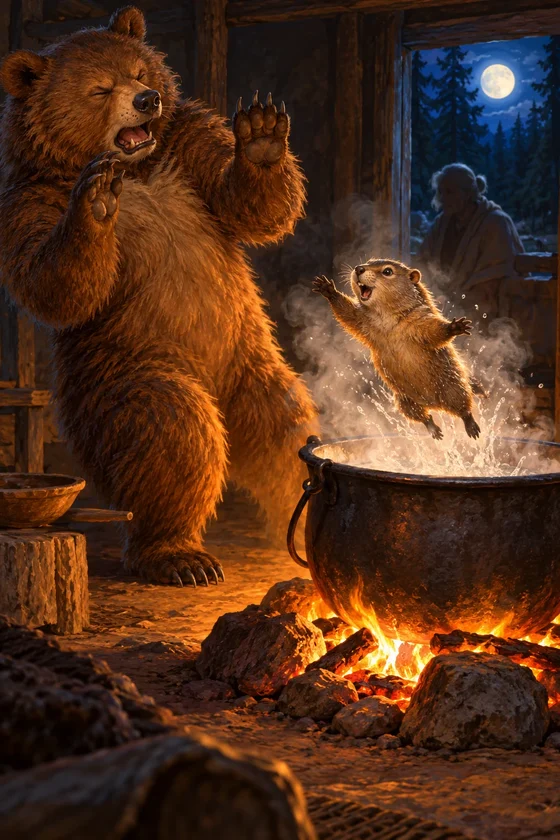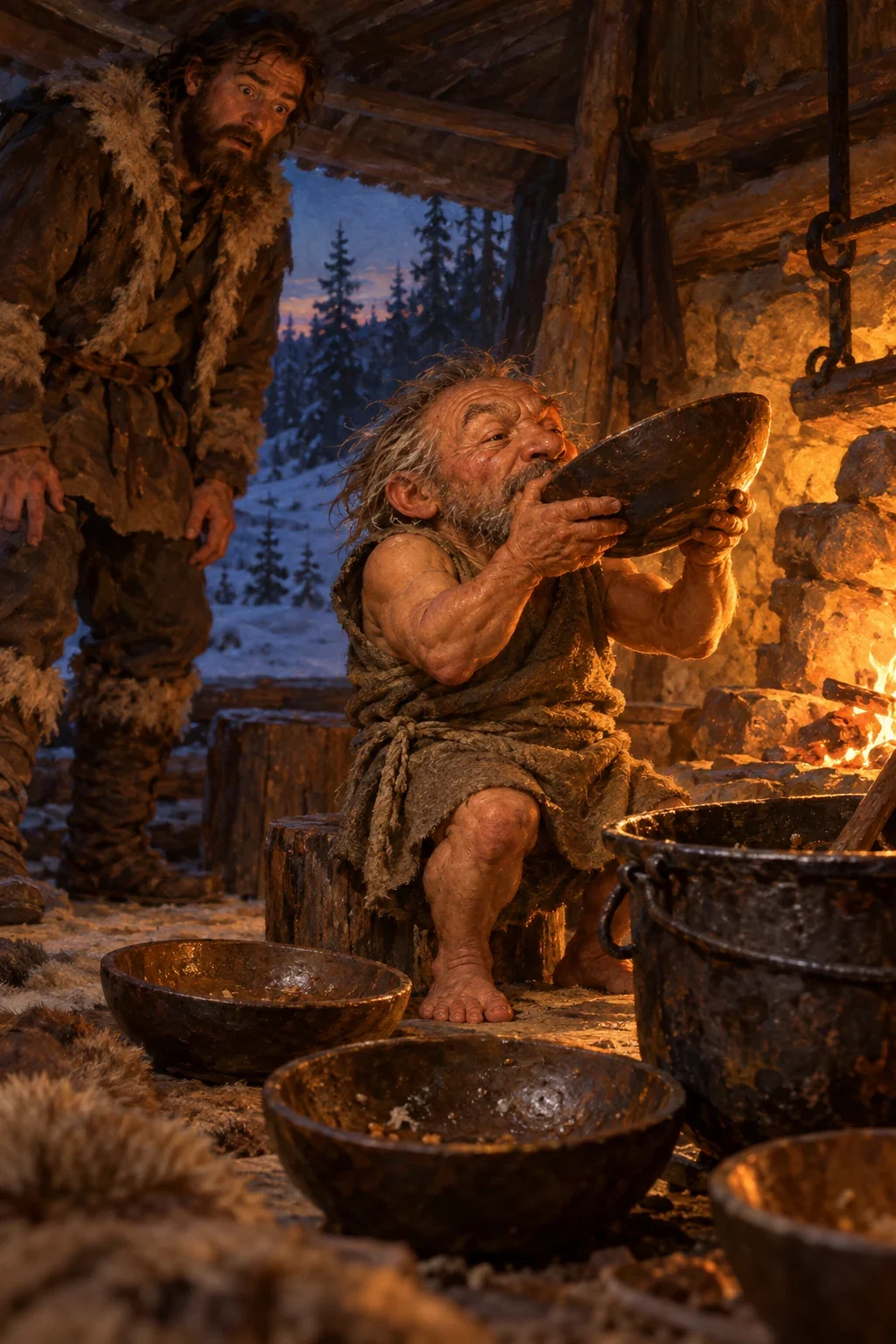
AI-generated interpretation of the hungry visitor consuming the brothers’ food in Nancy Jeddore’s Fairy account, translated by Rand. Small stature, large appetite and a watching householder follow the narrative. Old-adult face, bodies, hair, wraps, bowls, shelter, season and light are imagined; no historic portrait or cultural reconstruction is claimed.
AI-generated interpretation of the hungry visitor consuming the brothers’ food in Nancy Jeddore’s Fairy account, translated by Rand. Small stature, large appetite and a watching householder follow the narrative. Old-adult face, bodies, hair, wraps, bowls, shelter, season and light are imagined; no historic portrait or cultural reconstruction is claimed.
Overview
Three unmarried brothers share hunting and housework in a solitary woodland home. A very small person, compared in size to the tiniest child, arrives when one brother has prepared supper. His requests seem pitiable and sincere. Fed repeatedly, he eats everything intended for all three men. The next brother resolves to resist him but likewise yields to his appeals. The eldest, keeping house on the third day, refuses food and orders him away. The visitor will not leave, and their struggle reveals strength as extraordinary as his appetite.
Finding himself overmatched, the brother releases the little man, then pursues him with a sharp iron weapon. He throws it at a precipice, piercing the fugitive, who immediately enters the rock with the iron still through him. Next day the visitor returns and asks for its removal. The brother refuses until he is promised help finding wives for himself and his companions. When the weapon is withdrawn, the visitor says that curing the wound will be easy. The narrative supplies that assurance, rather than a separately described healing procedure.
The guide brings all three brothers to a door at the top of a high cliff. It opens into a spacious cave chamber, where small women sit in a row and men occupy rows above them. The brothers are told to choose wives from the women. They initially refuse, then each takes one home, despite expecting the women to desert them. Next morning the women say that they know how to cook and keep house. The brothers leave to hunt, but return to find the home empty. That departure closes the account; there is no pursuit, recovered marriage or punishment of the visitor.
Nancy Jeddore told this story on23July1871. Rand’s heading translates the being as Fairy, and the text records a local term with a pronunciation attributed to her. Neither establishes that he is identical with every European fairy or with another named Mi’kmaw helper. His unusual appetite, strength, rock passage and bargain define this particular encounter. The final phrase about birds having flown is a metaphor for the women’s disappearance, not an explicit change into birds. No wings, pointed ears or fixed costume are supplied for the small people.
Origins & earliest records
Rand, Legends of the Micmacs, LXXXII, The Fairy, pp431–433; Nancy Jeddore,23July1871. Historical English translation edited by Helen L. Webster in1894.
Records & interpretation
Complete narrative including the cave and failed marriages, not a verified supernatural encounter or present universal classification. Rand’s English reconstruction and Webster’s later editing mediate the telling.
Selected bibliography
Documented works and useful reading. This is not a list of every appearance.
- 01
Legends of the Micmacs, LXXXII: The Fairy
Complete pp431–433 and closing attribution. Local-term pronunciation appears in main text, not a separate numbered note; complete editorial prefacev–ix retained.
Family & connections
A source-supported family tree or inspiration record has not yet been compiled for this profile. Related reading below indicates a connection in subject matter, not a proven lineage or creative influence.
References
Sources supporting this profile. Linked pages have their own scope and editorial standards.
- Primary historical translated collectionRand1894, The FairyResearch access: 2026-10-27
Image credits
AI-generated illustrationAI-generated interpretation of the hungry visitor consuming the brothers’ food in Nancy Jeddore’s Fairy account, translated by Rand. Small stature, large appetite and a watching householder follow the narrative. Old-adult face, bodies, hair, wraps, bowls, shelter, season and light are imagined; no historic portrait or cultural reconstruction is claimed.
AI-generated interpretation of the hungry visitor consuming the brothers’ food in Nancy Jeddore’s Fairy account, translated by Rand. Small stature, large appetite and a watching householder follow the narrative. Old-adult face, bodies, hair, wraps, bowls, shelter, season and light are imagined; no historic portrait or cultural reconstruction is claimed.