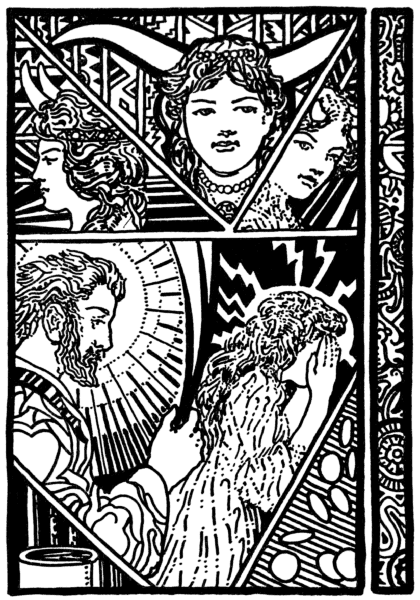
Three horned princesses and the youngest bride’s release scene, Jay Van Everen, 1922
The upper panels depict the king’s horned daughters, while the lower scene shows the servant striking the youngest bride in Fillmore’s Mysterious Servant. This violence and the claimed magical release are part of the retelling, not a treatment for bodily difference. The elder sisters have no corresponding release scene.
Overview
A prophecy warns Matti’s father that the boy will marry a horned woman if he leaves his native village. After travelling and returning with a mysterious servant, Matti learns that the king has three horned daughters. The eldest has long, thick horns and a hoarse voice; the second has smaller horns and a less hoarse voice. The youngest has soft, slight horns. Matti rejects the first two on the servant’s advice and chooses the youngest, whom he finds gentle and modest.
After the wedding, the servant violently beats the bride. Matti tries to stop him, but he claims to be releasing her from an enchantment. When the beating draws blood, her horns fall away and she becomes a beautiful young woman. This is the retelling’s stated magical outcome, not a factual claim about injury curing bodily difference. Neither the enchantment’s origin nor its caster is named. The two elder sisters do not receive a corresponding restoration scene, and the youngest never receives an individual name.
Origins & earliest records
Parker Fillmore, Mighty Mikko (1922), The Mysterious Servant, printed pp. 195–206; author’s note vii–xi.
Records & interpretation
Complete English retelling, including explicit final divine identification and the youngest bride’s stated release. Historical violence is described as a story event, not a therapeutic practice.
Selected bibliography
Documented works and useful reading. This is not a list of every appearance.
- 01
Mighty Mikko: The Mysterious Servant, pp. 195–206
Complete selected narrative. Divine visitor explicitly God, not inferred grateful-dead ghost; elder sisters’ restoration not stated.
Family & connections
A source-supported family tree or inspiration record has not yet been compiled for this profile. Related reading below indicates a connection in subject matter, not a proven lineage or creative influence.
References
Sources supporting this profile. Linked pages have their own scope and editorial standards.
- Primary historical literary retelling of folkloreFillmore1922: The Mysterious ServantResearch access: 2026-10-05
Image credits
Historical illustrationThree horned princesses and the youngest bride’s release scene, Jay Van Everen, 1922
The upper panels depict the king’s horned daughters, while the lower scene shows the servant striking the youngest bride in Fillmore’s Mysterious Servant. This violence and the claimed magical release are part of the retelling, not a treatment for bodily difference. The elder sisters have no corresponding release scene.