The mysterious servant in Van Everen’s1922 horned-bride narrative scene
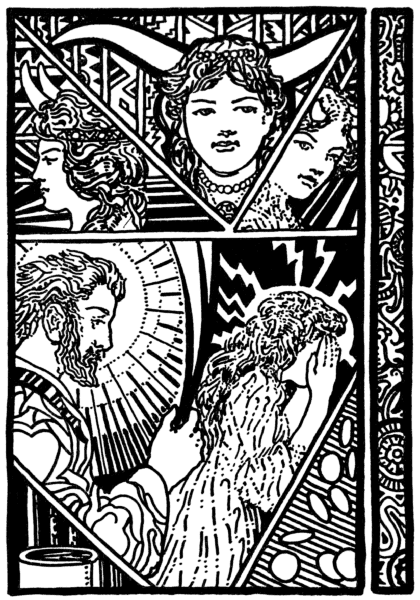
Van Everen depicts the servant striking the youngest bride beneath panels of the three horned princesses. Fillmore’s concluding narrator identifies him as God in a servant’s form; the image belongs to this particular retelling rather than a universal Finnish theological tradition.
Overview
After Matti spends his inheritance paying the debts of a man whose corpse was being abused, a stranger offers to serve him despite his poverty. The servant orders substantial meals at inns, then pays by placing three of Matti’s remaining coins into a borrowed measure and shaking it until full of silver. He repeats the multiplication on their journey home. He also knows the prophecy concerning Matti’s marriage and directs him to choose the king’s youngest horned daughter.
The servant subsequently claims to release the bride’s enchantment by a violent beating, after which her horns fall off. He announces that his work is finished, predicts that the king will make Matti heir and disappears. The concluding narrator explicitly identifies him as God in a servant’s form, rewarding Matti’s respect for the dead. He is therefore not identified as the buried debtor’s returning ghost. His divine identity belongs to Fillmore’s Christian-framed retelling; it is not evidence of a universally held Finnish theological account.
Origins & earliest records
Parker Fillmore, Mighty Mikko (1922), The Mysterious Servant, printed pp. 195–206; author’s note vii–xi.
Records & interpretation
Complete English retelling, including explicit final divine identification and the youngest bride’s stated release. Historical violence is described as a story event, not a therapeutic practice.
Selected bibliography
Documented works and useful reading. This is not a list of every appearance.
- 01
Mighty Mikko: The Mysterious Servant, pp. 195–206
Complete selected narrative. Divine visitor explicitly God, not inferred grateful-dead ghost; elder sisters’ restoration not stated.
Family & connections
A source-supported family tree or inspiration record has not yet been compiled for this profile. Related reading below indicates a connection in subject matter, not a proven lineage or creative influence.
References
Sources supporting this profile. Linked pages have their own scope and editorial standards.
- Primary historical literary retelling of folkloreFillmore1922: The Mysterious ServantResearch access: 2026-10-05
Image credits
Historical illustrationThe mysterious servant in Van Everen’s1922 horned-bride narrative scene
Van Everen depicts the servant striking the youngest bride beneath panels of the three horned princesses. Fillmore’s concluding narrator identifies him as God in a servant’s form; the image belongs to this particular retelling rather than a universal Finnish theological tradition.