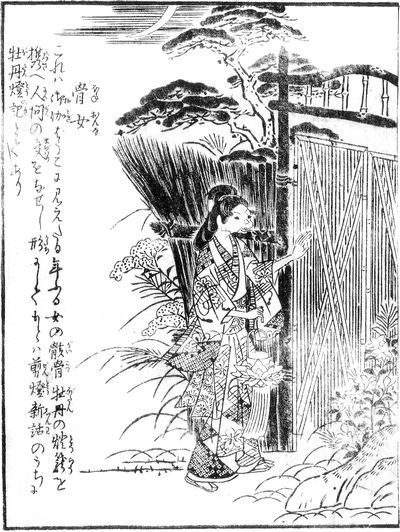
Hone-onna
Image associated with the exact linked encyclopedia article; consult credited file description for its interpretation.
Overview
Hone-onna means bone woman and names a female figure whose skeletal identity contrasts with a human appearance. Sekien includes her in his second illustrated encyclopedia. Later contextual readings connect the image with ghost-love narratives such as Botan Dōrō, where desire can prevent a living lover from recognizing a dead companion. The relationship is useful, but the print and a specific prose story remain separate kinds of witness.
A skeletal body can reveal death to an outside observer while preserving the beloved's beauty for someone emotionally involved. That difference in perception gives the figure more narrative interest than a simple category of female monster. This entry focuses on the visible bones and on the qualified connection with revenant romance. It does not treat modern rules about who can see the skeleton or how it consumes vitality as universal historical doctrine.
Origins & earliest records
Selected historical witness: Konjaku Gazu Zoku Hyakki (1779) by Toriyama Sekien. The linked library record identifies a surviving printed edition; it does not establish when the belief first arose.
Records & interpretation
The historical illustration and individual contextual reference support this profile. Named motifs, local narratives and later explanations are distinguished; image-to-plate matching still needs review.
Selected bibliography
Documented works and useful reading. This is not a list of every appearance.
- 01
Konjaku Gazu Zoku Hyakki
Selected historical witness; individual illustration now checked in the separately linked primary scan. This edition is not a claim of the earliest oral attestation.
Family & connections
A source-supported family tree or inspiration record has not yet been compiled for this profile. Related reading below indicates a connection in subject matter, not a proven lineage or creative influence.
Primary records and illustrations
Konjaku Gazu Zoku Hyakki
Volume 2; Smithsonian Libraries digitized copy. IIIF canvas index 23 (zero-based); Konjakuzokuhyak2Tori_0024.jp2
Printed 骨女 with reading ほねおんな; a woman with a partly skeletal face carries a lantern beside a fence under the moon. Label checked at1000 pixel scan width; cursive explanatory text not fully transcribed.
Encyclopedia background
An additional attributed reference, separate from the editorial profile above.
Read the open encyclopedia overview
Hone-onna (骨(ほね)女(おんな); "bone woman") is a type of Japanese yōkai first depicted in the Konjaku Gazu Zoku Hyakki (1779) by Toriyama Sekien, and retroactively originated in the famous kaidan Botan Dōrō (1666) by Asai Ryōi. As their name implies, they are depicted as women in the form of bones, though to the men they loved back when they were alive, they appear as beautiful women.
Text from Wikipedia contributors, “Hone-onna”. CC BY-SA 4.0. Extracted introduction; formatting changed. Retrieved 5 October 2026. The source article may have changed since retrieval.
References
Sources supporting this profile. Linked pages have their own scope and editorial standards.
- Primary illustration / library recordKonjaku Gazu Zoku Hyakki — historical library editionResearch access: 2026-10-05
- Secondary referenceHone-onna — contextual overview and bibliographyResearch access: 2026-10-05
- Primary illustrated plate / institutional digitizationKonjaku Gazu Zoku Hyakki — directly inspected IIIF canvas index 23 (zero-based); Konjakuzokuhyak2Tori_0024.jp2Research access: 2026-10-05
Image credits
Reference illustrationHone-onna
Image associated with the exact linked encyclopedia article; consult credited file description for its interpretation.