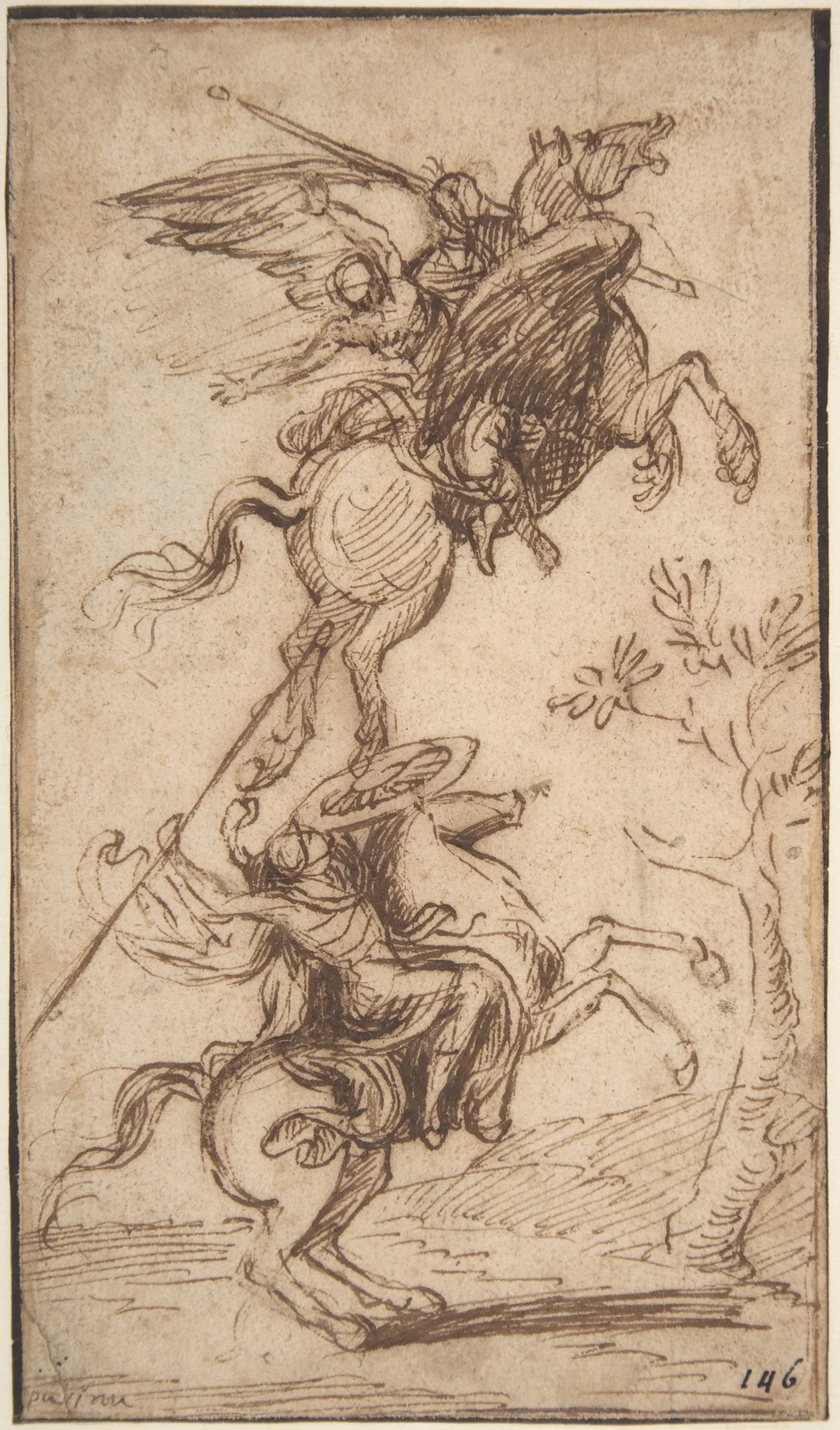
Poussin’s winged hippogriff carrying Atlante and Pinabello’s lady above a pursuing horseman
Poussin illustrates Atlante abducting Pinabello’s lady in Orlando Furioso, canto II, stanza 38. The broad wings, clawed forefeet and horse-like hindquarters belong to this representation. The Met distinguishes this scene from the formerly proposed identification of Rogero departing from Bradamant.
Overview
In Canto IV of Orlando Furioso, Ludovico Ariosto introduces the hippogriff as a real animal within the fictional world, expressly distinguishing it from an illusion produced by its magician rider. William Stewart Rose’s translation describes its mother as a mare and its father as a griffin. Its beak, crest, wings and forefeet resemble the father, while the remaining body resembles the mother. The poem places these rare creatures beyond the frozen ocean in the Riphaean hills. That is the romance’s geography, not evidence for a historical range or a natural animal.
The magician Atlantes takes one from its lair and trains it over a month to accept saddle and bit and to move both on the ground and through the air. During the encounter with Bradamant, the flying mount serves a rider who also uses a dazzling shield. Protected by her ring, Bradamant pretends to have fallen under the enchantment; Atlantes dismounts and is captured. The castle’s destruction releases its prisoners, but the hippogriff remains a separate problem. It escapes those trying to catch it until Rogero mounts, when it carries him away beyond his control. The episode attributes the removal of Rogero from Europe to Atlantes’s plan, rather than treating the creature as innately malicious.
Canto X gives a later lesson in control. Logistilla prepares a new means of restraining the mount and teaches Rogero how to make it rise, descend, turn, hover and change speed. His ability to direct the journey therefore belongs to a particular stage of the narrative. A summary that makes every rider automatically master the animal would erase the contrast between his earlier helpless flight and this instruction.
In Canto XXXIV, Astolpho rides the hippogriff up a great mountain and then dismounts at the terrestrial paradise. The creature receives fodder while its rider is welcomed and meets John. The subsequent journey to the moon takes place in Elijah’s chariot drawn by four horses. The inspected episode therefore does not support the familiar shorthand that Astolpho flies to the moon on the hippogriff. Mount, rider and means of travel must be tracked separately through the scene.
A later visual witness is Nicolas Poussin’s drawing The Sorcerer Atlante Abducting Pinabello’s Lady, dated about 1635–1638 in the Metropolitan Museum of Art catalogue. The museum identifies its subject with Canto II, stanza 38, rather than a different scene involving Rogero and Bradamant. It documents artistic reception of the romance, not an independent animal sighting. The hippogriff’s griffin-and-mare parentage is likewise a narrative family relationship. Pegasus and later franchise hippogriffs may be useful comparisons, but resemblance alone does not establish a creator-confirmed chain of inspiration.
Origins & earliest records
Orlando Furioso first appeared in 1516 and reached its final authorial version in 1532. These publication dates do not establish that the inspected wording was present in the first edition. This profile follows Rose’s public-domain English translation; the verified volume I title page is dated 1823.
Records & interpretation
Read Canto IV stanzas XII–L, Canto X LXV–LXXII, and Canto XXXIV XLVIII–LXXI in Rose’s translation. The Poussin museum record was read for attribution and subject, but image pixels were not accepted by root. The evidence establishes literary and artistic witnesses, not biological existence.
In the literature
“For him a filly to griffin bore;”
CantoIV XII–L, parentage XVIII · William Stewart Rose
CantoIVXVIII explicitly states the fictional mount’s parentage.
Selected bibliography
Documented works and useful reading. This is not a list of every appearance.
- 01
Orlando Furioso
Inspected passages: IV XII–L; X LXV–LXXII; XXXIV XLVIII–LXXI. Volume I title date verified separately; no claim that the whole poem or the 1516 edition was inspected.
- 02
The Sorcerer Atlante Abducting Pinabello’s Lady
Artistic adaptation; Metropolitan Museum object 1972.118.224. Museum identifies Ariosto II.38; catalogue record inspected, image acceptance pending.
- 03
Orlando Furioso: hippogryph encounters and instruction
William Stewart Rose historical English translation; volumeI London: JohnMurray,1823 title independently read in Wikisource. Translation published1823–1831; exact assembled Gutenberg print impression unidentified. Original poem publication1516/final1532 is contextual, not a claim of collating those versions.
Family, evolution & connections
Ariosto’s hippogriff parentage — IV.18
The steed’s parentage in Canto IV, stanza XVIII, in Rose’s translation.
Scroll sideways to see all branches. With a keyboard, focus the tree and use the arrow keys.
- Unnamed griffin sire and unnamed mare dam
The stanza explicitly names the sire and dam types. Literary genealogy, not real interspecies reproduction or a lineage for all later adaptations. Parents are unnamed individuals, not whole creature classes. The wizard’s training is not parentage. No Virgil influence is inferred.
Unnamed griffin sire in Ariosto IV.18
Rose’s translation identifies a griffin as this steed’s father and assigns its wings, beak, crest and front feet to that parent. This is Ariosto’s fictional parentage, not a biological claim about griffins.
Unnamed mare dam in Ariosto IV.18
The same stanza gives the steed a mare mother and attributes the rest of its form to her. This literary witness is separate from later Harry Potter hippogriffs.
Located primary passages
Specific passages supporting details in this entry, grouped by their published witness.
Orlando Furioso
William Stewart Rose historical English translation; volumeI London: JohnMurray,1823 title independently read in Wikisource. Translation published1823–1831; exact assembled Gutenberg print impression unidentified. Original poem publication1516/final1532 is contextual, not a claim of collating those versions.
- IV makes the animal real within the romance, born to a mare and griffin, with paternal wings, beak, crest and forefeet. Atlantes trains it, uses it in the Bradamant encounter and engineers Rogero’s uncontrolled flight. X shows Logistilla supplying a bit and teaching aerial control. XXXIV has Astolpho ride it to the mountain paradise, dismount and leave it to forage; the subsequent lunar journey uses Elijah’s four-horse chariot.
CantoIV XII–L, parentage XVIII; X LXV–LXXII; XXXIV XLVIII–LXXI
Selected witness only; no first-ever attestation or whole-book inspection claimed. Reported supernatural events are textual testimony, not verified biological facts.
References
Sources supporting this profile. Linked pages have their own scope and editorial standards.
- Primary textAriosto, Orlando Furioso, Rose translationResearch access: 2026-10-05
- Primary textRose translation, volume I title page, 1823Research access: 2026-10-05
- Museum collection recordMetropolitan Museum: Poussin drawing, object 1972.118.224Research access: 2026-10-05
- Museum chronologyMetropolitan Museum timeline: Orlando Furioso publication historyResearch access: 2026-10-05
Image credits
Historical illustrationPoussin’s winged hippogriff carrying Atlante and Pinabello’s lady above a pursuing horseman
Poussin illustrates Atlante abducting Pinabello’s lady in Orlando Furioso, canto II, stanza 38. The broad wings, clawed forefeet and horse-like hindquarters belong to this representation. The Met distinguishes this scene from the formerly proposed identification of Rogero departing from Bradamant.