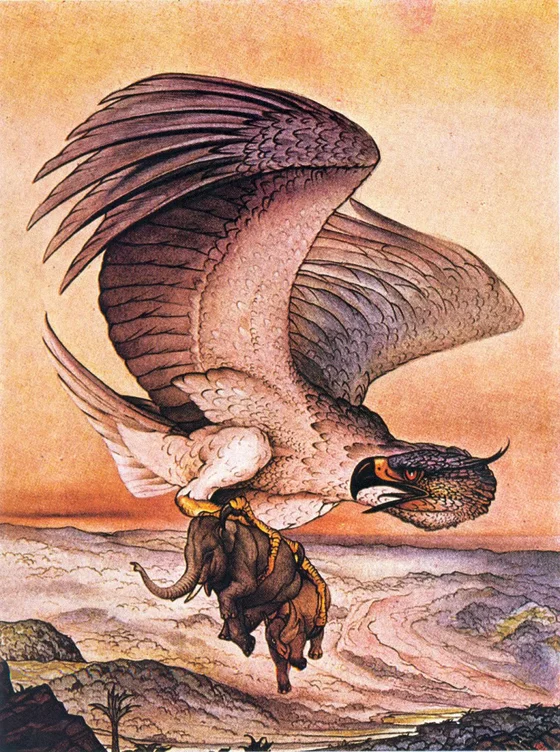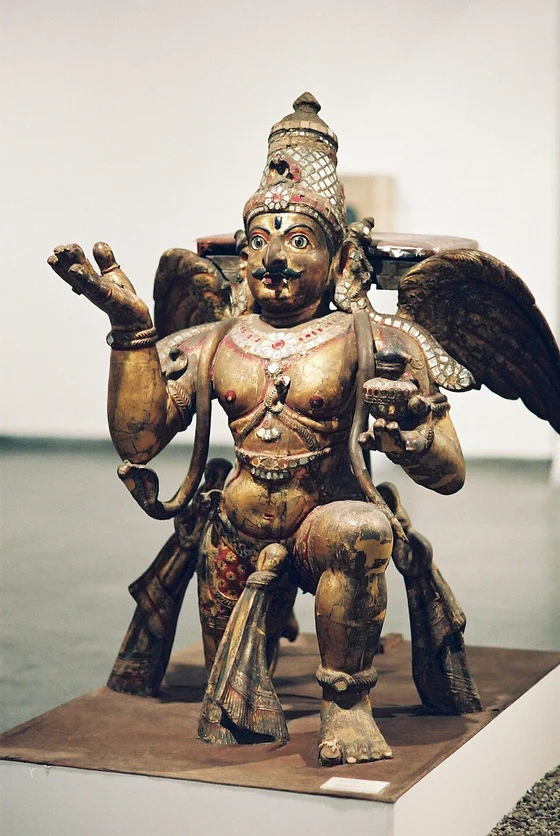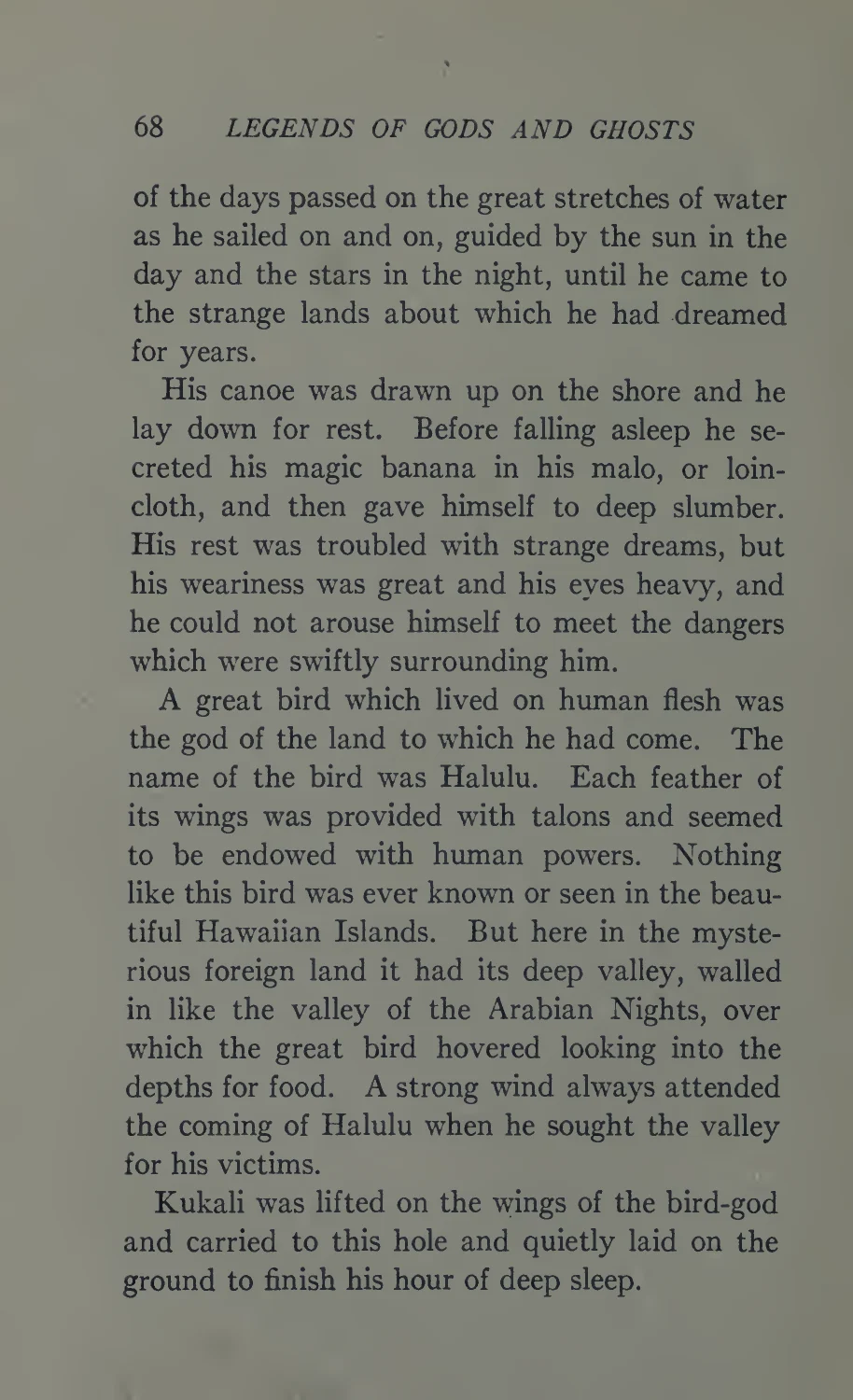
halulu,1915 named narrative passage, printed page68; documentary source-page facsimile
Documentary text facsimile of the exact named narrative, not a creature picture. Local facsimile PDF zero-based index93, printed page68.
Overview
Kukali’s voyage brings him to a distant land, where Halulu lifts him while he sleeps and deposits him among other prisoners in a steep-sided valley. Westervelt describes the bird’s wing feathers as independently effective grasping weapons. Halulu perches above the enclosure and sweeps a wing through it, taking those too weak to escape while stronger captives hide in crevices.
Kukali uses his replenishing banana to feed the prisoners and helps them prepare stone weapons. Together they attack the reaching feathers and limbs until the bird falls among them and is destroyed. Halulu’s surviving breast feathers carry warning to his sister. This episode combines captivity, shared nourishment and collective resistance. The foreign setting is part of a Hawaiian voyage narrative; it does not identify Halulu as a documented animal of another island nation.
The escape continues beyond the attack. The prisoners cut steps into the enclosing walls and use vines to climb out. From above, they throw branches and tree trunks onto Halulu’s remains and burn them, making bodily destruction a separate part of their liberation. Two breast feathers reach his sister Namakaeha, carrying the smell of smoke and revealing that he is dead. Kukali’s subsequent descent into her bottomless pit, survival in a pool of life-giving water and eventual marriage to her extend the voyage into another ordeal. The replenishing banana remains important because it lets him refuse dangerous food offered in the new household.
The bilingual Fornander collection preserves an Aukelenuiaiku version. Halulu’s wings blot out sunlight; it catches the hero’s head in its mouth and carries him into a cliff cave containing four men reserved as food. The prisoners explain that first the right wing, then the left, reaches in to seize victims, followed by the beak. Aukelenuiaiku directs two men deeper into the cave and has the others prepare a fire. Using an axe from the box containing his god, he severs the wings and then the reaching beak. This sequence differs from Westervelt’s Kukali and his replenishing banana.
In the Fornander edition’s English translation, Halulu is Namakaokahai’s cousin. Head feathers reach the queen, who recognizes them as a warning of its death; her brothers judge that it deserved its fate because it ate people. Halulu’s mate, Kiwaha, supplies a shortened rainbow with yellow, red and green colours, allowing the hero and four captives to descend. All four later die after eating foods they were warned were kapu. Aukelenuiaiku returns alone to his wife. The escape and family wording belong to this witness.
Origins & earliest records
The selected witness is chapter IX of Westervelt’s 1915 Legends of Gods and Ghosts. Its distant land is described through the collected narrative’s broad travel vocabulary, which should not be forced into a modern national location. Publication attests this retelling, without supplying the time at which Halulu first entered oral transmission. A second witness is Fornander Collection IV, Legend of Aukelenuiaiku VIII, pp. 64–66, in the Thrum-edited bilingual edition.
Records & interpretation
Westervelt IX describes Kukali’s valley prison and taloned feathers. Fornander IV VIII instead gives Aukelenuiaiku’s cliff cave, severed wings and a rainbow descent. The complete encounter accounts preserve distinct heroes, family wording and aftermaths.
In the literature
“Each feather of its wings was provided with talons”
IX: The Strange Banana Skin; printed p.68; paragraph beginning “A great bird which lived…”
Halulu is a flesh-eating bird-god of the strange foreign land Kukali reaches, with talons on each feather and wind attending his capture of victims into a deep valley.
“The prisoners made steps in the walls”
IX: The Strange Banana Skin; printed p.70; paragraph beginning “Kukali and his companions then…”
Kukali strengthens the prisoners with his banana, equips them with stone weapons, and they destroy Halulu’s wings and legs before cutting his fallen body to pieces, escaping and burning it.
Selected bibliography
Documented works and useful reading. This is not a list of every appearance.
- 01
Legends of Gods and Ghosts, IX: The Strange Banana Skin
Selected inspected chapter; a dated collected witness, not a comprehensive bibliography.
- 02
Fornander Collection IV: Legend of Aukelenuiaiku, VIII, pp. 64–66
Complete Halulu encounter and descent; Hawaiian on facing pages. English calls Halulu Namakaokahai’s cousin and Kiwaha its mate.
- 03
Legends of Gods and Ghosts (Hawaiian Mythology)
Boston: Press of Geo. H. Ellis,1915, first edition; University of California Libraries facsimile.
- 04
Fornander CollectionIV: Legend of Aukelenuiaiku, VIII
Fornander Collection of Hawaiian Antiquities and Folk-lore, first series, Memoirs of the Bernice Pauahi Bishop MuseumIV, Honolulu: Bishop Museum Press,1916–1917. Hawaiian manuscript collection gathered by AbrahamFornander with native helpers; English translations largely supervised by W.D.Alexander, revised and edited by ThomasG.Thrum, as the independently read preface states. No particular tale’s otherwise unnamed translator or informant is invented.
Family, evolution & connections
Namakaokahai in Fornander IV
Page 66 explicitly calls Halulu Namakaokahai’s cousin. This witness is retained separately from Westervelt’s sister wording; no parental chain is supplied or reconstructed.
Located primary passages
Specific passages supporting details in this entry, grouped by their published witness.
Legends of Gods and Ghosts (Hawaiian Mythology)
Boston: Press of Geo. H. Ellis,1915, first edition; University of California Libraries facsimile.
- Halulu is a flesh-eating bird-god of the strange foreign land Kukali reaches, with talons on each feather and wind attending his capture of victims into a deep valley.
IX: The Strange Banana Skin; printed p.68; paragraph beginning “A great bird which lived…”
- Kukali strengthens the prisoners with his banana, equips them with stone weapons, and they destroy Halulu’s wings and legs before cutting his fallen body to pieces, escaping and burning it.
IX: The Strange Banana Skin; printed p.70; paragraph beginning “Kukali and his companions then…”
Historical English Hawaiian narrative witness as edited by Westervelt; not an original-language transcript or universal account. Scan checked visually because OCR contains spacing errors.
Fornander Collection IV: Legend of Aukelenuiaiku, VIII, pp. 64–66
Fornander Collection of Hawaiian Antiquities and Folk-lore, first series, Memoirs of the Bernice Pauahi Bishop MuseumIV, Honolulu: Bishop Museum Press,1916–1917. Hawaiian manuscript collection gathered by AbrahamFornander with native helpers; English translations largely supervised by W.D.Alexander, revised and edited by ThomasG.Thrum, as the independently read preface states. No particular tale’s otherwise unnamed translator or informant is invented.
- Halulu blots out sunlight with its wings, seizes Aukelenuiaiku’s head in its mouth and deposits him in a cliff cave with four men kept for food. The hero directs two men deep into the cave and the others to make a fire. He takes an axe from his god’s box and severs the arriving right wing, then left wing, then beak. Head feathers announce the death to Namakaokahai, called its cousin in this English rendering. The men eat the bird. Kiwaha, called Halulu’s mate, gives them a shortened three-coloured rainbow for descent. The four rescued men later die after disregarding food prohibitions; Aukelenuiaiku returns alone.
Complete Halulu encounter64–66, transition68 through IX heading; Hawaiian65/67 facing
Specific historical translation/version only; Hawaiian facing pages present but not independently retranslated. Entire collection and the full Aukelenuiaiku voyage are not claimed read. Web tool failed on the item page; retained original primary cache was used without bypassing access restrictions.
Encyclopedia background
An additional attributed reference, separate from the editorial profile above.
Read the open encyclopedia overview
Halulu Lake is a lake in the south central region of the island of Niʻihau (the smallest inhabited island in the chain). It is the largest (non-intermittent) natural lake in the Hawaiian Islands and ranks third in size after Halaliʻi Lake (also on Niʻihau) and Keālia Pond (on Maui) which are intermittent bodies of water.
The lake measures around 182 acres (74 ha) during the rainy seasons. During dry periods on the arid island, the shallow lake shrinks due to effect of evaporation. Other sources give it the measurement of 371 acres (150 ha).
According to Hawaiian linguists Mary Kawena Pukui, Samuel H. Elbert, and Esther T. Mookini, the lake shares its name with the land division of Halulu on the island and probably originated from the man-eating halulu bird of Hawaiian mythology. Halaliʻi and Halulu were also the names of important Hawaiian high chiefs (aliʻi) of the island of Niʻihau.
Prior to the attack on Pearl Harbor during World War II, Niʻihau owner and rancher Aylmer Francis Robinson plowed trenches using mules and tractors into the lakes and surrounding lands on Niʻihau to prevent Japanese planes from landing and using the island as a military airfield. These efforts led to the crash landing of Imperial Japanese Navy Air Service pilot Shigenori Nishikaichi during the Niihau incident. Many of the furrows are still visible today on the island.
The lake provides natural wetland habitats for Hawaiian bird species including the ʻalae keʻokeʻo (Hawaiian coot), aeʻo (Hawaiian stilt) and koloa maoli (Hawaiian duck).
The lake is also home to mullets which naturally enter the lake from the sea through lava tubes when they are young. In ancient Hawaii, a kapu forbade Hawaiians from catching the fish in the lake except during harvest time. Modern day Niihauans use the lakes and ponds on the island for mullet farming, bringing the baby pua mullets from the sea in barrels. The grown fish are later sold at market on Kauaʻi and Oʻahu.
Text from Wikipedia contributors, “Halulu Lake”. CC BY-SA 4.0. Extracted introduction; formatting changed. Retrieved 5 October 2026. The source article may have changed since retrieval.
References
Sources supporting this profile. Linked pages have their own scope and editorial standards.
- Primary textLegends of Gods and Ghosts, IX: The Strange Banana SkinResearch access: 2026-10-05
- Primary textFornander Collection IV, original bilingual scanResearch access: 2026-10-05
Image credits
Historical text facsimilehalulu,1915 named narrative passage, printed page68; documentary source-page facsimile
Documentary text facsimile of the exact named narrative, not a creature picture. Local facsimile PDF zero-based index93, printed page68.